space junk crashing
p. 21 · Read in the full issue
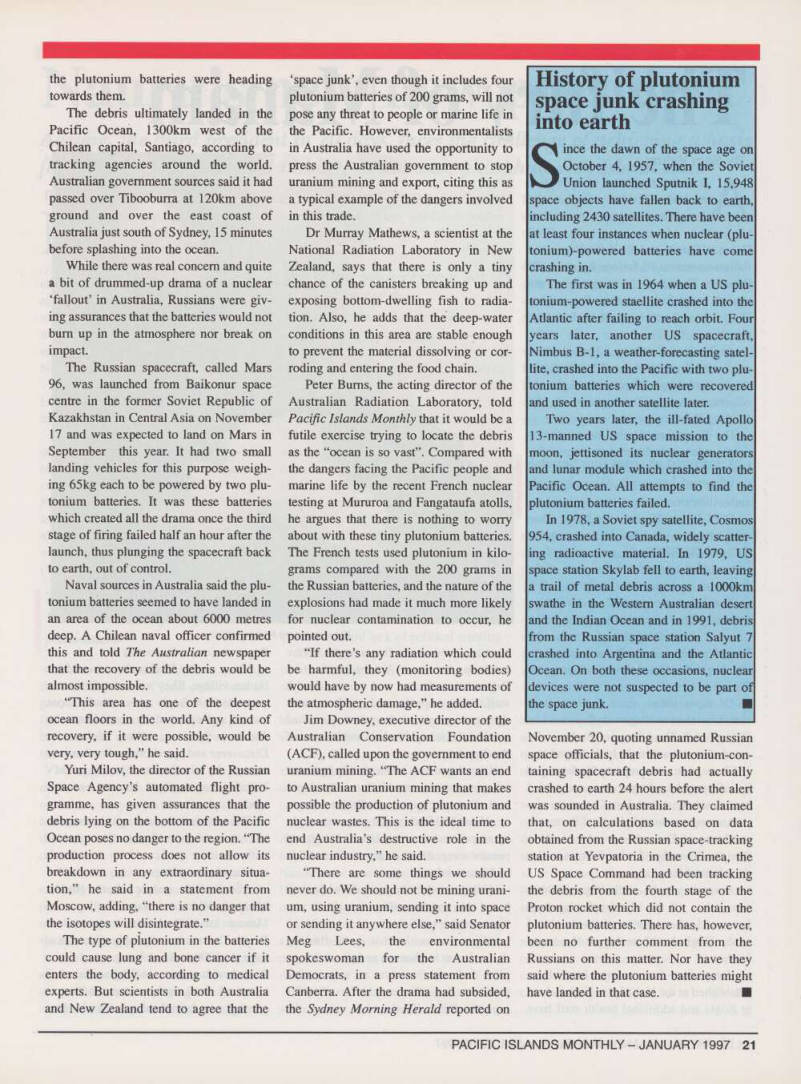
History of plutonium space junk crashing into earth
Since the dawn of the space age on October 4, 1957, when the Soviet Union launched Sputnik I, 15,948 space objects have fallen back to earth, including 2430 satellites. There have been at least four instances when nuclear (plu toniumj-powered batteries have come crashing in.
The first was in 1964 when a US plu tonium-powered staellite crashed into the Atlantic after failing to reach orbit. Four years later, another US spacecraft.
Nimbus B-l, a weather-forecasting satel lite, crashed into the Pacific with two plu tonium batteries which were recovered and used in another satellite later.
Two years later, the ill-fated Apollo 13-manned US space mission to the moon, jettisoned its nuclear generators and lunar module which crashed into the Pacific Ocean. All attempts to find the plutonium batteries failed.
In 1978, a Soviet spy satellite. Cosmos 954, crashed into Canada, widely scatter ing radioactive material. In 1979, US space station Skylab fell to earth, leaving a trail of metal debris across a 1000 km swathe in the Western Australian desert and the Indian Ocean and in 1991, debris from the Russian space station Salyut 7 crashed into Argentina and the Atlantic Ocean. On both these occasions, nuclear devices were not suspected to be part of the space junk. ■