batteries from failed Russian spacecraft Mars 96
pp. 20-21 · Read in the full issue
Red
alert
By Kalinga Seneviratne
On the morning of November 18, for just a few hours, Australia was gripped in the drama of a nuclear device possibly landing in the continent - heralded by a phone call from US President Bill Clinton to Australian Prime Minister John Howard at Sam, warning him that debris from a failed Russian rocket with four plutonium bat teries was speeding at 27,000 kilometres per hour towards Australia.
The prime minister immediately called a meeting of the National Security Council and, after putting the country’s armed forces and emergency services on red alert, announced the news to the nation at a hastly arranged press confer ence in Canberra.
For four hours, Australian emergency
crews waited and watched as debris from the failed Russian Mars probe, which included 200 grams of plutonium batter ies, plunged out of control and headed towards the continent, according to both Australian and US radar screens. Between 10am and noon, all predictions were that the plutonium batteries would land in either central or eastern Australia.
In central Australia, an Alice Springs bookmaker - Centreßet - had even got a number of calls by punters wanting to take a bet on the exact location in Australia where the rocket would land.
A republican in the north-western New South Wales town of Tibooburra offered free beers to his customers after the news came in at around 12.30 pm that the debris had fallen in the Pacific Ocean. Just a few hours earlier, people in the town had been warned by state emergency services that
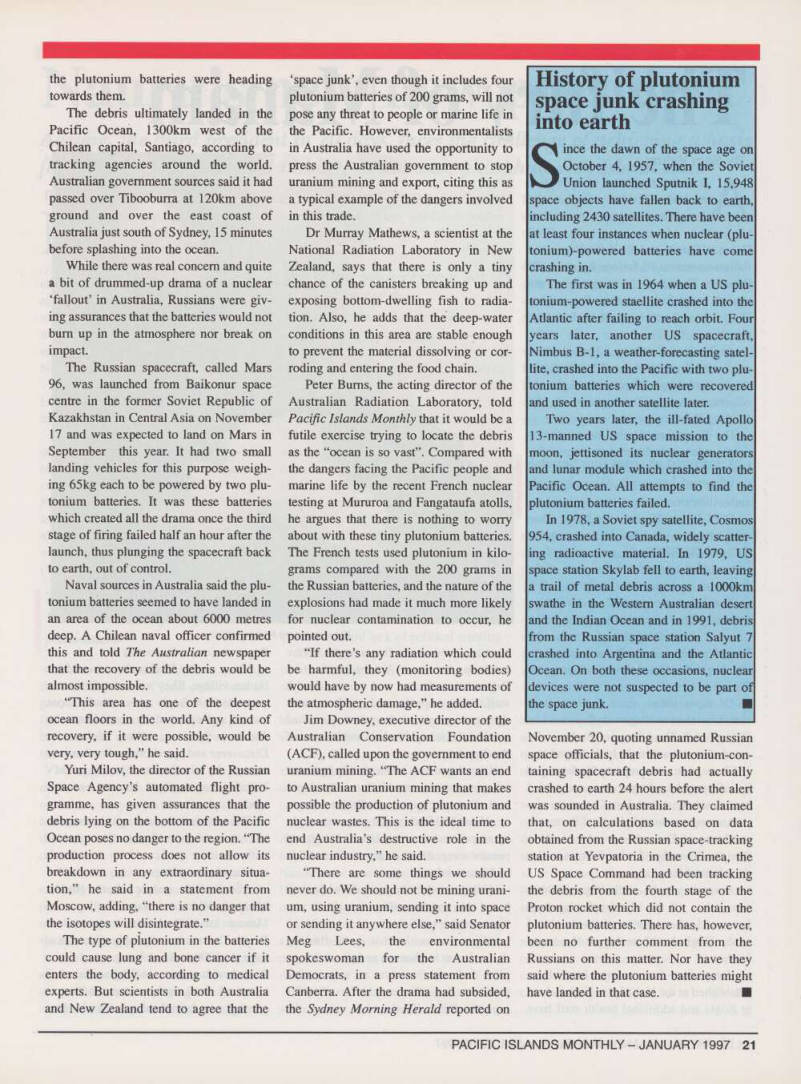
Australia declares state of emergency as plutonium batteries from failed Russian spacecraft Mars 96 almost crash into the Island continent
the plutonium batteries were heading towards them.
The debris ultimately landed in the Pacific Ocean, 1300 km west of the
Chilean capital, Santiago, according to
tracking agencies around the world.
Australian government sources said it had passed over Tibooburra at 120 km above ground and over the east coast of Australia just south of Sydney, 15 minutes before splashing into the ocean.
While there was real concern and quite a bit of drummed-up drama of a nuclear ‘fallout’ in Australia, Russians were giv ing assurances that the batteries would not bum up in the atmosphere nor break on
impact.
The Russian spacecraft, called Mars 96, was launched from Baikonur space centre in the former Soviet Republic of Kazakhstan in Central Asia on November 17 and was expected to land on Mars in September this year. It had two small landing vehicles for this purpose weigh ing 65 kg each to be powered by two plu tonium batteries. It was these batteries which created all the drama once the third stage of firing failed half an hour after the launch, thus plunging the spacecraft back to earth, out of control.
Naval sources in Australia said the plu tonium batteries seemed to have landed in an area of the ocean about 6000 metres deep. A Chilean naval officer confirmed this and told The Australian newspaper that the recovery of the debris would be
almost impossible.
“This area has one of the deepest ocean floors in the world. Any kind of recovery, if it were possible, would be very, very tough,” he said.
Yuri Milov, the director of the Russian
Space Agency’s automated flight pro
gramme, has given assurances that the debris lying on the bottom of the Pacific Ocean poses no danger to the region. “The production process does not allow its breakdown in any extraordinary situa tion,” he said in a statement from Moscow, adding, “there is no danger that
the isotopes will disintegrate.”
The type of plutonium in the batteries could cause lung and bone cancer if it enters the body, according to medical experts. But scientists in both Australia and New Zealand tend to agree that the
‘space junk’, even though it includes four plutonium batteries of 200 grams, will not pose any threat to people or marine life in the Pacific. However, environmentalists in Australia have used the opportunity to press the Australian government to stop uranium mining and export, citing this as a typical example of the dangers involved in this trade.
Dr Murray Mathews, a scientist at the National Radiation Laboratory in New Zealand, says that there is only a tiny chance of the canisters breaking up and exposing bottom-dwelling fish to radia tion. Also, he adds that the deep-water conditions in this area are stable enough to prevent the material dissolving or cor roding and entering the food chain.
Peter Bums, the acting director of the Australian Radiation Laboratory, told Pacific Islands Monthly that it would be a futile exercise trying to locate the debris as the “ocean is so vast”. Compared with the dangers facing the Pacific people and marine life by the recent French nuclear testing at Mururoa and Fangataufa atolls, he argues that there is nothing to worry about with these tiny plutonium batteries.
The French tests used plutonium in kilo grams compared with the 200 grams in the Russian batteries, and the nature of the explosions had made it much more likely for nuclear contamination to occur, he pointed out.
“If there’s any radiation which could be harmful, they (monitoring bodies) would have by now had measurements of the atmospheric damage,” he added.
Jim Downey, executive director of the Australian Conservation Foundation (ACF), called upon the government to end uranium mining. “The ACF wants an end to Australian uranium mining that makes possible the production of plutonium and nuclear wastes. This is the ideal time to end Australia’s destructive role in the nuclear industry,” he said.
“There are some things we should never do. We should not be mining urani um, using uranium, sending it into space or sending it anywhere else,” said Senator Meg Lees, the environmental spokeswoman for the Australian Democrats, in a press statement from Canberra. After the drama had subsided, the Sydney Morning Herald reported on
November 20, quoting unnamed Russian space officials, that the plutonium-con taining spacecraft debris had actually crashed to earth 24 hours before the alert was sounded in Australia. They claimed that, on calculations based on data obtained from the Russian space-tracking station at Yevpatoria in the Crimea, the US Space Command had been tracking the debris from the fourth stage of the Proton rocket which did not contain the plutonium batteries. There has, however, been no further comment from the Russians on this matter. Nor have they said where the plutonium batteries might have landed in that case. ■