country
pp. 13-14 · Read in the full issue
Cover Stories
Cry,
the beloved country
Papua New Guinea faces reign of bloody terror, ; tough economic times blamed
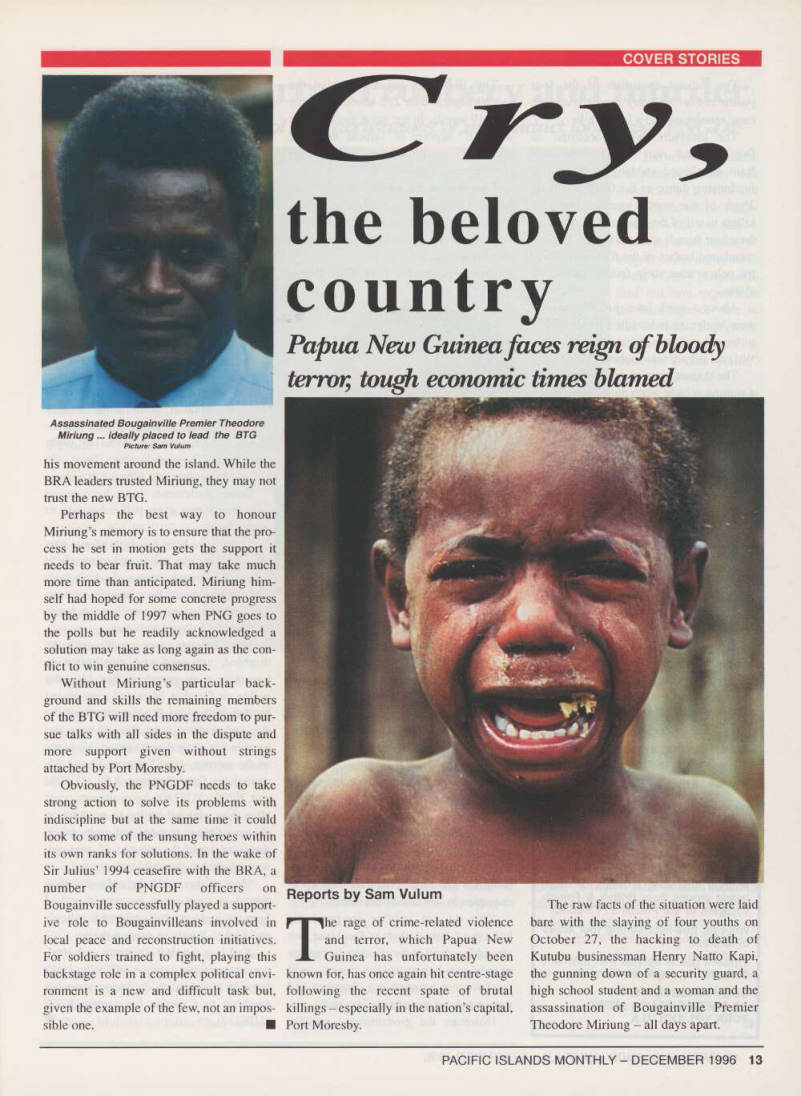
The rage of crime-related violence and terror, which Papua New Guinea has unfortunately been known for, has once again hit centre-stage following the recent spate of brutal killings-especially in the nation’s capital, Port Moresby.
The raw facts of the situation were laid bare with the slaying of four youths on October 27, the hacking to death of Kutubu businessman Henry Natto Kapi, the gunning down of a security guard, a high school student and a woman and the assassination of Bougainville Premier Theodore Miriung - all days apart.
Reports by Sam Vulum
The vicious execution of the four youths is Port Moresby’s most gruesome mass murder case in a long while.
The massacre, which occurred on Dogura beach near the city, stemmed from an alleged stabbing incident at a fundraising dance at the Gerehu suburb.
Three of the youths escaped from the killers to tell of their night of terror when their four friends were murdered. The dis membered bodies of the four were found by police after their friends raised the alarm.
About a week later, just as people were beginning to breathe a little easier, a branch of the Westpac bank in Waigani suburb was robbed.
The thieves were about to escape in a waiting vehicle when police intercept ed.
They fled and police gave chase.
More than 400 police officers were called in with helicopter back-up as a they descended on the gang in the hills I near a settlement.
They exchanged fire with the gang I and a grenade was hurled at the police I in a two-hour battle that left two of the I thieves dead and three police wounded. Two other gangsters were critically
wounded. 1
The grim reality of the situation was driven home with statistics released by Police Commissioner Bob Nenta on November 6. Police recorded 875 serious offences throughout the country and only 398 arrests in October. Of the total num ber of criminal acts committed, 370 ser tious offences occurred in the National Capital District and surrounding areas with only 152 arrests, according to the statistics.
The Highlands region recorded the second highest with 212 serious offences and 119 arrests. In the same month, there were 107 reports of vehicle thefts of which 87 were committed in Port Moresby and its surrounds.
Members of the public, including the business community, churches and politi cians, have been drawing attention to the situation but the government continued to dismiss such calls.
Prime Minister Sir Julius Chan threat-
ened to summon the editor of a daily newspaper before parliament for high lighting the impending crime problem in an editorial comment. Sir Julius again told Goroka business leaders in late October that the country’s law and order problem was no worse than that in most other countries. He said it was a matter of per
spective.
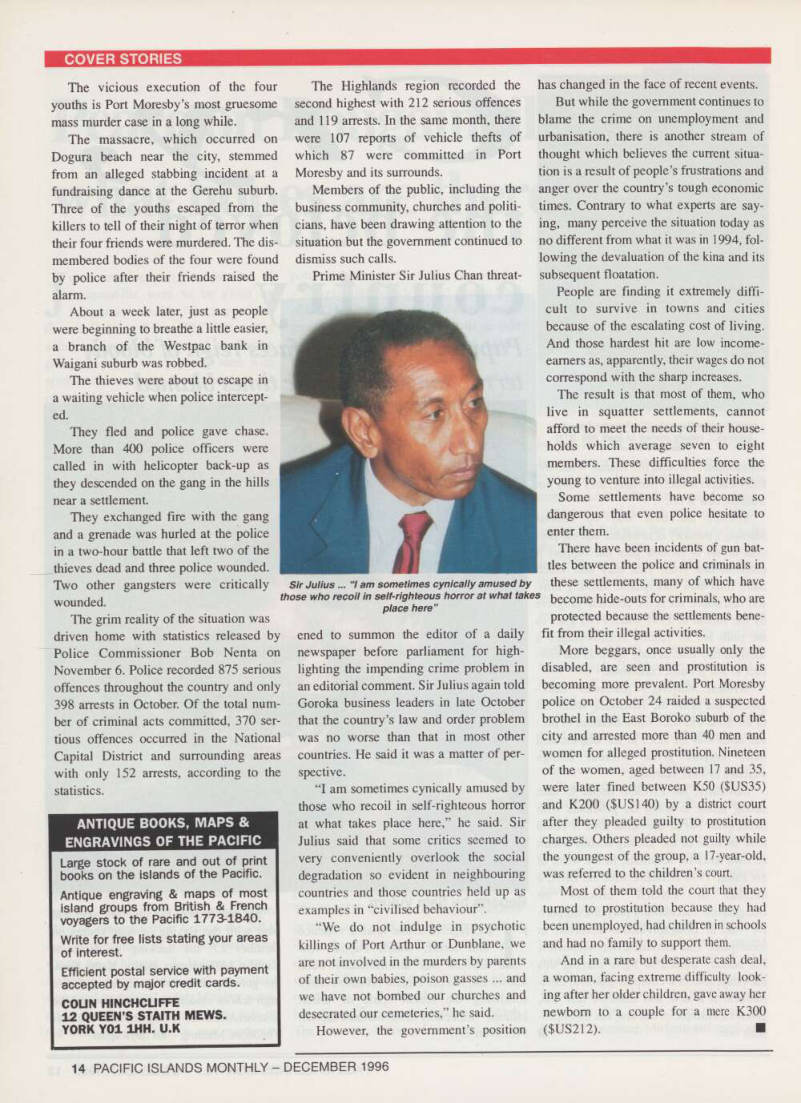
“I am sometimes cynically amused by those who recoil in self-righteous horror at what takes place here,” he said. Sir Julius said that some critics seemed to very conveniently overlook the social degradation so evident in neighbouring countries and those countries held up as examples in “civilised behaviour”.
“We do not indulge in psychotic killings of Port Arthur or Dunblane, we are not involved in the murders by parents of their own babies, poison gasses ... and we have not bombed our churches and desecrated our cemeteries,” he said.
However, the government’s position
has changed in the face of recent events.
But while the government continues to blame the crime on unemployment and urbanisation, there is another stream of thought which believes the current situa tion is a result of people’s frustrations and anger over the country’s tough economic times. Contrary to what experts are say ing, many perceive the situation today as no different from what it was in 1994, fol lowing the devaluation of the kina and its
subsequent floatation.
People are finding it extremely diffi
cult to survive in towns and cities because of the escalating cost of living.
And those hardest hit are low income earners as, apparently, their wages do not correspond with the sharp increases.
The result is that most of them, who live in squatter settlements, cannot afford to meet the needs of their house holds which average seven to eight members. These difficulties force the young to venture into illegal activities.
Some settlements have become so dangerous that even police hesitate to enter them.
There have been incidents of gun bat j ties between the police and criminals in these settlements, many of which have s become hide-outs for criminals, who are protected because the settlements bene fit from their illegal activities.
More beggars, once usually only the disabled, are seen and prostitution is becoming more prevalent. Port Moresby police on October 24 raided a suspected brothel in the East Boroko suburb of the city and arrested more than 40 men and women for alleged prostitution. Nineteen of the women, aged between 17 and 35, were later fined between K5O (SUS3S) and K2OO (SUSI4O) by a district court
after they pleaded guilty to prostitution
charges. Others pleaded not guilty while the youngest of the group, a 17-year-old, was referred to the children’s court.
Most of them told the court that they turned to prostitution because they had been unemployed, had children in schools and had no family to support them.
And in a rare but desperate cash deal, a woman, facing extreme difficulty look ing after her older children, gave away her newborn to a couple for a mere K3OO
(Sus2I2). ■
Sir Julius... "I am sometimes cynically amused by those who recoil in self-righteous horror at what takes place here”