what hopes are there?
pp. 12-13 · Read in the full issue
Peace on Bougainville... what hopes are there?
Just imagine for a minute if Bougainville were to be given its independence today. The Papua New Guinea Defence Force (PNGDF) would withdraw leaving a mass of conflicting groups and gun-toting young men with grudges to slog it out. In the north of the island ethnic tensions could easily erupt into violence. Elsewhere, the secessionist Bougainville Revolutionary Army (BRA) would attack members of the pro-PNG resistance, who are also well armed.
All over the island rascals who once had links with some political leadership (either pro- or anti-BRA) would exploit the many and varied animosities that have been thrown up or accentuated by this war.
Without a political settlement the thou sands of ordinary Bougainvilleans who have watched their homeland tom apart and suffered as relatives died in the con flict or of deprivation brought on by the war, would find the peace they so urgently desire more elusive than ever.
What can also be seen from this vision is just how difficult it will be to secure the peace in real life. Not only is a political settlement needed between the main actors but each community needs to heal its divi sions, draw in violent elements and stop the never-ending cycle of payback. That is why Theodore Miriung, the premier of the Bougainville Transitional Government (BTG) who was assassinated on October 12, was so important. In 1994, after Prime Minister Sir Julius Chan won office and called for a negotiated settlement to the then six-year-old war on Bougainville, Miriung emerged from behind the BRA lines with a vision of how that settlement could be achieved. A lawyer, former National Court judge and a widely respected traditional elder, Miriung want ed to place more emphasis on the role of the chiefs and to form a new moderate
political force based around a proposal for a Bougainville which would remain part of PNG but with a special status and much greater autonomy. He planned to do that by working to build the peace on a clan by-clan, village-by-village level.
Sir Julius responded with one of his most inspired decisions. He established the(BTG) which was to become the vehi cle for Miriung’s peace efforts. Miriung was ideally placed to lead the BTG. He was from the North Nasioi language group which provided most of the BRA leader ship and he commanded their respect. His legal background meant he would be taken seriously in Port Moresby and his status as a traditional elder made it possible for him to talk with chiefs from across the province. Now Miriung has gone, what are the prospects for peace?
An all-out military offensive (as is advocated by Opposition Leader Roy Yaki) has been tried on a number of occa sions most recently in Operation High Speed 2, an offensive which, like previous military offensives, was a complete fiasco for the PNGDF resulting only in casualties and ignominious defeat. Although this option remains attractive to those in Port Moresby desperate to bring a speedy con clusion to the war, it fails to take account of the terrain on Bougainville and the multi-faceted nature of the problem. Both of these elements make all-out war a solu tion which cannot work. In many ways, the activities of the PNGDF are as much part of the problem as they are solution.
The PNGDF has been heavily implicated in the murder of Miriung. Just prior to that it was the activities of the security forces drug-taking, loutish behaviour and harass ment of Bougainvillean women - which resulted in the deaths of 11 of their num ber during the massacre at Kangu Beach.
The success of that raid was caused by
members of the Bougainvillean resistance teaming up with the BRA to get their own back on the PNGDF. That raid has also left the BRA much better armed with the com mander of BRA military operations, Sam Kaona, claiming that captured mortars, bombs, weapons, explosives and mines had equipped the BRA to go on fighting for “five, six or even seven more years”.
These events, and the attack on Kaona by the PNGDF when he was returning from peace talks in Australia last December, have left Port Moresby’s standing on the island at an all-time low.
Now more than ever, a Bougainvillean initiated solution to the war is likely to be the only one which would be viable.
Ironically, it is only after Miriung’s death that many in Port Moresby have reached the conclusion that he was a genuine force for peace, a man of integrity and not a double dealer who was really working with the BRA’s interests at heart.
Miriung’s plan had been to use the BTG to draw in all but the most extreme elements around a proposal for more autonomy.
The planning and rebuilding of shat tered infrastructure would provide work for young men (either resistance or BRA) who were persuaded to lay their arms as well as getting the economy going and allowing those Bougainvilleans who are still harvesting crops to get their produce to market. To prevent those steeped in blood from continuing to cause problems after a formal settlement was agreed, Miriung proposed an as yet undefined amnesty for war crimes.
Miriung’s vision did not win full sup port in Port Moresby, Sir Julius had agreed to allow him to work on a political solu tion but did not give the BTG enough resources to be able to find useful employ ment for the young men or stop the PNGDF harassing Miriung and restricting
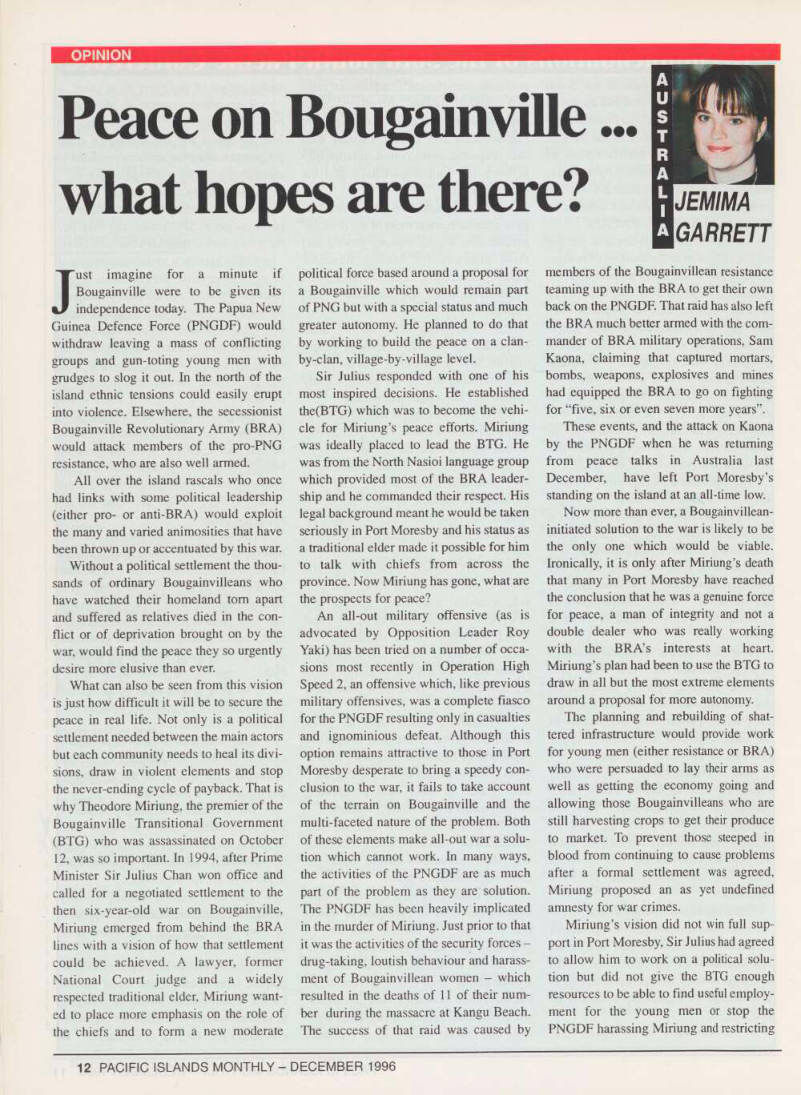
Jemima
Garrett
Aystralia
his movement around the island. While the BRA leaders trusted Miriung, they may not trust the new BTG.
Perhaps the best way to honour Miriung’s memory is to ensure that the pro cess he set in motion gets the support it needs to bear fruit. That may take much more time than anticipated. Miriung him self had hoped for some concrete progress by the middle of 1997 when PNG goes to the polls but he readily acknowledged a solution may take as long again as the con flict to win genuine consensus.
Without Miriung’s particular back
ground and skills the remaining members of the BTG will need more freedom to pur sue talks with all sides in the dispute and more support given without strings
attached by Port Moresby.
Obviously, the PNGDF needs to take strong action to solve its problems with indiscipline but at the same time it could look to some of the unsung heroes within its own ranks for solutions. In the wake of Sir Julius’ 1994 ceasefire with the BRA, a number of PNGDF officers on
Bougainville successfully played a support
ive role to Bougainvilleans involved in local peace and reconstruction initiatives.
For soldiers trained to fight, playing this backstage role in a complex political envi ronment is a new and difficult task but, given the example of the few, not an impos sible one. ■
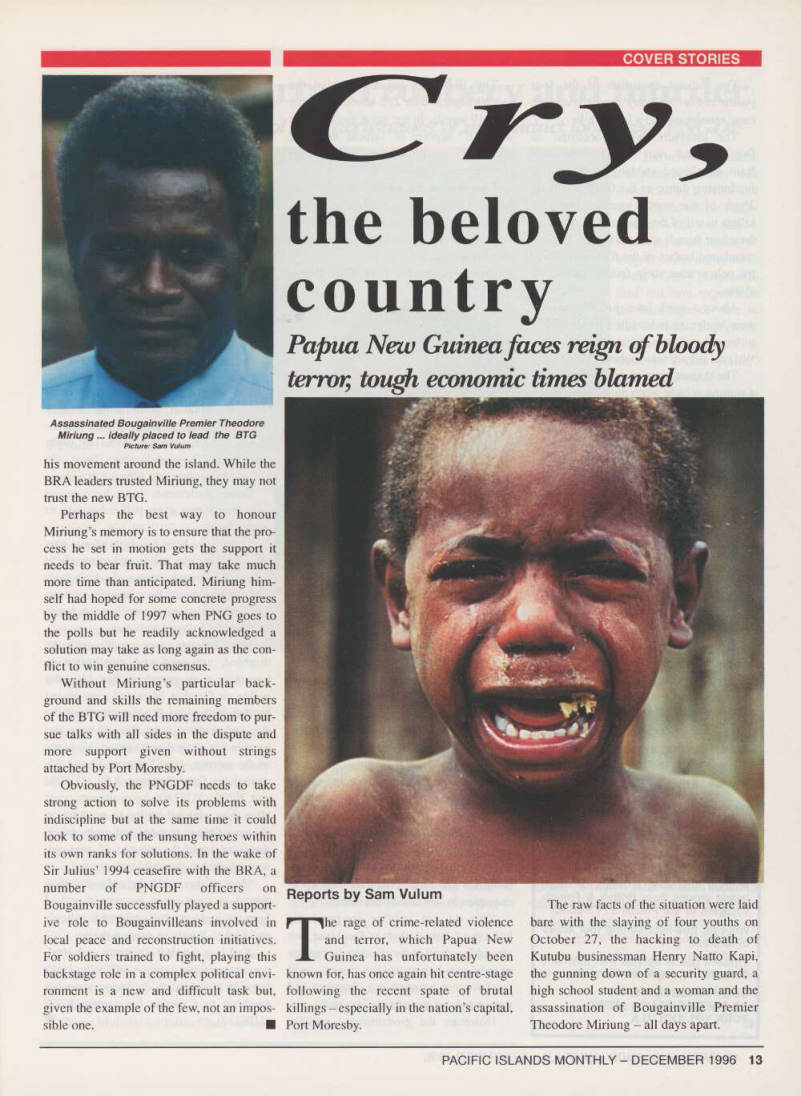
Assassinated Bougainville Premier Theodore Miriung... ideally placed to lead the BTG Picture: Sam Vulum