Internet promises major
pp. 50-53 · Read in the full issue

benefits to the Islands
By David North
Would you like to know the likelihood of a hurricane threat ening your Island in the next 24 hours?
The temperature of the ocean’s water off the Solomons? The cost of hotel rooms in Apia? The extent of political rights in Tonga?
Today’s sports scores in Australia? You can get all this and much more - through a per sonal computer and the Internet.
It is a system that will bring, in effect, the libraries, the databas es, and the news services of the world to the most distant of Islands.
The Internet can be best visualised as a desktop refer ence tool that brings informa tion, graphics and (if you like) gossip to you. The Internet is not owned by anyone, nor can it be controlled or edited by any one or any government. As this is being written, the US Supreme Court has just ruled that a Congressional effort to wipe out obscene material would be unconstitutional but, given the nature of the technolo gy, no government would be
able easily to censor it. They could order their phone companies not to make Internet links, but this would only inhibit, not kill the Internet.
Further, the Internet is a volunteer activity. There is nothing on the ‘Net’ that was not put there by someone who want ed it to be there. It is very much a work in progress and changes all the time. Its databases are currently expanding rapidly.
And, like other works in progress, there are still some glitches, dead ends, and missing connections. And someone in my shoes, who is not very adept with new computer systems, often gets lost and frustrated.
So what’s out there? Lots.
Let’s start with what you can find out about your Island’s government that your Island’s government would rather you did not know. There is some material of this nature for all six of the US-related territo ries (American Samoa, Guam, the Northern Marianas, and the three
Associated States in Micronesia); this is in the US Department of the Interior’s system.
Then there is another set of material on refugee-producing situations (or the lack of them) all over the world, including State Department reports on all of the independent states of the Pacific and the associated states (Cook Islands, Federated States of Micronesia, Marshall Islands, Niue and Palau). If you read French better than I do, you may be able to find similar material on the French colonies. The Internet is not just in English.
The US Department of the Interior series includes both bland budget data and descriptions of parks as well as the often searing audits of the Office of the Inspector-General. One such report, on American Samoa’s finances, can be viewed at this electronic address:
http://www.access.gpo.gov/doi
Once there, you can seek out the Office of the Inspector General and enter
American Samoa in the search system - and do it exactly as it says. (Not only does neatness count in the Internet, sloppiness is fatal. If you use a comma instead of a dot - periods are dots in ‘Nettalk’ - the machine will not give you what you want.) So what do you learn about American Samoa’s finances?
There are countless instances of bad fiscal management, inade quate controls, non-functioning computer software, over-spend
ing and overly optimistic projec
tions of anticipated income. In one instance, a make-work pro gramme for older Samoans, the government overspent so much money early in the year, that it went through 12 months of fund ing in nine months and had to close down the programme for the balance of the year.
The US State Department’s human rights reports are, as you
might expect, written ‘carefully’,
but there is some pretty straight
forward reporting on political
rights in the Islands. For example, on the Press in Vanuatu: “Freedom of the independent Press remains tenuous. The presi dent ... urged the government to prohibit newspapers from false reporting and invasions of priva
cy... [but] correspondents for internation al media are ... allowed to report from Vanuatu without interference.”
The State Department reports appeared pretty solid to me but I did notice, in the section on the Nauru Press, the following: “The country has two reg ular publications - the private ... Central Star News, which operates and editorialis es freely; and the Government Gazette which contains mainly official notices and announcements.”
I do not know about the Star News, but I see the Nauru Bulletin regularly; it is clearly government-produced. Maybe the Gazette is an old name for this publica tion; maybe I know about a publication unknown to the State Department. The State Department’s reports on the politi cal situation in Tonga are highly critical as well. One way to reach these reports is to look up the US Country Conditions Reports after reaching this address:
http://gatekeeper.unicc.org/unhcrcdr
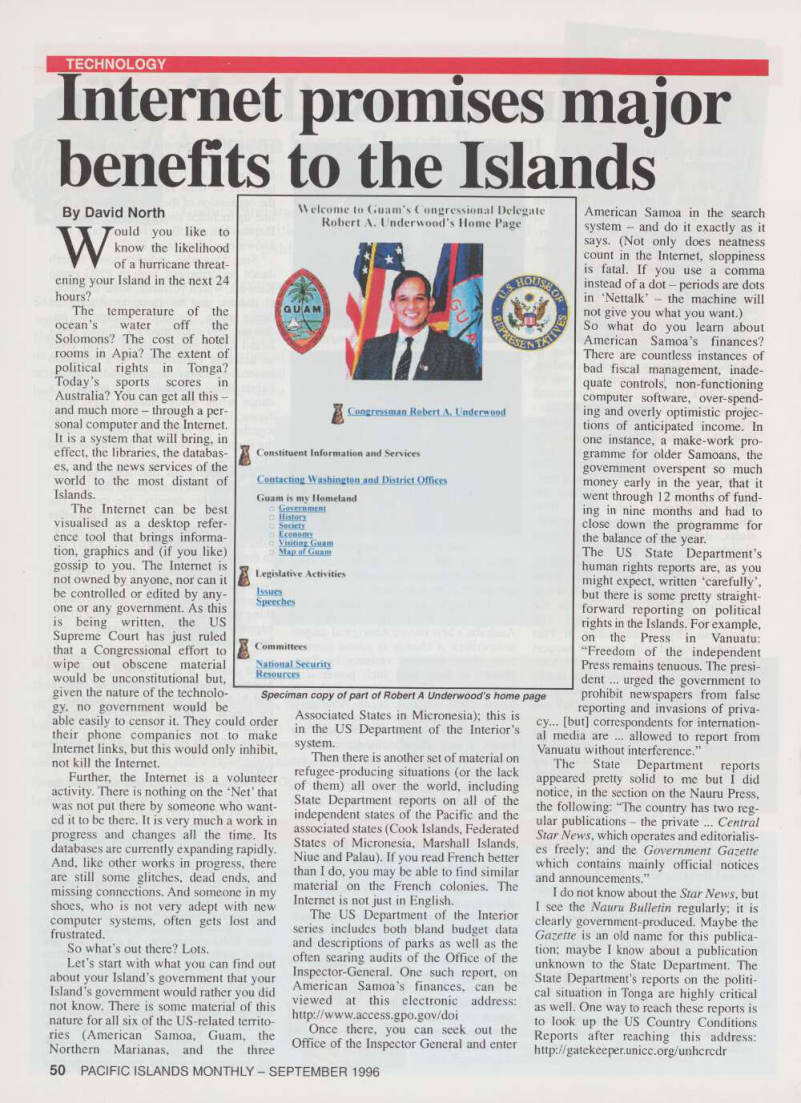
Speciman copy of part of Robert A Underwood’s home page
In my own work for Pacific Islands Monthly, I have started using the Internet.
For example, I wanted to look at the writ ings of the Nobel prize winner who was accused of molesting youngsters from the islands, Dr. Daniel Gajdusek {PIM June,
P 32). Before I drove off to the National Library of Medicine some 15 miles away, I checked with the computerised file of holdings at the library and found dozens of his listings; then I drove there.
For the July issue, I wanted to read
pending Congressional legislation on America’s Palmyra Atoll, a proposed dump for atomic waste. I dialled a database at the US Capitol, found a search device, plugged in the name of the Island, and soon was reading the bill; all while
sitting at my PC in my robe and slippers.
There are several home pages on the World Wide Web that relate to the Islands.
A home page is a point of departure, a table of contents, if you will, for what you can read on the pages or hundreds of pages to which it is linked. Home pages often lead to other home pages. A favourite of mine is at http://microstate.com From here you can get tourist informa tion in the South Pacific and other small states of the world; ocean temperatures; hurricane warnings; summaries of the business climate in each of the Islands, and the chatty electronic exchanges of the Kava Bowl: The Pacific Forum.
In one browsing, I stumbled on some exchanges about homosexuality in Tonga, including what appeared to be an offer, written in Pidgin English for a “good time”; I couldn’t describe it more exactly, even if I wanted to because I never could find my way back to that specific item - a problem that I encountered frequently.
The tourist interests who want you to come to the Islands, and then come back to the Islands, are among the most active users of the Internet in the Islands because they aim their messages at the Mainland.
The Fijian government, in general, has no home page, but its tourist agency has one. The Papua New Guinea government does not have a home page for the govern ment or its tourist bureau. Meanwhile there is a Guam government home page,
and a tourist agency one as well.
The Equator seems to be a dividing line on Internet access, with much more north of it than south of it. The congressional delegate from Guam, Bob Underwood, has a lively home page, which leads you to various Congressional listings and home pages on Guam. (The address is http://www.house.gov then look for the listing of members of the House.) But Underwood’s opposite number, Eni Faleomavaega from American Samoa, has no such listing.
Former PIM colleague Sophie Foster reports that the most extensive use of the Internet by Fiji’s young people can be found among those hunkered over the computers at the University of the South Pacific.
There are only a few at-home users of the Net, she said. Similarly, the PNG embassy does not use the Net, preferring the fax, in its communications with Port
Moresby - though, apparently, the newly
corporatised telecommunications system provides Internet services to customers within PNG.
Meanwhile competition among Internet providers has started in both Guam and CNMI; that, and more exten sive utilisation, will ultimately drive down
the prices.
The three providers on Guam, accord ing to Underwood’s Press secretary, Cathy Gault, quote rates (for different services,
with different numbers of hours) from SUSIO to SUSSO a month; at the lower level, however, you get only five hours of computer time, and it is SUS 3 an hour above that. There are two providers in CNMI, but we do not have their rates.
We do know that there is an electronic postmaster on Saipan who has a three page list of electronic-mail users there. As we noted earlier, much of the substance of the Internet is provided by volunteers. The Republic of the Marshall Islands has found one such volunteer, also a resident of the Washington suburbs, named Lance Lack. He has created, in effect, an infor mal home page for the Marshalls (at
http://www.clark.net/pub/llaack/rmi)
which he is filling with information about the Marshalls in general as well as a high ly useful page of advice on how RMI citi zens can avoid international hucksters and conmen. He is hoping) to make available, soon, to a wider public, some of the newly
released, previously suppressed US
Department of Energy information on the effects of the nuclear explosions on the health of the Islanders; this is material, to pick up an earlier theme, that the US Government did not want you to read, until the Clinton administration came along.
If you want to comment on any of this, disagree, or add your own ideas, you can reach me via E-mail at: [email protected] ■