A songline across the Pacific
p. 49 · Read in the full issue
Text and photographs by Liz
Thompson
A Sing Sing is taking place in the middle of Melbourne. Sing Sing is a word commonly used in Papua New Guinea to describe a gather ing of people for a ceremony that includes singing, dancing and a ritual pig kill.
In this instance, it is villagers from Papua New Guinea joining Torres Strait Islanders and black and white Australians for performance of music and dance wich explores their cultural connections.
The gathering initially took place in the middle of Fitzroy at Adelphia studios; Adelphia - Greek for Brother - is run by three Greek brothers. Here, for several days, arriving at 1 lam and often not leav ing until midnight, 23 performers gather.
From the rehearsal rooms you can hear the sounds of a truly cross-cultural col laboration - garamut drums from PNG carved from one large tree trunk and beat en with wooden sticks, flutes from the PNG Highlands, didgeridoo from Aboriginal Australia, clap sticks, synthe sisers, drums, mandolins, cellos and ukuleles.
This landmark event was presented by the Victorian Arts Centre, the Next Wave Festival, Triple J World Music Show and sponsored by CRA Foundation for the Arts and the Australia Council. The Australian High Commission in Port Moresby assisted with financial support for the PNG leg of the concert tour.
Rehearsals lasted for two weeks before performances at the State Theatre in Sydney, the Melbourne Concert Hall and Port Moresby, PNG.
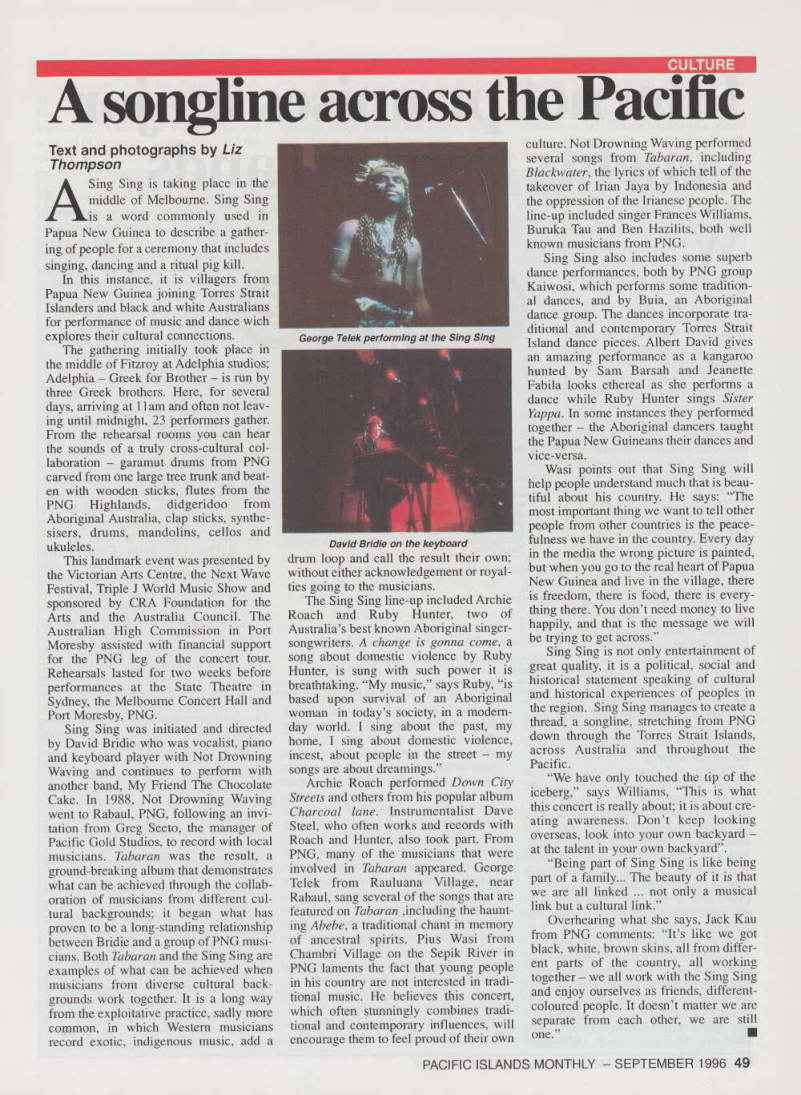
Sing Sing was initiated and directed by David Bridie who was vocalist, piano and keyboard player with Not Drowning Waving and continues to perform with another band. My Friend The Chocolate Cake. In 1988, Not Drowning Waving went to Rabaul, PNG, following an invi tation from Greg Seeto, the manager of Pacific Gold Studios, to record with local musicians. Tabaran was the result, a ground-breaking album that demonstrates what can be achieved through the collab oration of musicians from different cul tural backgrounds; it began what has proven to be a long-standing relationship between Bridie and a group of PNG musi cians. Both Tabaran and the Sing Sing are examples of what can be achieved when musicians from diverse cultural back grounds work together. It is a long way from the exploitative practice, sadly more common, in which Western musicians record exotic, indigenous music, add a
drum loop and call the result their own; without either acknowledgement or royal ties going to the musicians.
The Sing Sing line-up included Archie
Roach and Ruby Hunter, two of Australia’s best known Aboriginal singer songwriters. A change is gonna come, a song about domestic violence by Ruby Hunter, is sung with such power it is breathtaking. “My music,” says Ruby, “is based upon survival of an Aboriginal woman in today’s society, in a modern day world. I sing about the past, my home, I sing about domestic violence, incest, about people in the street - my songs are about dreamings.”
Archie Roach performed Down City Streets and others from his popular album Charcoal lane. Instrumentalist Dave Steel, who often works and records with Roach and Hunter, also took part. From PNG, many of the musicians that were involved in Taharan appeared. George Telek from Rauluana Village, near Rabaul, sang several of the songs that are featured on Taharan .including the haunt ing Abebe, a traditional chant in memory of ancestral spirits. Pius Wasi from Chambri Village on the Sepik River in PNG laments the fact that young people in his country are not interested in tradi tional music. He believes this concert, which often stunningly combines tradi tional and contemporary influences, will encourage them to feel proud of their own
culture. Not Drowning Waving performed several songs from Tabaran, including Blackwater, the lyrics of which tell of the takeover of Irian Jaya by Indonesia and the oppression of the Irianese people. The line-up included singer Frances Williams, Buruka Tau and Ben Hazilits, both well known musicians from PNG.
Sing Sing also includes some superb dance performances, both by PNG group Kaiwosi, which performs some tradition al dances, and by Buia, an Aboriginal dance group. The dances incorporate tra ditional and contemporary Torres Strait Island dance pieces. Albert David gives an amazing performance as a kangaroo hunted by Sam Barsah and Jeanette Fabila looks ethereal as she performs a dance while Ruby Hunter sings Sister Yappa. In some instances they performed together - the Aboriginal dancers taught the Papua New Guineans their dances and vice-versa.
Wasi points out that Sing Sing will help people understand much that is beau tiful about his country. He says: “The most important thing we want to tell other people from other countries is the peace fulness we have in the country. Every day in the media the wrong picture is painted, but when you go to the real heart of Papua New Guinea and live in the village, there is freedom, there is food, there is every thing there. You don’t need money to live happily, and that is the message we will be trying to get across.”
Sing Sing is not only entertainment of great quality, it is a political, social and historical statement speaking of cultural and historical experiences of peoples in the region. Sing Sing manages to create a thread, a songline, stretching from PNG down through the Torres Strait Islands, across Australia and throughout the Pacific.
“We have only touched the tip of the iceberg,” says Williams, “This is what this concert is really about; it is about cre ating awareness. Don’t keep looking overseas, look into your own backyard at the talent in your own backyard”.
“Being part of Sing Sing is like being part of a family... The beauty of it is that we are all linked ... not only a musical link but a cultural link.”
Overhearing what she says, Jack Kau from PNG comments; “It’s like we got black, white, brown skins, all from differ ent parts of the country, all working together - we all work with the Sing Sing and enjoy ourselves as friends, different coloured people. It doesn’t matter we are separate from each other, we are still one.” ■
George Telek performing at the Sing Sing
David Bridie on the keyboard