Wolfgramm - doing the Pacific proud
pp. 12-13 · Read in the full issue
Special Report
By Atama Raganivatu
Up to the 1996 Olympic Games’ 12th day of competition, the world’s greatest sporting festival appeared destined to be a huge disap pointment for Pacific Island nations.
One after the other, our athletes had suffered defeat. Most were expected and some were gallant but the manner in which many who travelled to Atlanata with great expectations failed to do them
selves justice was highly disconcerting.
It seemed that the region lagged as far behind the rest of the world as ever and anyone would be forgiven if believing that the gold of an Olympic medal remained just as remote then as when our athletes first competed 40 years earlier.
Then, Tongan boxer Paea Wolfgramm stepped into the ring to face the mighty Cuban Rubalcaba Alexis.
Alexis was the overwhelming favourite for the superheavyweight title..
Cuba has dominated amateur boxing for over a decade, winning seven of the 12 Olympic gold medals at stake in 1992, and Alexis’ form suggested that he would
further consolidate the Caribbean nation’s extraordinary record.
Wolfgramm was such an underdog for the quarter-final fight that one American newspaper even suggested that he should be forced to withdraw in order to save himself from what it termed “certain humiliation and probable serious injury”.
The capacity crowd at the massive Alexander Memorial Coliseum was, therefore, astonished when Wolfgramm took the initiative from the outset and become delirious as the illustrious Cuban was decked for a compulsory eight count.
Sensing a sensational upset, the fans
commenced chanting “Tonga, Tonga,
Tonga” in unison and the kingdom’s rep resentative responded by maintaining a barrage of blows until the end. The final score of 17-12 gave a fair reflection of proceedings. Over the course of 10 min utes, Wolfgramm had been transformed from an international nonentity to the toast of the Olympics. And the American spectators, most of whom did not know where Tonga was, had adopted him as one of their own.
Two days later, Wolfgramm was in
action again and the fairy tale continued as he poached a win over Duncan Dokiwair, the All African and Commonwealth champion, by registering the deciding point with just 17 seconds remaining after trailing for almost the entire bout.
The Nigerian had extracted a toll though. Wolfgramm sustained a broken wrist and broken nose at his hands and the former, in particular, handicapped him in the final against Valdimir Klichko.
Despite this, and being physically drained
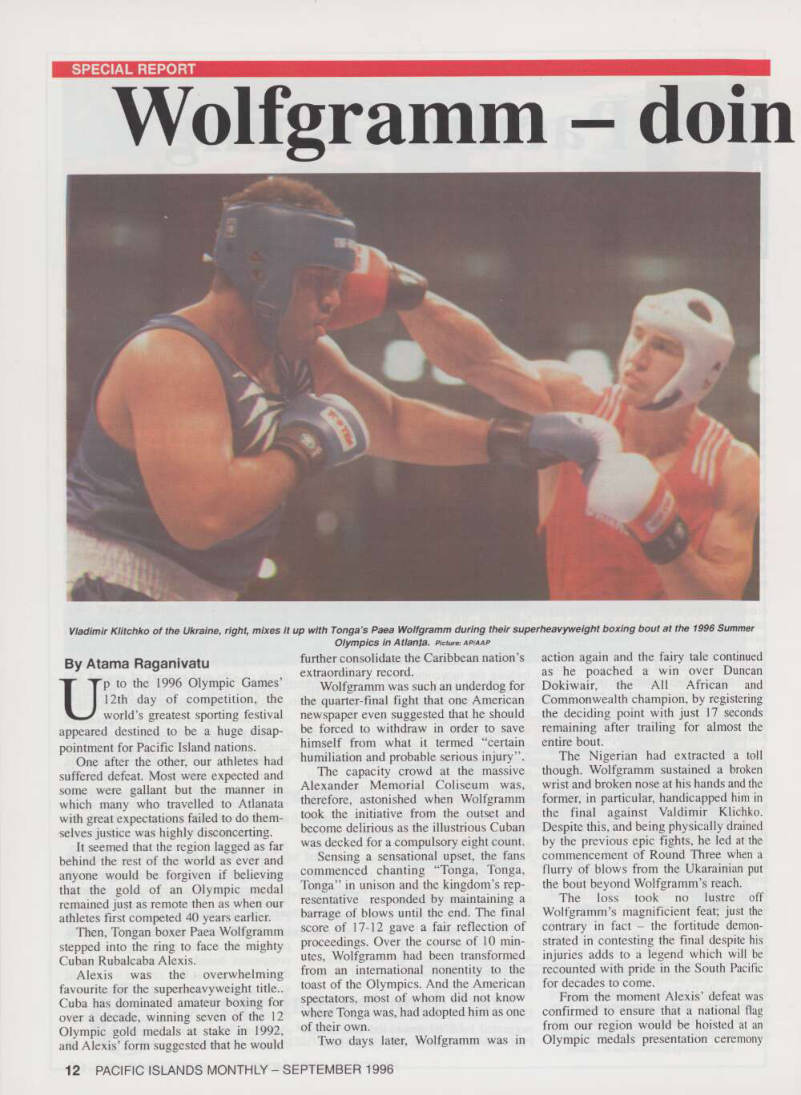
by the previous epic fights, he led at the commencement of Round Three when a flurry of blows from the Ukarainian put the bout beyond Wolfgramm’s reach.
The loss took no lustre off Wolfgramm’s magnificient feat; just the contrary in fact - the fortitude demon strated in contesting the final despite his injuries adds to a legend which will be recounted with pride in the South Pacific for decades to come.
From the moment Alexis’ defeat was confirmed to ensure that a national flag from our region would be hoisted at an
Olympic medals presentation ceremony
Vladimir Klitchko of the Ukraine, right, mixes it up with Tonga’s Paea Wolfgramm during their superheavyweight boxing bout at the 1996 Summer Olympics in Atlanta. Picture: ap/aap
for the first time, his place in local folk lore had been guaranteed.
Utungake, in Vava’u, can claim the honour of producing the Pacific Islands’ latest hero as Wolfgramm spent the initial four years of his life there.
In 1974, he was taken with his parents, Bernard and Fatafehi, to New Zealand and the family settled at Manukau, a south Auckland surburb. Like most New Zealand-based Tongans, Paea spent much of his youth playing rugby union. Despite always having an interest in boxing and idolising Muhammed Ali, he did not actu ally lace up a pair of boxing gloves until he was 20 years old and then only as part of a training programme devised to help him overcome a rugby injury.
Quickly realising he was far more effective between the ropes than between the touchlines, Wolfgramm joined the Otara Amateur Boxing Club, where he came under the wing of fellow Tongan Tupou Fulilangi.
Fulilangi had been a professionbal based in the United States and could boast having fought the great George Foreman before retiring to pass on his extensive knowledge as a coach. He has been Wolgramm’s guiding light throughout his career and provided invaluable advice from the comer during the Atlanta adven ture.
Unfortunately, New Zealand possesses few boxers in the superheavyweight divi sion, which caters for fighters weighing over 91 kilograms. And even fewer of these are prepared to face a Tongan man who stands 1.93 metres tall and tips the
scales at 150 kg.
Thus, several Kiwi national champi onships had been won with minimal diffi culty when Tonga’s boxing officials began to enquire about his availability for
international competitions. Wolfgramm
feared he would face a dilemma because, although regarding himself a Tongan, he recognised that New Zealand’s training facilities were responsible for his devel opment and it might lay claim to his loy alties.
The 1993 South Pacific Mini Games presented Wolfgramm, wearing the red vest of Tonga, with his first intemationbal honour. He then prepared himself for an approach by New Zealand as the follow ing years Commonwealth games neared.
New Zealand’s selection policy for Commonwealth and Olympic games is notoriously fickle and when the Kiwis decided they would not consider Wolfgramm a member of their squad to
travel to Victoria, his allegiance was determined once and for all. In the British Columbian city Wolfgramm won a bronze medal (Dokiwair claimed the gold) and, when returning home, decided to post pone his law studies at Auckland University and concentrate on the pursuit of an Olympic medal. Since then, he has been a ‘house husband’, looking after his three children while not training or com peting and depending on his wife, Vanessa, to be the breadwinner. The time the familty spent in a hotel outside Atlanta during the Olympics was the longest period they had been together for almost a year.
Gold medals at both the South Pacific games and Oceania Championships in 1995 established Wolfgramm as the
region’s best.
His older brother, Tevita, a welter weight, was presented with lesser medals in these events to underline the fact that their cousin, Vai Sikehema, a prominent American football player, was not the clan’s only talented sportsman.
In the Oceania Championships at Nukualofa’s Atele Stadium, Paea delighted his Tongan fans by knocking Western Samoan Pete Falamoe out of the ring just 84 seconds info their final.
Among those witnessing Falamoe’s destruction was Kevin Barry, a former Olympic silver medallist who had been sent to Tonga to spot talent for American trainer Lou Duva.
Barry invited Wolfgram to spend two weeks with Duva’s Main Event organisa tion in New York where Samoan heavy weight hope David Tua is based among many other talented fighters.
He learnt much about ringcraft during his brief stint at Main Event but was dis appointed when Duva failed to arrange some bouts for him. Wolfgram arrived in Atlanta having featured in just 22 match es.
The four months prior to the Olympics had been spent training in Phoenix, Arizona. That inexperience only occa sionally became evident at the Alexander Memorial Coliseum but, should he join the professional ranks, a great deal more polishing of technique, better condition ing and the development of a killer instinct will be required if he is to become a real force.
Duva is reported to have already offered the affable Tongan a contract but Wolfgramm refuses to make commit ments to him or any other manager until after enjoying a long, well-deserved rest.
During this holiday, he will visit Tonga where a momentous welcome can be
guaranteed.
A modest, immensely likable man with deep religious convictions (he is a Mormon), a high regard for sportsman ship and a keen sense of humour, Wolfgramm won the hearts of all in Atlanta through his conduct in and out of the ring. If gold medals were awarded for demeanour, the Tongan would have returned home with a pocketful.
Wolfgramm’s efforts stood head and shoulders above those of all other Pacific Island competitors and cannot hide the reality that an unconmfortably high num ber of them fared poorly.
Australia is the obvious source of help if our sports officials genuinely aspire to improvement. Only four other countries gained more medals than the Aussies’ 41 and due largely to the federal govern ment-funded Institute of Sport, the Commonwealth’s athletes revel in train ing facilities and coaching expertise among the best in the world. Should Australia include entrance to the institute for our elite sportspeople in an aid pack age, we can anticipate a much better all round performance in Sydney four years hence.
The New Zealand record was flattered by the achievements of swimming star Danyon Loader and the success of its equestrian team. In total, the Kiwis acquired just six medals.
The meticulous preparations enjoyed
by the Australians is far more appealing than the comparatively disorganised sys tem New Zealand endures - even if the Kiwis do from time to time bring to light talent such as Loader and Wolfgramm.
However, no government in our region has the resources to build anything akin to the Australian Institute of Sport and only
the federal government’s generosity
would give Pacific Island athletes avenue to the very best groundwork for future Olympics.
Loader, along with Irish swimmer Michelle Smith, South African marathon runner Josia Thugwane, American sprint er Michael Johnson, and Canada’s 100metres world-record breaker Donovan Bailey will be remembered by the rest of the world as the outstanding achievers of Atlanta 96.
For our region, though, this particular Olympiad belongs to Paea Wolfgramm the man who proved to every Pacific Island athlete that Olympic fame is not an imoossible dream. ■