The land of Ta-Har
pp. 57-58 · Read in the full issue
Yachting
By Sally Andrew
The sailing distance from Santo to Pentecost in Vanuatu is about 50 miles (80 kilometres) to wind ward. We never imagined that our pil grimage to the “Land or Ta-har” would take two weeks and 125 sea miles.
After saying goodbye to friends in Venui Bay, on the south coast of Espiruto Santo, we sailed to nearby Aore Island and anchored near the Seventh Day Adventist (SDA) settlement at Port Latour. Strong south-easterly trade winds dictated that we head south in short hops to the east coast of Malekula. From there, we hoped to have a better lay across Vanuatu’s inland sea to our ultimate destination in northern Pentecost.
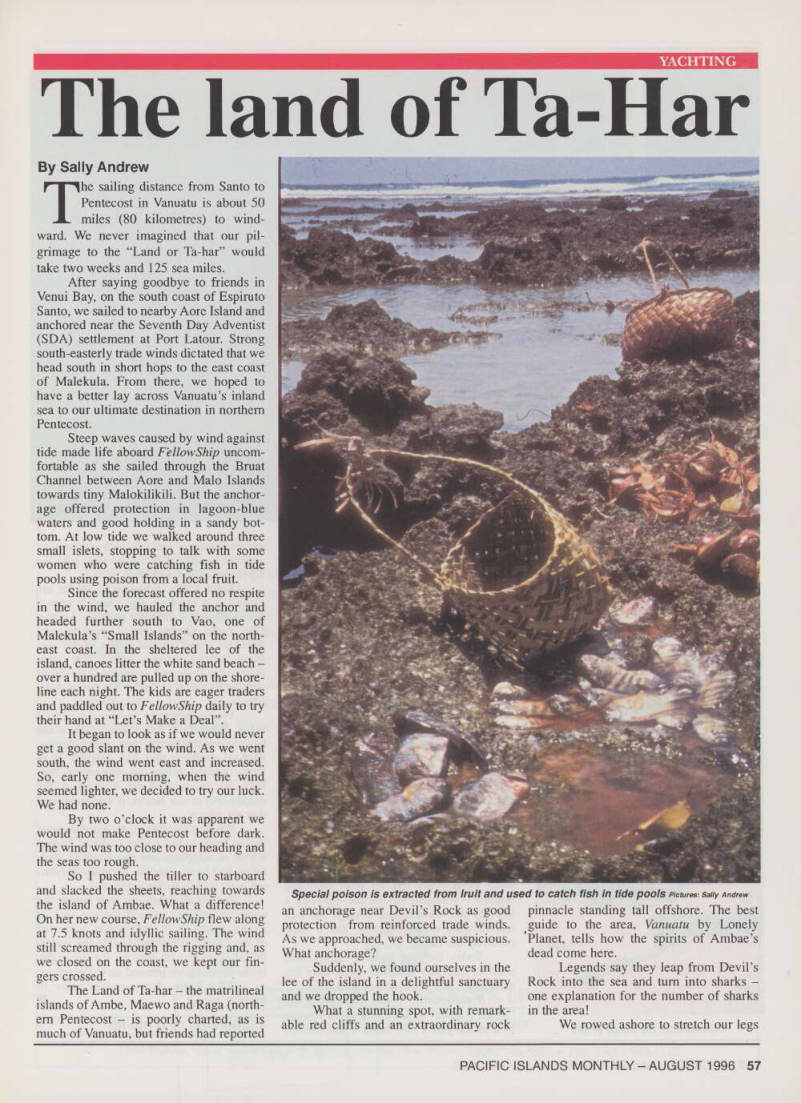
Steep waves caused by wind against tide made life aboard Fellowship uncom fortable as she sailed through the Bruat Channel between Aore and Malo Islands towards tiny Malokilikili. But the anchor age offered protection in lagoon-blue waters and good holding in a sandy bot tom. At low tide we walked around three small islets, stopping to talk with some women who were catching fish in tide pools using poison from a local fruit.
Since the forecast offered no respite in the wind, we hauled the anchor and headed further south to Vao, one of Malekula’s “Small Islands” on the north east coast. In the sheltered lee of the island, canoes litter the white sand beach over a hundred are pulled up on the shore line each night. The kids are eager traders and paddled out to Fellowship daily to try their hand at “Let’s Make a Deal”.
It began to look as if we would never get a good slant on the wind. As we went south, the wind went east and increased.
So, early one morning, when the wind seemed lighter, we decided to try our luck.
We had none.
By two o’clock it was apparent we would not make Pentecost before dark.
The wind was too close to our heading and the seas too rough.
So I pushed the tiller to starboard and slacked the sheets, reaching towards the island of Ambae. What a difference!
On her new course. Fellowship flew along at 7.5 knots and idyllic sailing. The wind still screamed through the rigging and, as we closed on the coast, we kept our fin gers crossed.
The Land of Ta-har - the matrilineal islands of Ambe, Maewo and Raga (north ern Pentecost - is poorly charted, as is much of Vanuatu, but friends had reported
an anchorage near Devil’s Rock as good protection from reinforced trade winds.
As we approached, we became suspicious.
What anchorage?
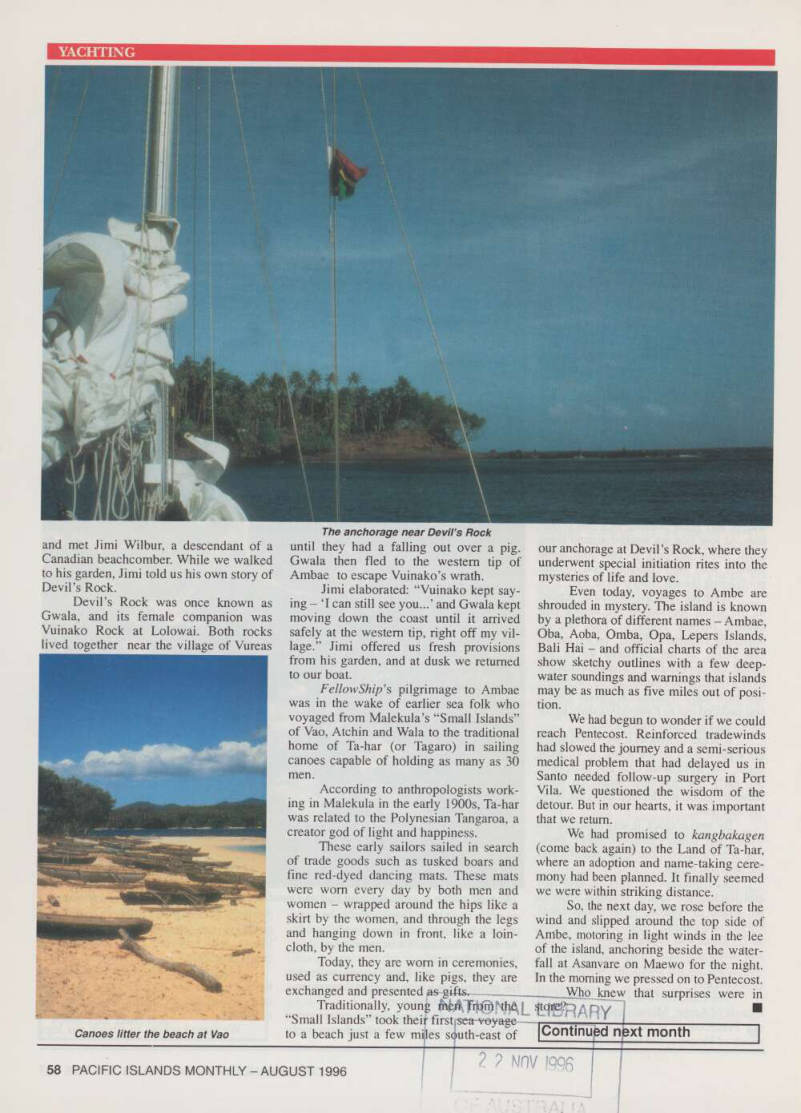
Suddenly, we found ourselves in the lee of the island in a delightful sanctuary and we dropped the hook.
What a stunning spot, with remark able red cliffs and an extraordinary rock
pinnacle standing tall offshore. The best guide to the area, Vanuatu by Lonely 'Planet, tells how the spirits of Ambae’s dead come here.
Legends say they leap from Devil’s
Rock into the sea and turn into sharks one explanation for the number of sharks in the area!
We rowed ashore to stretch our legs
Special poison is extracted from Iruit and used to catch fish in tide pools Pictures: sally Andrew
and met Jimi Wilbur, a descendant of a Canadian beachcomber. While we walked to his garden, Jimi told us his own story of Devil’s Rock.
Devil’s Rock was once known as Gwala, and its female companion was Vuinako Rock at Lolowai. Both rocks lived together near the village of Vureas
until they had a falling out over a pig.
Gwala then fled to the western tip of Ambae to escape Vuinako’s wrath.
Jimi elaborated: “Vuinako kept say ing - T can still see you...’ and Gwala kept moving down the coast until it arrived safely at the western tip, right off my vil lage.” Jimi offered us fresh provisions from his garden, and at dusk we returned to our boat.
Fellowship 1 s pilgrimage to Ambae was in the wake of earlier sea folk who voyaged from Malekula’s “Small Islands” of Vao, Atchin and Wala to the traditional home of Ta-har (or Tagaro) in sailing canoes capable of holding as many as 30 men.
According to anthropologists work ing in Malekula in the early 1900 s, Ta-har was related to the Polynesian Tangaroa, a
creator god of light and happiness.
These early sailors sailed in search of trade goods such as tusked boars and fine red-dyed dancing mats. These mats were worn every day by both men and women - wrapped around the hips like a skirt by the women, and through the legs and hanging down in front, like a loin cloth, by the men.
Today, they are worn in ceremonies, used as currency and, like pigs, they are exchanged and presented as gifts.
Traditionally, young
“Small Islands” took their firstjsea-voyage to a beach just a few miles south-east of
our anchorage at Devil’s Rock, where they underwent special initiation rites into the mysteries of life and love.
Even today, voyages to Ambe are shrouded in mystery. The island is known by a plethora of different names - Ambae, Oba, Aoba, Omba, Opa, Lepers Islands, Bali Hai - and official charts of the area show sketchy outlines with a few deep water soundings and warnings that islands may be as much as five miles out of posi tion.
We had begun to wonder if we could reach Pentecost. Reinforced tradewinds had slowed the journey and a semi-serious medical problem that had delayed us in Santo needed follow-up surgery in Port Vila. We questioned the wisdom of the detour. But in our hearts, it was important that we return.
We had promised to kangbakagen (come back again) to the Land of Ta-har, where an adoption and name-taking cere mony had been planned. It finally seemed we were within striking distance.
So, the next day, we rose before the wind and slipped around the top side of Ambe, motoring in light winds in the lee of the island, anchoring beside the water fall at Asanvare on Maewo for the night.
In the morning we pressed on to Pentecost.
Who knew that surprises were in
[Continued next month"
Canoes litter the beach at Vao
The anchorage near Devil's Rock