Protecting our wetlands
pp. 55-56 · Read in the full issue
Environment
By Liz Thompson
Wetlands appear in many forms,
including bays, coral reefs,
lakes, rivers, flood plains, salt pans, springs and waterholes. These areas are often home to particular species of flora and fauna which only thrive in wet land environments and which provide a habitat for some of the world’s greatest congregations of wildlife. Wetlands, in fact, represent some of the most produc tive ecosystems in the world.
Twenty-five years ago, the Convention on Wetlands was established. A group of concerned researchers from a number of organisations wanted to initiate some kind of protection of wetlands for migratory birds. Also involved were a number of non-government organisations keen to instigate a treaty to protect wetlands. They managed to persuade a number of govern ments to draw up a convention to protect wetlands and migratory birds. This con vention was then adopted at Ramsar, in Iran, and marked the beginning of the Ramsar convention.
When initially set up, the convention focused on protecting the migration routes of birds moving between Europe and Africa. It has now expanded its mandate as well as its membership. The Ramsar Wetland Convention is now the largest environmental conference to be staged in
Australia with around 1000 delegates from nearly 120 countries. Today, Ramsar includes 93 member countries around the world and has a strong membership in almost all continents and regions except the Pacific. This year, the triennial confer ence was held in Brisbane with the specif ic intention of trying to raise the member ship of Pacific nations. There were a sig nificant number of observer nations which
included representatives from Fiji,
Federated States of Micronesia, Solomon Islands and Vanuatu. Much of the Pacific is made up of coral reefs and mangroves, both vital wetland habitats. However, these environments are facing a number of serious threats. As a result of increasing populations, there are concerns that there is a slow breakdown of the traditional sys tems of management of fishing and that areas are often over-fished. In South-East Asia, one of the most important timber resources is mangroves, which are exten sively cut for firewood, woodchips and sometimes construction timber.
Mangroves are vital as fish nurseries and because they are being over-harvested or destroyed, fisheries resources are shrinking, which will ultimately affect vast numbers of people. Wetlands are being cleared for shrimp ponds and urban expansion in the face of increasing popu lation, particularly of atoll lagoons, over dynamiting of reefs, coral mining for con struction materials, and a fair bit of land
fill for extra housing as the population continues to grow.
The convention is hoping to assist Pacific countries in developing plans and strategies for managing their resources. In the Pacific region particularly, a great many people make their living from wet lands fishing or harvesting marine resources and it is critical that wetland areas be maintained. For this reason it has been of some concern that, excluding Australia and New Zealand, the Ramsar conventions bureau identified 25 Pacific Island states and territories with only one of them being a member of the conven tion. The Ramsar directory lists 640 wet lands in the Pacific; the area of those wet lands is considered to be around 10 mil lion hectares. One of the points made at the 1996 Ramsar convention was that one of the major threats to wetlands in the Pacific is resource consumption, logging, mining and overfishing by regional pow ers such as Australia, Malaysia, South Korea, Taiwan and Japan. These countries are responsible for much of the logging of forests, particularly in Papua New Guinea, Solomons and Vanuatu. It was suggested that these resource-consuming countries contribute to wetland conservation in the Pacific.
In many other countries the value of wetlands has been tragically neglected with the result that many important wet land areas have already been lost or
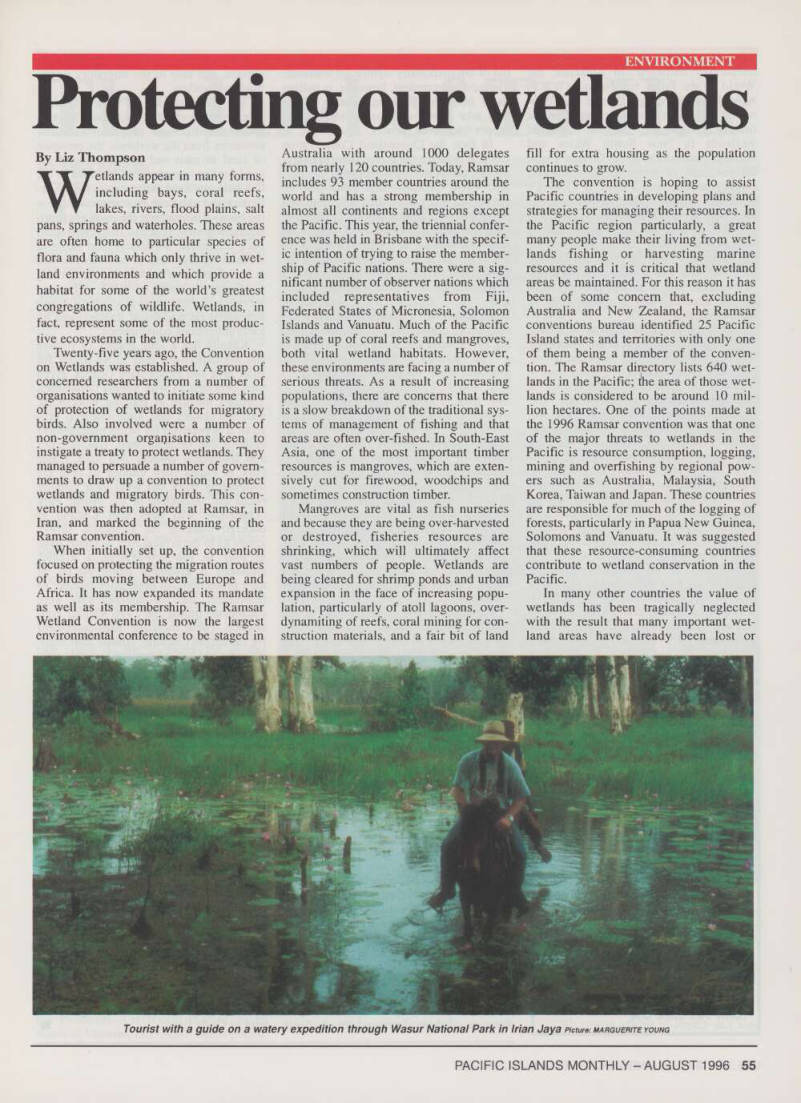
Tourist with a guide on a watery expedition through Wasur National Park in Irian Jaya Picture: MARGUERITE YOUNG
irreparably damaged. In Australia, the World Wide Fund for Nature (WWF) reports that a great number of the conti nent’s wetlands have been filled or drained, including 75 per cent of coastal wetlands in New South Wales and Western Australia’s Swan Coastal Plain; 89 per cent of wetlands in south-east South Australia; and a third of Victoria’s wetlands. The 1993 Directory of Important Wetlands in Australia identifies 520 wetlands of national significance. A vast number of these are not protected by any kind of conservation reserves and only 42 are listed under the Ramsar Convention, which should provide them special attention and a commitment to
their protection.
However, of the 42 Ramsar Wetlands, WWF believes 62 per cent are threatened by poor management or proposed devel opments. The impacts are numerous wetlands are ‘reclaimed’ and fdled in for
building development, agriculture and
recreation. Governments drain river sys tems to provide a carrier of human waste to ocean outfall and in Australia, the high agricultural activity demands extraction of water from river systems. According to David Butcher of WWF: “Blue-green
algae blooms, increasing salinity, drying
out swamps, fish die-offs, acidification of estuaries, declining fisheries and dramatic changes in coral reefs are all warnings that what we are doing is unsustainable.”
Launched at the Ramsar Convention was the East Asia-Australasian Shorebird Reserve Network. However, the network is missing a critical component, the wet lands of Queensland’s south-east Gulf of Carpentaria. The gulf area is the most important site for shorebirds in eastern Australia and one of the most important sites on the whole East Asia-Australasian fly way for migratory shorebirds.
According to the Queensland Conservation Council, this site is home to over 200,000 wading birds - equivalent to all other Queensland wetlands combined.
The former Queensland government was about to nominate this site for the Ramsar
list of internationally significant wetlands.
The new government, however, is pulling away from this position, arguing that it may take them two years to identify the proper traditional owners.
In fact, the Queensland Conservation Council believes the government is delay ing any protective measures until the mas sive CRA Century Zinc mine can be developed. They argue that this mine will drain the underground aquifer believed to feed the only perennial river system in arid Queensland and pump a slurry of heavy metals across the gulf plains to the export port at Karumba. Representatives of Friends of the Earth Australia (FOE) and the Australian Conservation Foundation (ACF) warned delegates at the conference of the dangers of uranium min ing in Australia’s Kakadu National Park.
The facilities at Jabiluka, site of the proposed new mine, are, according to FOE and ACF, already at their limit. A new mine will put them under further strain. A series of water-management problems at the mine culminated in last year’s plan to release 500,000 cubic metres of contaminated water into the Ramsar-listed wetlands on Magela Creek.
The release was only averted by the onset of the dry season. FOE campaigner Steve Barker pointed out: “‘As the new Jabiluka mine will be partially underground, it is possible that another evaporation pond will be needed for contaminated water pumped out of the mine. If this goes ahead, a larger area of Kakadu’s wetlands will be put at risk.”
Barker is critical of the fact that, in his opinion, the Australian government was ignoring the fact that these areas had already been highlighted for protection.
WWF Australia has initiated a project to assist in the sharing of information related to wetland management in Asia- Pacific. The Australian Conservation Agency, the Department of Forest Protection and Nature Conservation in Indonesia (PHPA) and the Department of Environment and Conservation (DEC) in Papua New Guinea announced the details of a proposal for a co-operative pro gramme to manage over three million hectares of wetlands in Irian Jaya, Papua New Guinea and Australia.
The three-nation management and training programme links three wetland reserves in Australia, Irian Jaya and Papua New Guinea. According to WWF, Kakadu National Park in Australia, Wasur National Park in Irian Jaya and Tonda Wildlife Management Area in Papua New Guinea represent the least disturbed, most extensive and diverse wetlands in the Asia-Pacific region. All three areas are of great importance to the many indigenous people who live in the area, particularly in the case of Irian Jaya and Papua New
Guinea, and also to the migratory water fowl and waders.
All three wetlands are subject to simi lar conservation issues, including the pres ence of indigenous people who utilise resources from the wetlands, the presence of feral animals and pest plants and the need for fire management. The idea of the link between these three sites is that expe riences and ideas can be communicated in the hope of developing the most appropri ate management systems. Indigenous peo ple’s traditional knowledge and skills in wetland management is considerable and is a vital source of information. According to Marguerite Young of WWF, “The con servation of these areas is to a large extent dependent on traditional management by local/indigenous communities.”
Kakadu has a long history of mining and the experience may prove useful for Irian Jaya and Papua New Guinea, given their experiences with mining companies.
Through the use of training workshops, staff exchanges and joint research pro jects, it is believed far better management systems can be developed. Kakadu staff and traditional owners will visit Wasur Park in Papua New Guinea to help the community work out what their training needs are. Members of the Wasur Park community will then visit Kakadu to undergo training. As awareness slowly grows as to the critical role wetlands have to play in the eco-system, a greater emphasis is gradually being placed on their protection. An impressive number of resolutions and recommendations were established during the 1996 Ramsar con ference. These included: Encouragement for catchment catching; coastal zone man agement and better attention to coral reefs; measures addressing toxic chemicals in wetlands; provision of good quality infor mation on listed wetland sites, and on changes in their condition; a range of spe cific actions called for at named sites around the world where conservation problems are being experienced; a call for proper assessment of the state of the world’s wetlands; emphasis on involving local communities.
The 1996 Convention, held in Brisbane, consolidated the treaty by set ting out a work plan and modernising it to ensure it is a more active, broader state ment. Jamie Pittock, conservation officer with WWF believes; ‘“Australia and the Pacific made a greater commitment to wetlands conservation than ever before.
We are already seeing results in Australia with new sites being listed and a commit ment by Senator Hill to pledge SA2 mil lion (SUSI. 4 million) toward an interna tional fund to support wetland initia tives.”
In 1999, the Ramsar convention will be held in Costa Rica. ■