Championing freedom of expression?
p. 22 · Read in the full issue
By Bernadette Hussein
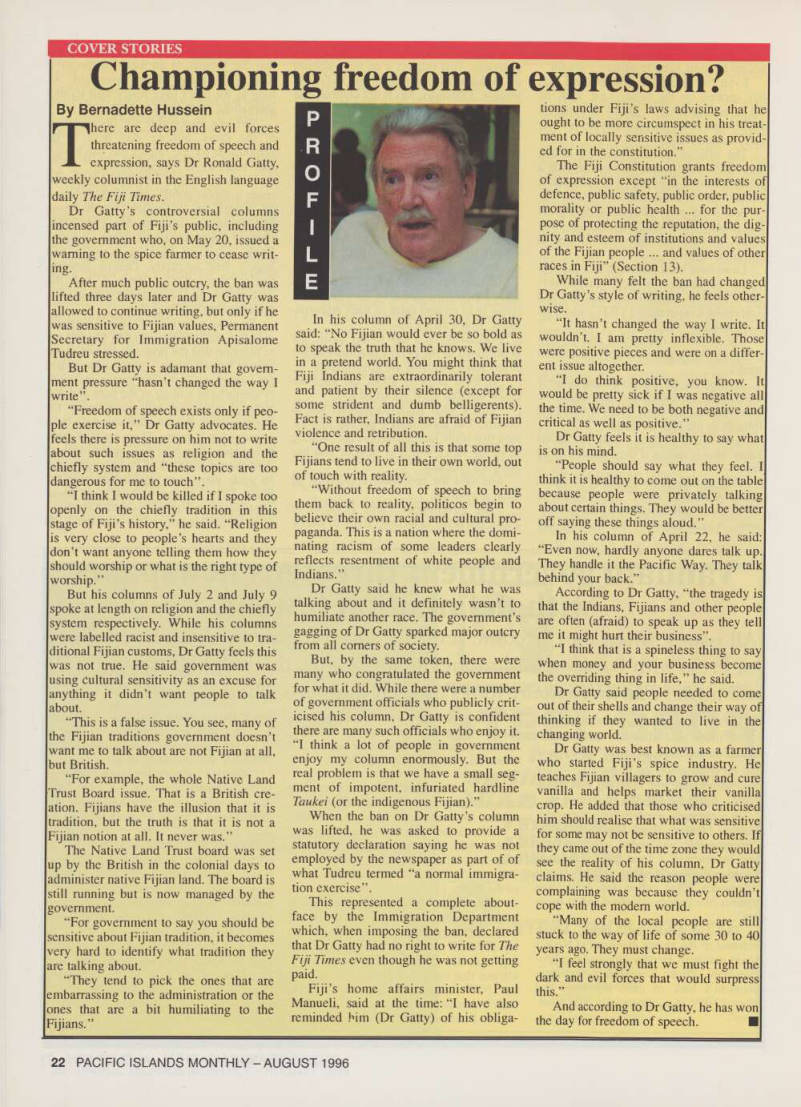
There are deep and evil forces threatening freedom of speech and expression, says Dr Ronald Gatty, weekly columnist in the English language daily The Fiji Times.
Dr Gatty’s controversial columns incensed part of Fiji’s public, including the government who, on May 20, issued a warning to the spice farmer to cease writ
ing.
After much public outcry, the ban was lifted three days later and Dr Gatty was allowed to continue writing, but only if he was sensitive to Fijian values. Permanent Secretary for Immigration Apisalome Tudreu stressed.
But Dr Gatty is adamant that govern ment pressure “hasn’t changed the way I write”.
“Freedom of speech exists only if peo ple exercise it,” Dr Gatty advocates. He feels there is pressure on him not to write about such issues as religion and the chiefly system and “these topics are too dangerous for me to touch”.
“I think I would be killed if I spoke too openly on the chiefly tradition in this stage of Fiji’s history,” he said. “Religion is very close to people’s hearts and they don’t want anyone telling them how they should worship or what is the right type of
worship.”
But his columns of July 2 and July 9 spoke at length on religion and the chiefly system respectively. While his columns were labelled racist and insensitive to tra ditional Fijian customs. Dr Gatty feels this was not true. He said government was using Cultural sensitivity as an excuse for anything it didn’t want people to talk about.
“This is a false issue. You see, many of the Fijian traditions government doesn’t want me to talk about are not Fijian at all, but British.
“For example, the whole Native Land Trust Board issue. That is a British cre ation. Fijians have the illusion that it is tradition, but the truth is that it is not a Fijian notion at all. It never was.”
The Native Land Trust board was set up by the British in the colonial days to administer native Fijian land. The board is still running but is now managed by the government.
“For government to say you should be sensitive about Fijian tradition, it becomes very hard to identify what tradition they are talking about.
“They tend to pick the ones that are embarrassing to the administration or the ones that are a bit humiliating to the
Fijians.”
In his column of April 30, Dr Gatty said: “No Fijian would ever be so bold as to speak the truth that he knows. We live in a pretend world. You might think that Fiji Indians are extraordinarily tolerant and patient by their silence (except for some strident and dumb belligerents).
Fact is rather, Indians are afraid of Fijian violence and retribution.
“One result of all this is that some top Fijians tend to live in their own world, out of touch with reality.
“Without freedom of speech to bring them back to reality, politicos begin to believe their own racial and cultural pro paganda. This is a nation where the domi nating racism of some leaders clearly reflects resentment of white people and Indians.”
Dr Gatty said he knew what he was talking about and it definitely wasn’t to humiliate another race. The government’s gagging of Dr Gatty sparked major outcry from all comers of society.
But, by the same token, there were many who congratulated the government for what it did. While there were a number of government officials who publicly crit icised his column, Dr Gatty is confident there are many such officials who enjoy it.
“I think a lot of people in government enjoy my column enormously. But the real problem is that we have a small seg ment of impotent, infuriated hardline Taukei (or the indigenous Fijian).”
When the ban on Dr Gatty’s column was lifted, he was asked to provide a statutory declaration saying he was not employed by the newspaper as part of of what Tudreu termed “a normal immigra tion exercise”.
This represented a complete about face by the Immigration Department which, when imposing the ban, declared that Dr Gatty had no right to write for The Fiji Times even though he was not getting
paid.
Fiji’s home affairs minister, Paul Manueli, said at the time: “I have also reminded him (Dr Gatty) of his obliga
tions under Fiji’s laws advising that he ought to be more circumspect in his treat ment of locally sensitive issues as provid ed for in the constitution.”
The Fiji Constitution grants freedom of expression except “in the interests of defence, public safety, public order, public morality or public health ... for the pur pose of protecting the reputation, the dig nity and esteem of institutions and values of the Fijian people ... and values of other races in Fiji” (Section 13).
While many felt the ban had changed Dr Gatty’s style of writing, he feels other wise.
“It hasn’t changed the way I write. It wouldn’t. I am pretty inflexible. Those were positive pieces and were on a differ ent issue altogether.
“I do think positive, you know. It would be pretty sick if I was negative all the time. We need to be both negative and critical as well as positive.”
Dr Gatty feels it is healthy to say what is on his mind.
“People should say what they feel. I think it is healthy to come out on the table because people were privately talking about certain things. They would be better off saying these things aloud.”
In his column of April 22, he said: “Even now, hardly anyone dares talk up.
They handle it the Pacific Way. They talk behind your back.”
According to Dr Gatty, “the tragedy is that the Indians, Fijians and other people are often (afraid) to speak up as they tell me it might hurt their business”.
“I think that is a spineless thing to say when money and your business become the overriding thing in life,” he said.
Dr Gatty said people needed to come out of their shells and change their way of thinking if they wanted to live in the
changing world.
Dr Gatty was best known as a farmer who started Fiji’s spice industry. Fie teaches Fijian villagers to grow and cure vanilla and helps market their vanilla crop. He added that those who criticised him should realise that what was sensitive for some may not be sensitive to others. If they came out of the time zone they would see the reality of his column. Dr Gatty claims. He said the reason people were complaining was because they couldn’t cope with the modem world.
“Many of the local people are still stuck to the way of life of some 30 to 40 years ago. They must change.
“I feel strongly that we must fight the dark and evil forces that would surpress this.”
And according to Dr Gatty, he has won the day for freedom of speech. ■