with defamation lawsuit
p. 21 · Read in the full issue
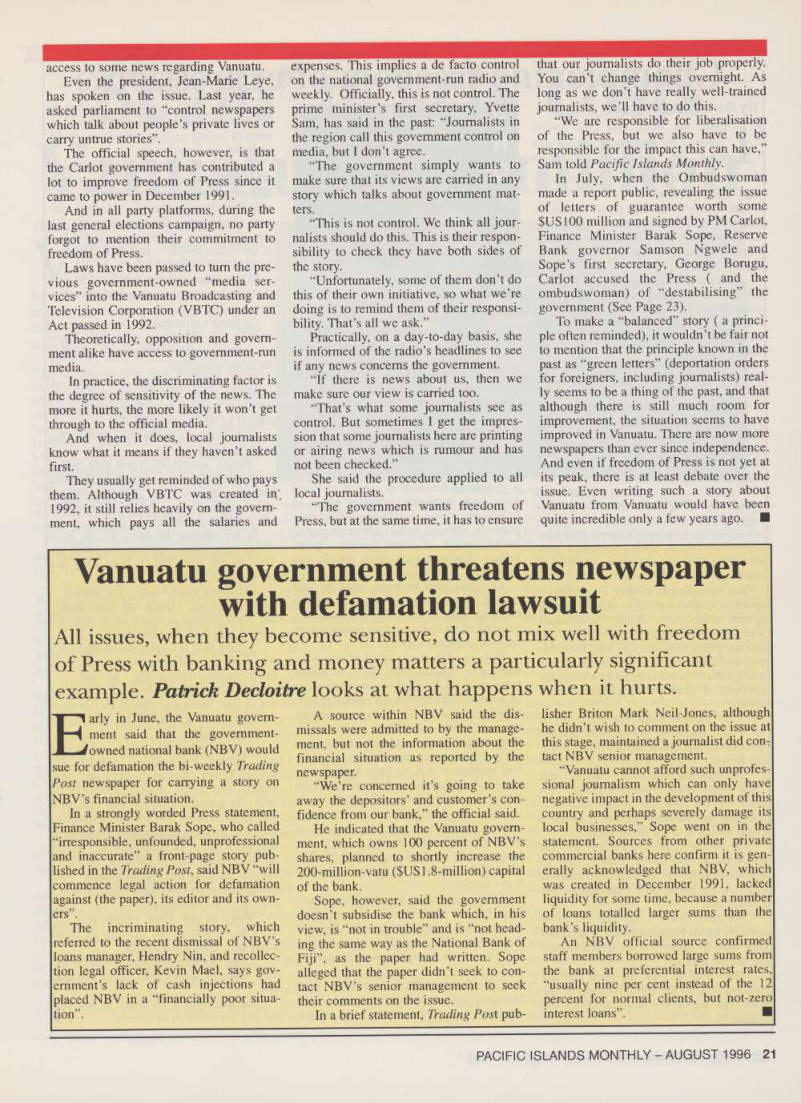
Vanuatu government threatens newspaper with defamation lawsuit
All issues, when they become sensitive, do not mix well with freedom of Press with banking and money matters a particularly significant example. Patrick Decloitre looks at what happens when it hurts.
Early in June, the Vanuatu govern ment said that the government owned national bank (NBV) would sue for defamation the bi-weekly Trading Post newspaper for carrying a story on NBV’s financial situation.
In a strongly worded Press statement, Finance Minister Barak Sope, who called
“irresponsible, unfounded, unprofessional
and inaccurate” a front-page story pub lished in the Trading Post, said NBV “will commence legal action for defamation against (the paper), its editor and its own ers”.
The incriminating story, which referred to the recent dismissal of NBV’s loans manager, Hendry Nin, and recollec tion legal officer, Kevin Mael, says gov ernment’s lack of cash injections had placed NBV in a “financially poor situa tion”.
A source within NBV said the dis missals were admitted to by the manage ment, but not the information about the financial situation as reported by the newspaper.
“We’re concerned it’s going to take away the depositors’ and customer’s con fidence from our bank,” the official said.
He indicated that the Vanuatu govern ment, which owns 100 percent of NBV’s shares, planned to shortly increase the
200-million-vatu (SUS 1.8-million) capital
of the bank.
Sope, however, said the government doesn’t subsidise the bank which, in his view, is “not in trouble” and is “not head ing the same way as the National Bank of Fiji”, as the paper had written. Sope alleged that the paper didn’t seek to con tact NBV’s senior management to seek their comments on the issue.
In a brief statement. Trading Post pub
lisher Briton Mark Neil-Jones, although he didn’t wish to comment on the issue at this stage, maintained a journalist did com tact NBV senior management.
“Vanuatu cannot afford such unprofes sional journalism which can only have negative impact in the development of this country and perhaps severely damage its local businesses,” Sope went on in the statement. Sources from other private commercial banks here confirm it is gen erally acknowledged that NBV, which was created in December 1991, lacked liquidity for some time, because a number of loans totalled larger sums than the
bank’s liquidity.
An NBV official source confirmed staff members borrowed large sums from the bank at preferential interest rates, “usually nine per cent instead of the 12 percent for normal clients, but not-zero interest loans”. ■