sporting chance
pp. 42-43 · Read in the full issue
Women
Giving women a sporting chance
Reports and pictures by Sophie Foster
It is not often the South Pacific can claim a first for the Olympics - but the region did just that in May with the world’s first International Olympic Committee women’s leadership work shop.
Twenty-five Pacific women from Papua New Guinea to the Cook Islands gathered in Suva, Fiji’s capital, as part of the lOC drive to increase the number of women in sports leadership positions.
Workshop organiser and a member of the lOC Working Party on Women and Sport, Libby Darlinson, said the Olympic Committee’s goal was that 10 per cent of all lOC decision-making positions, including those on committees and com missions, be held by women before December 31, Year 2000 and 20 per cent by December 31, 2005. One of the most important outcomes of the lOC workshop was the committee to look into the South Pacific Island Nations Sports Charter for Women (SPIN). “By joining together, these women will have a stronger voice then they would by trying to operate as separate countries,” Darlinson said.
Women were under-represented in all areas of sport at international level as leaders, participants, and coaches, she said, and this was reflected in most nation al sporting bodies throughout the world.
The South Pacific workshop was a model for others to be conducted around the world, particularly in developing countries in Africa, Latin America, and Asia where opportunities for women in sports leadership were virtually non-exis tent, she said. “That’s not saying that men are not interested - all I’m saying is that women have a better understanding of the issues that affect them. And if they’re not in positions of leadership, then it doesn’t matter whether they’re coaches or partici pants - it’s not going to be as easy to make changes,” she said. Through SPIN Pacific women would be able to address issues holding women back and build a network to help problem-solving, she said.
“We just have to be culturally sensitive wherever we are to understand that we don’t empower women by coming in and telling them what to do - it is for them to
voice their opinions,” she said.
In the Pacific, the basic right of women to voice their opinions had to be acknowl edged by policy-makers and new skills learnt to negotiate traditional problems, Darlinson said. Fili Mata’afa, administra tive secretary of the Western Samoa Sports Federation and NOC, said tradi tional roles and responsibilities played a big part in how women were seen, and how receptive people were to new ideas.
She said it was difficult to implement changes in a place where women were still frowned upon if they wore shorts or sports
skirts. In certain villages, where the coun cil of chiefs was relatively progressive, she said, women were allowed to wear sports clothing with a lavalava (full length wraparound skirt). “When she gets to the sporting area, she takes off the lavalava and wears the shorts, and when the game’s over, she puts her lavalava on again and goes home,” Mata’afa said.
While in Western culture women may not stand for such a situation, it was “very progressive” for Samoa, she ■ said.
“Samoan men are starting to understand the importance of health and are allowing, if not encouraging, their wives to partici pate in activities like jogging after work,” she said. But the lack of organised sports for Samoan women was severe with limit
ed funds and facilities its major cause, she said. Mata’afa said it was discouraging that there was only one stadium, the Apia Park, available for all sports, and that most school compounds were off limits because of damage to the turf by players.
But by far the biggest obstacle to women in sports was the women them selves, who have become used to the rou tine of work, home, cooking, cleaning, and caring for the family, she said.
Mata’afa said the sports charter would be a good step for such women but she hopes that all sporting activity, whether compet itive or recreational, will be looked at. “In Western Samoa, the place to start would be fitness and general well-being,” she said. Emily Moala, of the Tonga Amateur Sports Association and NOC, said a con servative and traditional sporting society was the biggest barrier for Tongan women trying to break into sports leadership. The sporting culture of Tonga associated women with netball, she said, while the men were tied to cricket, boxing, and rugby. “We had a hard time trying to get women to play soccer because it’s not really with the culture, and now they are trying to organise female basketball teams,” Moala said. But the Tongan expe rience could be changed through decision making at policy level - with the ministry of education - which people would not question, she said.
“The policy-makers will play a big part in helping women into leadership roles in Tonga and if the situation is approached through the Education Ministry it will be well received by the community,” Moala said. But the approach would have to be multi-pronged to tackle the vast attitude changes that were needed, she said.
“We believe teachers will play a big role in shaping the attitudes of the new
generation, and because the king (of
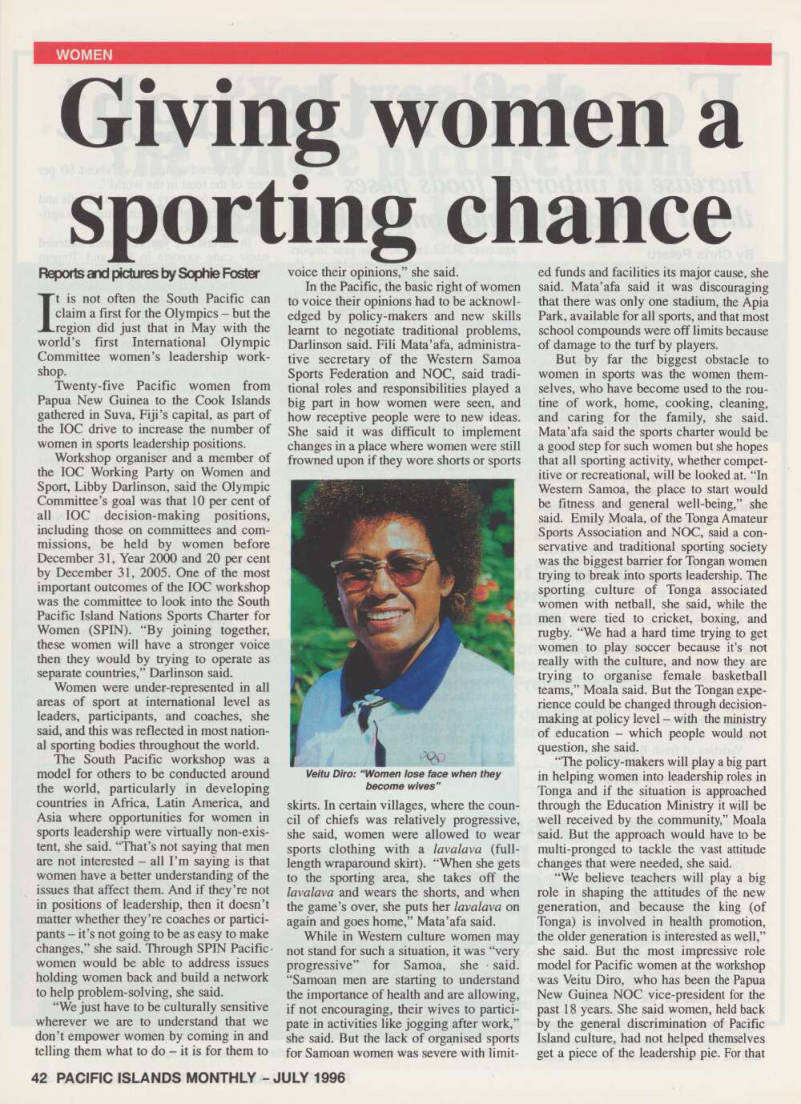
Tonga) is involved in health promotion, the older generation is interested as well,” she said. But the most impressive role model for Pacific women at the workshop was Veitu Diro, who has been the Papua New Guinea NOC vice-president for the past 18 years. She said women, held back by the general discrimination of Pacific Island culture, had not helped themselves get a piece of the leadership pie. For that
Veitu Diro: “Women lose face when they become wives”
reason alone, she said, the sports charter was a good idea. “Like everything else, we are lumped in with the men and they swamp us, and a charter is a good idea towards gaining recognition,” she said, “Women lose face when they become wives because they are expected to leave their individuality aside and fulfil the roles of homemaker and mother, and income-earner,” she said. Diro said it did not matter how good a sportsperson the
woman was, if her husband or family demanded her time, she gave priority to them.
“I am probably the only woman who has throughout the past 30 years consistently been involved in sports in PNG, whether as a competitor or administrator, and I have earned my position in the NOC,” Diro said. PNG would have to adapt to the changing needs of modem
society, and that included gender equality,
she said. “You can’t still hold on to all your culture and fit into the modem world - there has to be give and take if you want to move ahead; otherwise, you will be left behind,” she said. And with the power of the lOC behind Pacific Island women, it is clear that NOCs in each Pacific country have to either address the challenges which lie ahead - progress and adaptation - or stubbornly cling to inappropriate and outdated ideas? ■
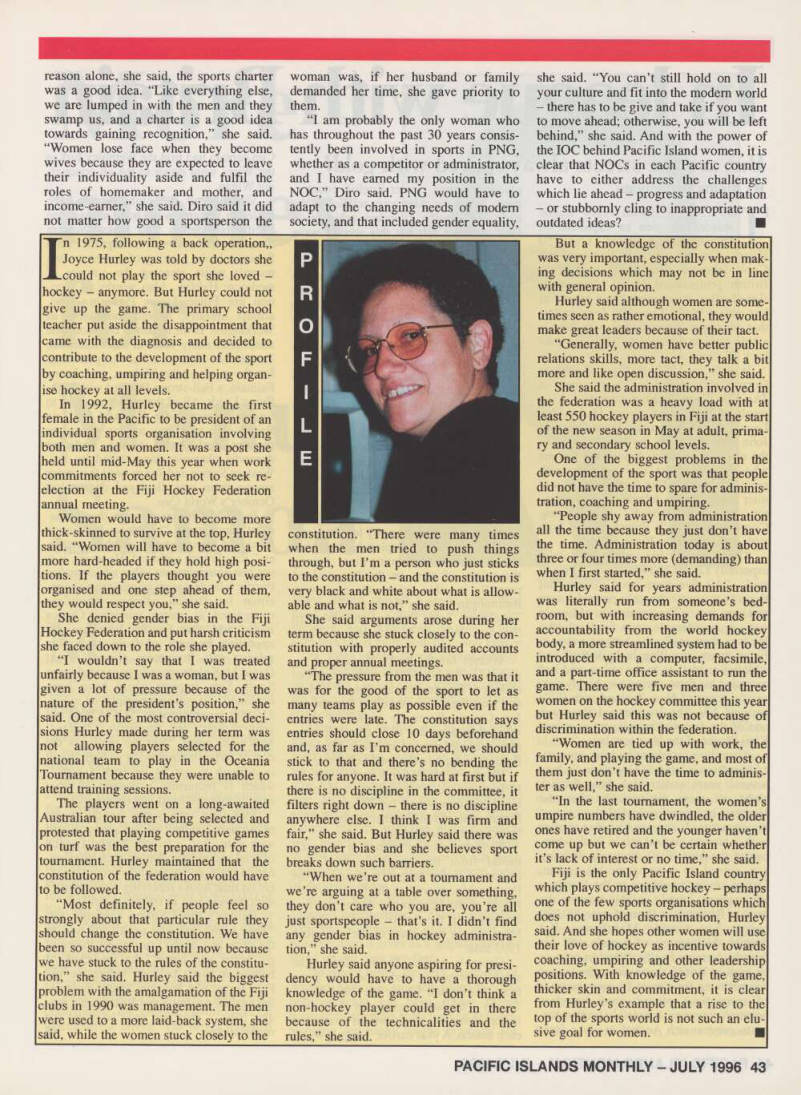
In 1975, following a back operation,, Joyce Hurley was told by doctors she could not play the sport she loved hockey - anymore. But Hurley could not give up the game. The primary school teacher put aside the disappointment that came with the diagnosis and decided to contribute to the development of the sport
by coaching, umpiring and helping organ
ise hockey at all levels.
In 1992, Hurley became the first female in the Pacific to be president of an
individual sports organisation involving
both men and women. It was a post she held until mid-May this year when work commitments forced her not to seek re election at the Fiji Hockey Federation
annual meeting.
Women would have to become more thick-skinned to survive at the top. Hurley said. “Women will have to become a bit more hard-headed if they hold high posi tions. If the players thought you were organised and one step ahead of them, they would respect you,” she said.
She denied gender bias in the Fiji Hockey Federation and put harsh criticism she faced down to the role she played.
“I wouldn’t say that I was treated unfairly because I was a woman, but I was given a lot of pressure because of the nature of the president’s position,” she said. One of the most controversial deci sions Hurley made during her term was not allowing players selected for the national team to play in the Oceania Tournament because they were unable to attend training sessions.
The players went on a long-awaited Australian tour after being selected and
protested that playing competitive games
on turf was the best preparation for the tournament. Hurley maintained that the constitution of the federation would have to be followed.
“Most definitely, if people feel so
strongly about that particular rule they
should change the constitution. We have been so successful up until now because we have stuck to the rules of the constitu tion,” she said. Hurley said the biggest problem with the amalgamation of the Fiji clubs in 1990 was management. The men were used to a more laid-back system, she said, while the women stuck closely to the
constitution. “There were many times when the men tried to push things through, but I’m a person who just sticks to the constitution - and the constitution is very black and white about what is allow able and what is not,” she said.
She said arguments arose during her term because she stuck closely to the con stitution with properly audited accounts and proper annual meetings.
“The pressure from the men was that it was for the good of the sport to let as many teams play as possible even if the entries were late. The constitution says entries should close 10 days beforehand and, as far as I’m concerned, we should stick to that and there’s no bending the rules for anyone. It was hard at first but if there is no discipline in the committee, it filters right down - there is no discipline anywhere else. I think I was firm and fair,” she said. But Hurley said there was no gender bias and she believes sport breaks down such barriers.
“When we’re out at a tournament and we’re arguing at a table over something, they don’t care who you are, you’re all just sportspeople - that’s it. I didn’t find any gender bias in hockey administra tion,” she said.
Hurley said anyone aspiring for presi
dency would have to have a thorough knowledge of the game. “I don’t think a non-hockey player could get in there because of the technicalities and the rules,” she said.
But a knowledge of the constitution was very important, especially when mak ing decisions which may not be in line
with general opinion.
Hurley said although women are some times seen as rather emotional, they would make great leaders because of their tact.
“Generally, women have better public relations skills, more tact, they talk a bit more and like open discussion,” she said.
She said the administration involved in the federation was a heavy load with at least 550 hockey players in Fiji at the start of the new season in May at adult, prima ry and secondary school levels.
One of the biggest problems in the development of the sport was that people did not have the time to spare for adminis
tration, coaching and umpiring.
“People shy away from administration all the time because they just don’t have the time. Administration today is about three or four times more (demanding) than when I first started,” she said.
Hurley said for years administration was literally run from someone’s bed room, but with increasing demands for accountability from the world hockey body, a more streamlined system had to be introduced with a computer, facsimile, and a part-time office assistant to run the game. There were five men and three women on the hockey committee this year but Hurley said this was not because of discrimination within the federation.
“Women are tied up with work, the family, and playing the game, and most of them just don’t have the time to adminis ter as well,” she said.
“In the last tournament, the women’s umpire numbers have dwindled, the older ones have retired and the younger haven’t come up but we can’t be certain whether it’s lack of interest or no time,” she said.
Fiji is the only Pacific Island country
which plays competitive hockey - perhaps
one of the few sports organisations which does not uphold discrimination, Hurley said. And she hopes other women will use their love of hockey as incentive towards
coaching, umpiring and other leadership
positions. With knowledge of the game, thicker skin and commitment, it is clear from Hurley’s example that a rise to the top of the sports world is not such an elu sive goal for women. ■