Food for thought
p. 41 · Read in the full issue
Food
Increase in imported foods poses threat to Pacific Island communities
By Chris Peteru
While gathering fresh food has never been a problem for peo ple on the tiny islands scat tered around the Pacific, a growing moun tain of imported foods is making some far-reaching impact on the way they live.
Fast-food giant McDonalds, who this year opened Golden Arches in Fiji and Western Samoa, are the latest arrival in a growing line of food manufacturers and import wholesalers altering the traditional diet of the region’s 1.3 millon inhabitants.
During the sub-regional conference of the Food and Agricultural Organisation in Western Samoa, attended by 100 dele gates from 27 Asian and Pacific countries, FAO spokesman Dederik de Vleeschauwer said island diets needed more vegetables and unprocessed foods. ‘’The percentage of calories attained from vegetables has fallen drastically from 40 per cent to below 20 per cent in the last five years.”
Unlike their Asian neighbours, home to half-a-billion malnourished people, Pacific Islanders were more prone to eat ing too much cholesterol and sugar-load ed food that was either imported or made locally.
One result has been a surge in deaths caused by heart disease, obesity and dia betes.
Varieties of fresh fish, coconut cream, and yams -staple foods for Islanders were now competing with a demand for cheap tinned fish, meat off-cuts and fizzy drinks.
In a region where the average wage is SUS 22 a week, such items are considered
luxury goods.
Geographically isolated and limited by land and financial resources. Pacific Island countries are finding themselves on the wrong end of the trade liberalisa
tion movement being touted by developed
countries. ‘’Fewer people are willing to work the land and, while food security is a concern, if this dependance on imported food con tinues we are at the mercy of forces beyond our control,” said Vanuatu Agriculture Minister Vincent Boulekone.
Vanuatu, Tonga, the Cook Islands, Fiji and the Solomon Islands spend on aver
age over SUS2.Im each per year import ing food, a huge amount considering the tiny wages and small populations.
Non-govemmental organisations say
the quality of the goods is frequently sub standard. ‘’Pacific NGOs are seriously con cerned about the dumping of food prod ucts from other countries to vulnerable Pacific nations. Because of low prices the standards are very poor, and in some cases the goods are not accepted in their own countries,” said Koroseta To’o, spokesman for 20 NGOs at the confer ence.
To’o, said that NGOs wanted a review on the Pacific accord within the General Agreement on Trade and Taniffs and renegotiation of the accord on the conclu sions reached. ‘ ’The situation now is basically one of continued neo-colonialism where our farmers can’t compete with bigger coun tries who can offer lower prices, then leave us high and dry.”
FAO director general Dr Jacques Diouf offered some support to the tough NGO stance. ‘’We shouldn’t do crisis management, we should plan ahead,” he said.
Natural disasters have also created food production problems unique to the Pacific.
The FAO report on the Asia-Pacific region stated that 35 major natural disas
ters happened annually - ‘’about 60 per cent of the total in the world”.
It went on to say cyclones, floods and droughts caused the most damage to agri cultural and food systems.
In the last five years cyclones flattened sugar cane exports in Fiji and Tongan squash destined for Japanese markets.
In the rush to recover, overproduction saw the price of both commodities spiral downwards, losing millions in overseas revenues.
A taro blight that spread to Western Samoa in 1993, destroyed the main diet staple and an industry that was earning SUS4OO,OOO a monljh. ‘ ’lndustrial espionage cannot be ruled out,” Agriculture Minister Misa Talefoni told the conference.
While denying any involvement from overseas rice exporters he said: ‘’Stranger things have happened. If we go by that reasoning ... Fiji or Tonga may also have introduced the blight considering that they are gaining the most on the New Zealand market now that we are not there.” Poor quarantine measures have recently seen the giant African Snail wreak havoc on crops around the Pacific.
Despite some success at containing the pest there is little hope of eradication.
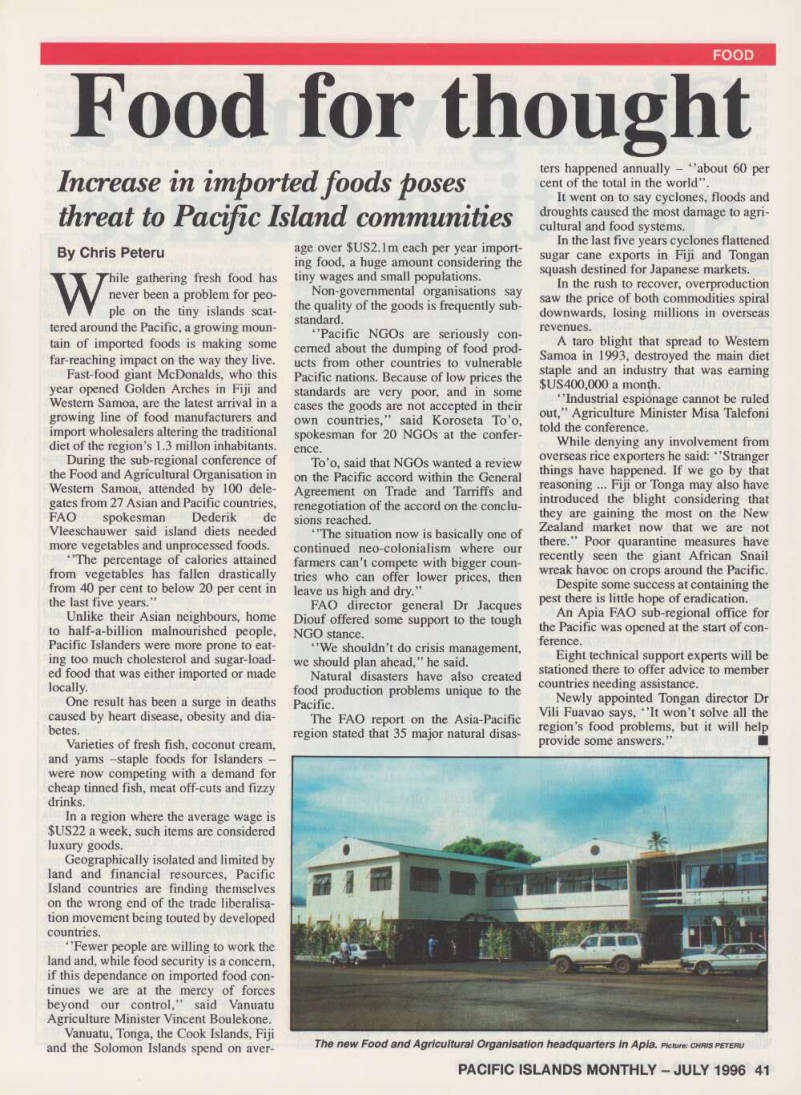
An Apia FAO sub-regional office for the Pacific was opened at the start of con ference.
Eight technical support experts will be stationed there to offer advice to member countries needing assistance.
Newly appointed Tongan director Dr
Vili Fuavao says, ‘Tt won’t solve all the region’s food problems, but it will help provide some answers.” ■
The new Food and Agricultural Organisation headquarters in Apia. picture: CHRIS PETERU