Vanuatu’s window to the outside world
p. 35 · Read in the full issue
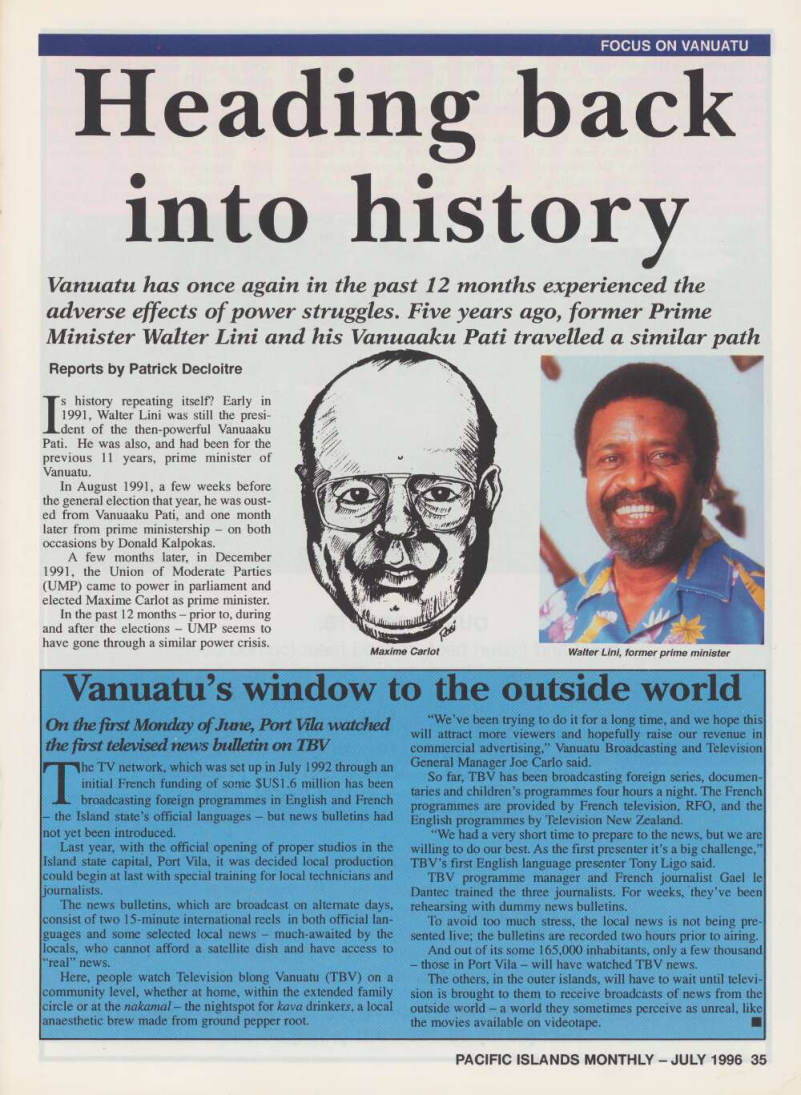
On the first Monday of June, Port Vila watched the first televised news bulletin on TBV The TV network, which was set up in July 1992 through an initial French funding of some SUS 1.6 million has been broadcasting foreign programmes in English and French - the Island state’s official languages - but news bulletins had not yet been introduced.
Last year, with the official opening of proper studios in the Island state capital. Port Vila, it was decided local production could begin at last with special training for local technicians and journalists.
The news bulletins, which are broadcast on alternate days, consist of two 15-minute international reels in both official lan guages and some selected local news - much-awaited by the locals, who cannot afford a satellite dish and have access to “real” news.
Here, people watch Television blong Vanuatu (TBV) on a community level, whether at home, within the extended family circle or at the nakamal - the nightspot for kava drinkers, a local anaesthetic brew made from ground pepper root.
“We’ve been trying to do it for a long time, and we hope this will attract more viewers and hopefully raise our revenue in commercial advertising,” Vanuatu Broadcasting and Television General Manager Joe Carlo said.
So far, TBV has been broadcasting foreign series, documen taries and children’s programmes four hours a night. The French programmes are provided by French television, RFO, and the English programmes by Television New Zealand.
“We had a very short time to prepare to the news, but we are willing to do our best. As the first presenter it’s a big challenge,”
TBV’s first English language presenter Tony Ligo said.
TBV programme manager and French journalist Gael le Dan tec trained the three journalists. For weeks, they’ve been rehearsing with dummy news bulletins.
To avoid too much stress, the local news is not being pre sented live; the bulletins are recorded two hours prior to airing.
And out of its some 165,000 inhabitants, only a few thousand - those in Port Vila - will have watched TBV news.
The others, in the outer islands, will have to wait until televi sion is brought to them to receive broadcasts of news from the outside world - a world they sometimes perceive as unreal, like the movies available on videotape. ■