Remembering
pp. 32-33 · Read in the full issue
Western Samoan Independence
Remembering the fight for freedom
By Chris Peteru
Independence celebrations are defi nitely not what they used to be in Western Samoa, and last month’s 34th birthday proved no exception. Once the most eagerly awaited event on the social events calander - with floats, long boat races a genuine festive atmosphere, and a feeling of national pride - it now resem bles a day-long sit-down concert for VIPs
and politicians to enjoy.
“This year’s programme was a bit lim ited,” said Telecommunications Minister Tolofuaivalelei Falemoe Leiataua. “We plan to have some special things for next year. We want to bring back some of the features which used to make our Independence Day special.”
Many complain that September’s week-long Teuila Tourism Festival that began in 1993 has wiped a lot of the glamour from Samoa’s flag day. Judging by the spectacle, that appears to be the case.
While the celebrations were met with the kind of enthusiasm reserved for a flat tyre on a rainy morning, the events that made Western Samoa the Pacific’s first independent state in 1962 are far more interesting. It began at the outbreak of World War I. Britain asked New Zealand to seize what was then German Samoa a European colony since 1900 following the signing of the Treaty of Berlin between the Germans, Britain and the United States.
So in August 1914, an expeditionary force of 1400 soldiers landed in the capi tal, Apia. In a bloodless takeover the New Zealanders assumed control - making Samoa the first enemy territory to be cap tured by the Allied forces.
A military government under Colonel Robert Logan (who soon became gover nor) was installed, and it was there that problems began in earnest. As with the Germans, the Samoans and part-
Europeans became increasingly frustrated
with what they viewed as colonial arro gance and paternalism by the New Zealanders.
In 1918, the steamer Talune arrived from Auckland and docked at Matautu wharf. On board was an influenza epe demic but despite prior knowledge of the condition, the New Zealand authorities failed to order any quarantine measures.
Eventually, one in five Samoans (popula tion 38,000) died. Strangely, Governor Logan refused offers of medical assis tance from neighbouring American Samoa to the point of breaking off radio transmission and ordered a temporary hospital set up by volunteers in Apia shut down. Although quarantine measures had been imposed when the Talune docked in
Fiji, Logan consistently denied any
responsibility for the influenza epidemic spreading to the islands.
Attempts to improve health facilities following the debacle were carried out, but by 1926 the poor impression Samoans and part-Europeans held of Logan and successive New Zealand administrators, led to the formation of the O le Mau (Samoan League) a national lobby group.
Led by Tupua Tamasese Lealofi, Tuimaleali’ifano Si’u, and Taisi O F Nelson, the Mau took the motto of Samoa mo Samoa (Samoa for Samoans), and an action plan of non-co-operation with the New Zealand administration.
The main cause of the defiance was an ordinance that allowed officials wide ranging power over village chiefs. This included the authority to remove their titles and banish them to all parts of the
empire. Following that policy between
1921-26, 53 chiefs were shipped out of Western Samoa. Simply put, the ordi nance was designed to destabilise the cor nerstone of the Samoan culture by a regu lated system of cultural genocide and racism. Four years of peaceful resistance were shattered on Christmas Day, 1929, when an unarmed demonstration through Apia was fired on by government troops.
Tupua Tamasese and 10 others were shot
dead. One military policeman was killed.
Anticipating his death, Tupua said: “My blood has been spilt for Samoa. I am proud to give it. Do not dream of aveng ing it as it was spilt in maintaining peace.
If I die, peace must be maintained at any price.”
Commodore Blake, who was in charge of the military personnel sent to disband the Mau, saw things differently.
“At the present moment he (the Samoan) is in the position of a sulky and insubordinate child who has deliberately disobeyed his father... There is no alterna tive, therefore, but to treat him roughly ... force is the only thing which will appear to the Samoan.”
However, Tamasese’s martyrdom became the turning point in the national struggle for self-rule. Following the shooting, the Mau were denounced as a seditious organisation. NZ military forces went on the offensive, raiding villages, destroying homes and terrifying villagers accused of aiding the Mau, many of whom had fled to the mountains to regroup.
From that point, the Mau declared a goal of independence from New Zealand and total self-government and, despite some negotiations, a deadlock between the two groups paralysed any hopes of a solution. In 1936, the NZ Labour Party, which had during the interim shown some empathy toward the Mau, came into power. Prime Minister Michael Joseph Savage promised more co-operation in resolving the problems. Harsh taxes were revoked, exiled political prisoners returned, and four Samoan legislative members were appointed to the council.
Assistance with health and education pro grammes was provided on an on-going scale.
By 1945, Prime Minister Peter Fraser visited to hold talks on self-government, and passed the Samoan Amendment Act in the NZ parliament that implemented suggestions on Samoan self-government.
Soon after, the United Nations arrived on
the first of several visits over the next 15 years to discuss and investigate the self government issue.
A UN-supervised plebiscite in 1961 resulted in an overwhelming consensus to accept a drafted constitution and to become an independent state the follow ing year. To mark the occasion, a Treaty of Friendship between New Zealand and Western Samoa was signed.
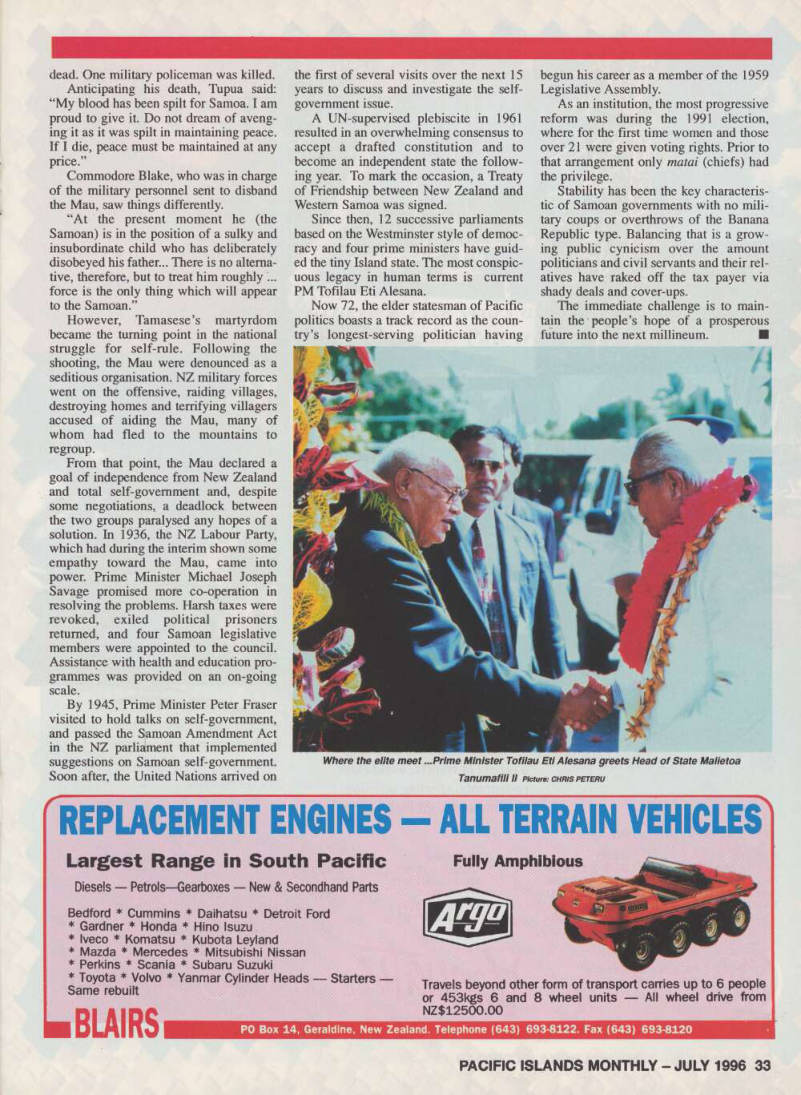
Since then, 12 successive parliaments based on the Westminster style of democ racy and four prime ministers have guid ed the tiny Island state. The most conspic uous legacy in human terms is current PM Tofilau Eti Alesana.
Now 72, the elder statesman of Pacific politics boasts a track record as the coun try’s longest-serving politician having
begun his career as a member of the 1959
Legislative Assembly.
As an institution, the most progressive reform was during the 1991 election, where for the first time women and those over 21 were given voting rights. Prior to that arrangement only matai (chiefs) had
the privilege.
Stability has been the key characteris tic of Samoan governments with no mili tary coups or overthrows of the Banana Republic type. Balancing that is a grow ing public cynicism over the amount politicians and civil servants and their rel atives have raked off the tax payer via shady deals and cover-ups.
The immediate challenge is to main tain the people’s hope of a prosperous future into the next millineum. ■
Where the elite meet ...Prime Minister Tofilau Eti Alesana greets Head of State Malietoa Tanumafili II picture: CHRIS PETERU