... theoretically
pp. 25-28 · Read in the full issue
Trillions in mineral riches for the Cooks ... theoretically
By David North
The Cooks may be having a financial crisis, and the local currency is not worth much but - theoretically, at least - the Cooks have in their Exclusive Economic Zone (EEZ) two trillion dollars worth of cobalt. That’s right, $U52,000,000,000,000 worth of the min eral! \ We derive that figure from two impec cable, if somewhat academic, sources.
The East-West Centre, in Honolulu, has estimated that there are 32,541,000 tons of cobalt in the Cooks waters; the US Bureau of Mines quotes the current (dry land) cobalt price at $60,400 a ton; and $60,400 x 32,541,000 $2,017,542,000,000. (Neither of these august institutions were venturesome enough to print the multiplication shown here.) There are several enormous caveats, however.
Problem one: The cobalt is imbedded in manganese nodules that are scattered all over the Cooks’ extensive EEZ, that is, the waters within 200 miles (320 kilome tres) of one or more of the Cook Islands.
Problem two: The East-West Centre says it will cost SUSI.2S billion or so to establish a high-tech system to vacuum the ocean floor for the nodules and to buy the ships to take them to an expensive facility (not yet built) where the nodules would be pulverised and processed.
Problem three: According to the US Bureau of Mines, the world uses about 20-30,000 tons of cobalt every year, and even if only one third of the Cooks’ sup ply could be recovered, that would keep the whole world supplied (at current usage rates) for more than 300 years. In the meantime, the arrival of massiye amounts of cobalt on the market would, of course, depress prices sharply.
For a feet-firmly-planted-on-the ground (maybe feet-in-the-water), highly sensible view of all of this we turned to Cook Islands official Taylor A Pryor. He’s the aide to the prime minister in charge of special projects, one of which is a low
tech, low-investment approach to the manganese nodules.
Pryor dismisses the ultra-long-range view of the East-Centre and its focus on space-era technologies (the enormous ships with their two-mile-long vacuum cleaner hoses sweeping the bottom of the ocean) which so often dominates discus sion of the nodules.
Pryor’s project is a pre-feasibility study of an alternative, small-is-beautiful approach to the underseas wealth. The Cooks have enlisted the support of Bechtel, the mighty, San Francisco-based engineering firm which managed the Chunnel from Britain to France, and the innovative new Hong Kong Airport.
Bechtel, using some of its funds and some US government money, has started to study the utility of mining the nodules in Cook waters.
The concept Bechtel and Pryor are checking out is a modest one: Let’s think about old freighters trawling for nodules using currently available electronic sens ing equipment to scout for the nodules.
The capital costs are not enormous.
One can buy a slightly used, 390-foot long trawler for $2.5 million.
Such a vessel could collect from 800 to 1600 tons of nodules a day (estimates vary); the trawler would then transfer its catch to a much larger ore carrier with a capacity of up to 40,000 tons, with the larger vessel making the trip to Australia or South America or wherever the pro cessing plant is to be built.
According to Pryor, one can rent such an ore carrier for $BOOO a day; expensive, yes, but no capital is involved.
Pryor sums up the Cooks’ position as follows: “I am not writing to convince you and Pacific Islands Monthly readers of the viability of this task. Who knows until the study and possible subsequent trials have been completed? ... CIGOV and Bechtel are taking the most obvious next step. Should that result in positive recommendations, CIGOV will seek grants for the next obvious steps. This cautious task will continue until there is
an insurmountable obstacle or we reach that magic point when investor confi dence is warranted.”
The Cooks are not alone in these
thoughts.
Even if one discounts some of the box car numbers mentioned earlier, island leaders throughout the Pacific are paying attention to those fist-sized rocks that lie half a mile to four miles under the surface of the ocean. With overseas aid shrinking, with revenue from tuna plateauing, and with large-scale tourism a distant glimmer for all but Hawaii, Guam and Saipan, the nodules do offer an attractive - albeit per haps long-term - prospect.
Often called manganese nodules (for that substance is the major element) the real value of this resource is found in the cobalt and nickel components.
Useful quantities of copper are also present in these rocks which draw the minerals in question from the surrounding sea water.
Nickel, which is mined in New Caledonia, is used in stainless steel; cobalt, which makes extremely tough cut ting tools and blue pigment, is also mined in New Caledonia, but comes primarily from Russia, Zaire and Canada.
Both metals are used in electrical bat teries, and if non-polluting electric auto mobiles catch on, the world market for both of these commodities will soar.
But it will take a sustained increase in the price of both commodities before any one invests in undersea mining.
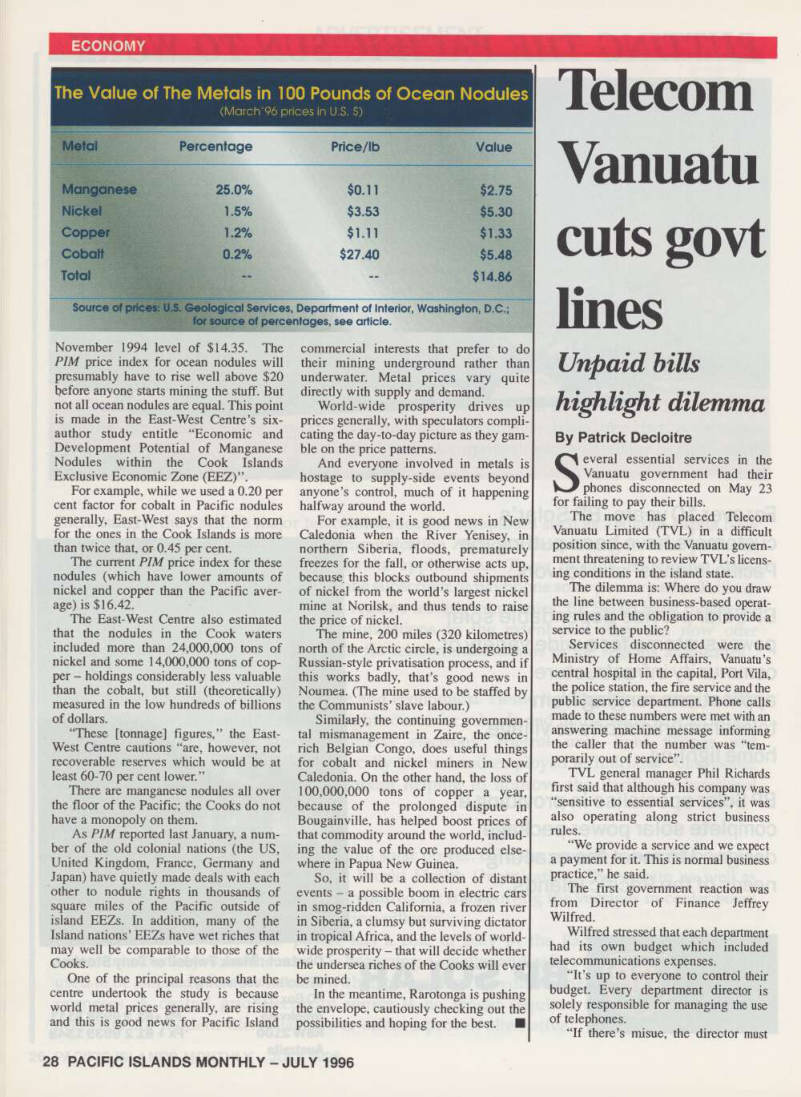
To illustrate the economics, the accompanying box (Page 28) shows how much of the four metals are found in the average Pacific nodule, the world price per pound in November, 1995 for the commodity, and the potential value of the metals within a typical 100 pounds of nodules.
The box shows the June 1996 value, for 100 lbs at $14.86; this is a sharp increase from the value of 100 lbs of nod ules in November, 1993, when it was $9.33, and a lesser increase from the
Continued on Page 28
November 1994 level of $14.35. The PIM price index for ocean nodules will presumably have to rise well above $2O before anyone starts mining the stuff. But not all ocean nodules are equal. This point is made in the East-West Centre’s six author study entitle “Economic and
Development Potential of Manganese
Nodules within the Cook Islands Exclusive Economic Zone (EEZ)”.
For example, while we used a 0.20 per cent factor for cobalt in Pacific nodules generally. East-West says that the norm for the ones in the Cook Islands is more than twice that, or 0.45 per cent.
The current PIM price index for these nodules (which have lower amounts of nickel and copper than the Pacific aver age) is $16.42.
The East-West Centre also estimated that the nodules in the Cook waters included more than 24,000,000 tons of nickel and some 14,000,000 tons of cop per - holdings considerably less valuable than the cobalt, but still (theoretically) measured in the low hundreds of billions of dollars.
“These [tonnage] figures,” the East- West Centre cautions “are, however, not recoverable reserves which would be at least 60-70 per cent lower.”
There are manganese nodules all over the floor of the Pacific; the Cooks do not have a monopoly on them.
As PIM reported last January, a num ber of the old colonial nations (the US, United Kingdom, France, Germany and Japan) have quietly made deals with each other to nodule rights in thousands of square miles of the Pacific outside of island EEZs. In addition, many of the Island nations’ EEZs have wet riches that may well be comparable to those of the Cooks.
One of the principal reasons that the centre undertook the study is because world metal prices generally, are rising and this is good news for Pacific Island
commercial interests that prefer to do their mining underground rather than underwater. Metal prices vary quite directly with supply and demand.
World-wide prosperity drives up prices generally, with speculators compli cating the day-to-day picture as they gam ble on the price patterns.
And everyone involved in metals is hostage to supply-side events beyond anyone’s control, much of it happening halfway around the world.
For example, it is good news in New Caledonia when the River Yenisey, in northern Siberia, floods, prematurely freezes for the fall, or otherwise acts up, because this blocks outbound shipments of nickel from the world’s largest nickel mine at Norilsk, and thus tends to raise the price of nickel.
The mine, 200 miles (320 kilometres) north of the Arctic circle, is undergoing a Russian-style privatisation process, and if this works badly, that’s good news in Noumea. (The mine used to be staffed by the Communists’ slave labour.) Similarly, the continuing governmen tal mismanagement in Zaire, the once rich Belgian Congo, does useful things for cobalt and nickel miners in New Caledonia. On the other hand, the loss of 100,000,000 tons of copper a year, because of the prolonged dispute in Bougainville, has helped boost prices of that commodity around the world, includ ing the value of the ore produced else where in Papua New Guinea.
So, it will be a collection of distant events - a possible boom in electric cars in smog-ridden California, a frozen river in Siberia, a clumsy but surviving dictator in tropical Africa, and the levels of world wide prosperity - that will decide whether the undersea riches of the Cooks will ever be mined.
In the meantime, Rarotonga is pushing the envelope, cautiously checking out the possibilities and hoping for the best. ■
The Value of The Metals in 100 Pounds of Ocean Nodules (March'96 prices in U.S. $) Metal Percentage Price/lb Value Manganese 25.0% $0.11 $2.75 Nickel 1.5% $3.53 $5.30 Copper 1.2% $1.11 $1.33 Cobalt 0.2% $27.40 $5.48 Total -- -- $14.86 Source of prices: U.S. Geological Services, Department of Interior, Washington, D.C.; for source of percentages, see article.