Pacific
p. 24 · Read in the full issue
Economy
A lesson for the Pacific
By Sophie Foster
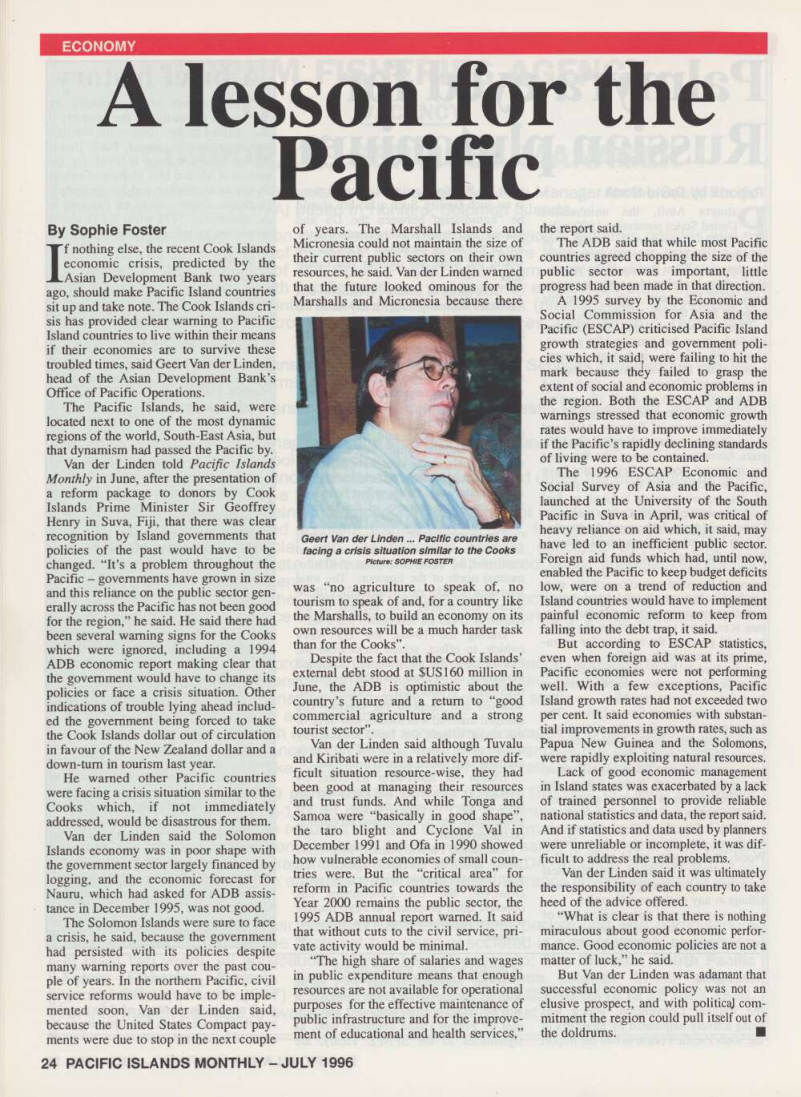
If nothing else, the recent Cook Islands economic crisis, predicted by the Asian Development Bank two years ago, should make Pacific Island countries sit up and take note. The Cook Islands cri sis has provided clear warning to Pacific Island countries to live within their means if their economies are to survive these troubled times, said Geert Van der Linden, head of the Asian Development Bank’s Office of Pacific Operations.
The Pacific Islands, he said, were located next to one of the most dynamic regions of the world, South-East Asia, but that dynamism had passed the Pacific by.
Van der Linden told Pacific Islands Monthly in June, after the presentation of a reform package to donors by Cook Islands Prime Minister Sir Geoffrey Henry in Suva, Fiji, that there was clear recognition by Island governments that policies of the past would have to be changed. “It’s a problem throughout the Pacific - governments have grown in size and this reliance on the public sector gen erally across the Pacific has not been good for the region,” he said. He said there had been several warning signs for the Cooks which were ignored, including a 1994 ADB economic report making clear that the government would have to change its policies or face a crisis situation. Other indications of trouble lying ahead includ ed the government being forced to take the Cook Islands dollar out of circulation in favour of the New Zealand dollar and a down-tum in tourism last year.
He warned other Pacific countries were facing a crisis situation similar to the Cooks which, if not immediately addressed, would be disastrous for them.
Van der Linden said the Solomon Islands economy was in poor shape with the government sector largely financed by logging, and the economic forecast for Nauru, which had asked for ADB assis tance in December 1995, was not good.
The Solomon Islands were sure to face a crisis, he said, because the government had persisted with its policies despite many warning reports over the past cou ple of years. In the northern Pacific, civil service reforms would have to be imple mented soon, Van der Linden said, because the United States Compact pay ments were due to stop in the next couple
of years. The Marshall Islands and Micronesia could not maintain the size of their current public sectors on their own resources, he said. Van der Linden warned that the future looked ominous for the Marshalls and Micronesia because there
was “no agriculture to speak of, no tourism to speak of and, for a country like the Marshalls, to build an economy on its own resources will be a much harder task than for the Cooks”.
Despite the fact that the Cook Islands’ external debt stood at SUSI6O million in June, the ADB is optimistic about the country’s future and a return to “good commercial agriculture and a strong tourist sector”.
Van der Linden said although Tuvalu and Kiribati were in a relatively more dif ficult situation resource-wise, they had been good at managing their resources and trust funds. And while Tonga and
Samoa were “basically in good shape”,
the taro blight and Cyclone Val in December 1991 and Ofa in 1990 showed how vulnerable economies of small coun tries were. But the “critical area” for reform in Pacific countries towards the Year 2000 remains the public sector, the 1995 ADB annual report warned. It said that without cuts to the civil service, pri vate activity would be minimal.
“The high share of salaries and wages
in public expenditure means that enough
resources are not available for operational purposes for the effective maintenance of public infrastructure and for the improve ment of educational and health services,”
the report said.
The ADB said that while most Pacific countries agreed chopping the size of the public sector was important, little progress had been made in that direction.
A 1995 survey by the Economic and Social Commission for Asia and the Pacific (ESCAP) criticised Pacific Island
growth strategies and government poli
cies which, it said, were failing to hit the mark because they failed to grasp the extent of social and economic problems in the region. Both the ESCAP and ADB warnings stressed that economic growth rates would have to improve immediately if the Pacific’s rapidly declining standards of living were to be contained.
The 1996 ESCAP Economic and Social Survey of Asia and the Pacific, launched at the University of the South Pacific in Suva in April, was critical of heavy reliance on aid which, it said, may have led to an inefficient public sector.
Foreign aid funds which had, until now, enabled the Pacific to keep budget deficits low, were on a trend of reduction and Island countries would have to implement painful economic reform to keep from falling into the debt trap, it said.
But according to ESCAP statistics, even when foreign aid was at its prime.
Pacific economies were not performing well. With a few exceptions, Pacific Island growth rates had not exceeded two per cent. It said economies with substan tial improvements in growth rates, such as Papua New Guinea and the Solomons, were rapidly exploiting natural resources.
Lack of good economic management in Island states was exacerbated by a lack of trained personnel to provide reliable national statistics and data, the report said.
And if statistics and data used by planners were unreliable or incomplete, it was dif ficult to address the real problems.
Van der Linden said it was ultimately the responsibility of each country to take heed of the advice offered.
“What is clear is that there is nothing miraculous about good economic perfor mance. Good economic policies are not a matter of luck,” he said.
But Van der Linden was adamant that successful economic policy was not an elusive prospect, and with politicaj com mitment the region could pull itself out of the doldrums. ■
Geert Van der Linden ... Pacific countries are facing a crisis situation similar to the Cooks Picture: SOPHIE FOSTER