Island of terror
pp. 14-15 · Read in the full issue
By Michael Field
From a bunker on the edge of a pic ture-postcard beach. Police Constable Alfred Gafui peers over the top of his light machine gun looking for the occasional scuds of rain which flit across the calm waters of ‘The Slot” - New Georgia Sound in the Solomon Islands.
“They come in the rain, some people think it is magic,” he says.
Fifty kilometres and a night later, rain passes over another village to be followed by the ominous sound of an outboard engine. Automatic weapons open up send ing tracer across the bay, chasing off the
mysterious intruders.
The Pacific’s running sore, Bougainville, dominates the area and now, in a piece of pure terror, Papua New Guinea is using a shadowy group to reach out across the border to cower Solomon Islanders.
It is little reported; PNG does not allow journalists onto Bougainville and the Solomon Islands discourages visits to the Shortland and Choiseul islands. Once there, local officials harass any stranger.
The area is familiar with war. The signs of the sacrifices paid by Allied and
“They come in the rain, some people think it's
magic”
Japanese soldiers are everywhere.
Bizarrely on the Shortlands, Japan’s last ing legacy is hundreds of concrete slabs, with footprints on them, and a hole in the middle - squat toilets.
Bougainville, home to around 168,000 people, was PNG’s single greatest source of wealth until 1989, thanks to the Panguna copper mine. Discontented with their share of the wealth, the Bougainville Revolutionary Army (BRA) called for independence. In the initial battles, BRA
was armed with relics from World War 11.
Their initial victories were rewarded with the modem firepower of the PNG Defence Forces (PNGDF) and both sides have fought themselves into a cruel stale mate.
The assessment on the Solomons side of the border is that PNG has reasserted control over a large part of Bougainville, except the central part of the island and much of the interior where BRA continues the struggle. PNG has created an interim
authority whose shadowy military arm is
known as Spear.
In the early part of the conflict, BRA was supplied from the Shortlands, ethni cally related to Bougainville, but now their access appears limited to Choiseul while civilian Bougainvilleans make the dangerous run across the Bougainville
Strait seeking medical help.
All atttempts to broker peace have failed and a ceasefire earlier this year was only honoured in the breach and by March, PNG Prime Minister Sir Julius Chan reopened the conflict.
Spear uses high-powered motor boats to raid the northern Solomons, seizing high frequency (HF) radios and supplies while driving the region’s people inland.
Solomon Airlines flies into tiny Balalai Island, dominated by its airstrip that runs from end to end. No one lives there and dense jungle edges the runway. As the plane touches down, a patrol led by Constable Leslie Ofu of the Royal Solomon Islands Police Field Force (PFF) melts into the undergrowth, peering out for an attack from Spear.
The weather station at the strip is a pile of ash, and the pilot and his other passen gers are anxious to get out quickly. The airline agent is too frightened to meet the plane. Spear got his radio a couple of weeks ago, he says, so transport to the main island is aboard a small aluminium
police patrol boat.
It’s like something out of a Vietnam war movie but the men are sharply
focused on the present, scanning the bay for Spear attacks, or those rain squalls.
Visitors to the Shortlands are taken to widow Sylvester Gali who lives on Faisi Island, a 48-ha piece of pure paradise with a rambling old guesthouse. Before
No one believes it was BRA - most of them were not
Bougainvilleans
Spear’s activity this year two German shortwave buffs broadcast from the house for a couple of weeks. It gives her hope for a tourism future. But then, in May, three government officials trying to assess the situation were kidnapped.
They were bundled across the water way to the local agent for the National Bank of the Solomon Islands.
There they were made to lie on the ground while the bank was robbed of its HF radio and its small amount of beer.
The money was untouched. One of the hostages, Robert Sisilio, sgid he was asleep in a guesthouse when people woke him up.
“I thought they were people who knew me well so I got up just to find out that they were dark men holding guns pointing at me and a torch direct onto my face,” he said.
One of the armed men told Sisilio, “You die today, we will kill you.”
Another of the hostages, government lawyer Prime Afeau, said he asked the men who they were and one replied: “We are BRA. We are cross with your govern ment for collaborating with the PNG gov ernment against us who are fighting for our land.” Gali said no one believes it was BRA - most of them were not Bougainvilleans. “There is fear here, oh yes. The people, they sleep in the bush,”
Gali says. “I am very frightened too.
“The government doesn’t have enough men here to protect us ... We saw the Spear canoe running past the point the other night. The police told us to leave but we just hid under our beds.”
There are about 1000 people on the Shortlands and most nights they leave their coastal homes and head into the bush to sleep. Their properties are guarded by the 50 police and PFF men and women who have built bunkers around each set tlement.
There is a strict 6pm-to-6am curfew any motor boat out after that brings down
tracer fire. People are fleeing. The prima ry school and health clinic have closed and government officials have left.
The bank is closed and imported food is running out. Disease, especially malar ia, is surging back into the anarchy Spear creates. Shortlands Immigration officer Billy Guporo is among those who fled back to Honiara.
“Spear say they want to kill me, pay back,” Guporo said. “I don’t know what payback is for - maybe they think we help BRA, but we don’t.”
He has a .22 rifle to shoot birds but intstead uses it nightly with police in the bunkers at Korovou.
“Around here people feel their lives are insecure, in danger. Most people are very fearful. Gardening, fishing - they don’t do those things any more. And they stay quiet during the day.” BRA no longer comes to the Shortlands, although Guporo says they were different from Spear.
“The BRA are a disciplined force.
When they come into Solomons waters they don’t carry their weapons, they respect our sovereignty.”
Before the current trouble started, Guporo processed visiting yachts but they have stopped coming. Bougainvilleans still arrive.
Last month a canoe arrived with two wounded children - one a girl who had had a bullet in her stomach for two weeks, another a boy with a wounded leg.
“Spear say they want
to kill me, payback”
“The people with them told us the Spear came to their village and shot at all the civilians.”
Peter Komasa cuts copra in more nor mal times but he has seen Spear go past his home. “There were seven men in the canoe; they were wearing bullet-proof
jackets.
They were armed with heavy weapons, machine guns, bomb launchers.” Komasa was convinced the men were PNG men,
not Bougainvilleans.
Former Governor-General Sir George Lepping, who comes from the Shortlands, told the Solomon Star people were scared to move around in their own villages or visit nearby ones.
“There is no peace, no free movement, no commercial activity and villagers can not go out fishing and now live in the bush,” he said. “The result of this is that there are no water facilities and good san itation in the bush camps, which could result in epidemics of diseases.”
Adding to the tension, big earthquakes
routinely roll through. The guardian angel
is the Australian-built Solomons patrol
boat, Auki, not much bigger than the PTIO9 a young John F Kennedy piloted around the waters 50 years ago.
“When we moor off a village the peo ple come out and tell us they will have a good night’s sleep,” an Auki officer, who asked not to be identified, said.
Only the night before, the Auki had managed to pick up on radar the outboard motor on the fibreglass Spear boat. They gave chase and although the Auki can do 25 knots, it seldom manages it in an area rich in navigation hazards.
Their charts have indentified Mamalohu, Turatao and Rantan islands, between Bougainville and the sea border, as the Spear bases. The Auki officer said they had seen Spear people on Turatao mixing with PNG navy men.
Prime Minister Solomon Mamaloni has been largely silent on the border problems and in Honiara, 520 kilometres to the southeast, there is an air of tired indiffer ence.
But a Spear man has defected and told the government the eight stolen HF radios are now at the Arawa PNGDF base on Bougainville and at Turatao.
“It was further revealed that these radios are being used by the Spear group to penetrate the daily frequencies of Solomon Airlines, Western Province, Choiseul and Telekom,” Mamaloni said in a statement. The navy officer claimed the PNG strategy now appears to be to carry the war across the border and down BRA’s perceived supply line in the Solomons,
thus the radio seizures in order to listen to
regional movements.
When Solomon Airlines fails to return to Balalai Island, the only alternative is a gruelling 75-kilometre trip across the Bougainville Strait in the small police patrol boat to Taro Island at the top end of the Solomons at Choiseul.
Halfway across, the Taro patrol comes out to meet the Shortlands patrol and pas sengers are swapped. Neither boat has life-jackets or radio - but there is plenty of firepower.
Last month. Taro, a sweet little village complete with a soccer pitch on the edge of a stunning lagoon, was evacuated by the authorities. Intelligence warned a Spear raid was imminent. It came and two HF radios were taken.
Now the people have returned, but it’s the same as on the Shortlands - curfews and tension. It is incredibly black and the rain rolls in from the sea and then clears.
Suddenly the village as one is awake in an instant as, first, a single appalling loud shot rings out followed by the steady rhythm of automatic-weapons fire. In the moments between shots, the distant sound of an outboard motor can be heard.
Tracer fire grasps out to it but the moment passes, the mystery deepens.
Next morning, two passengers waiting for the irregular plane connection sit on the beach at the end of the runway - and are promptly dragged over to the police.
“Sitting on the beach is forbidden here, it is very suspicious,” a Taro elder says. ■
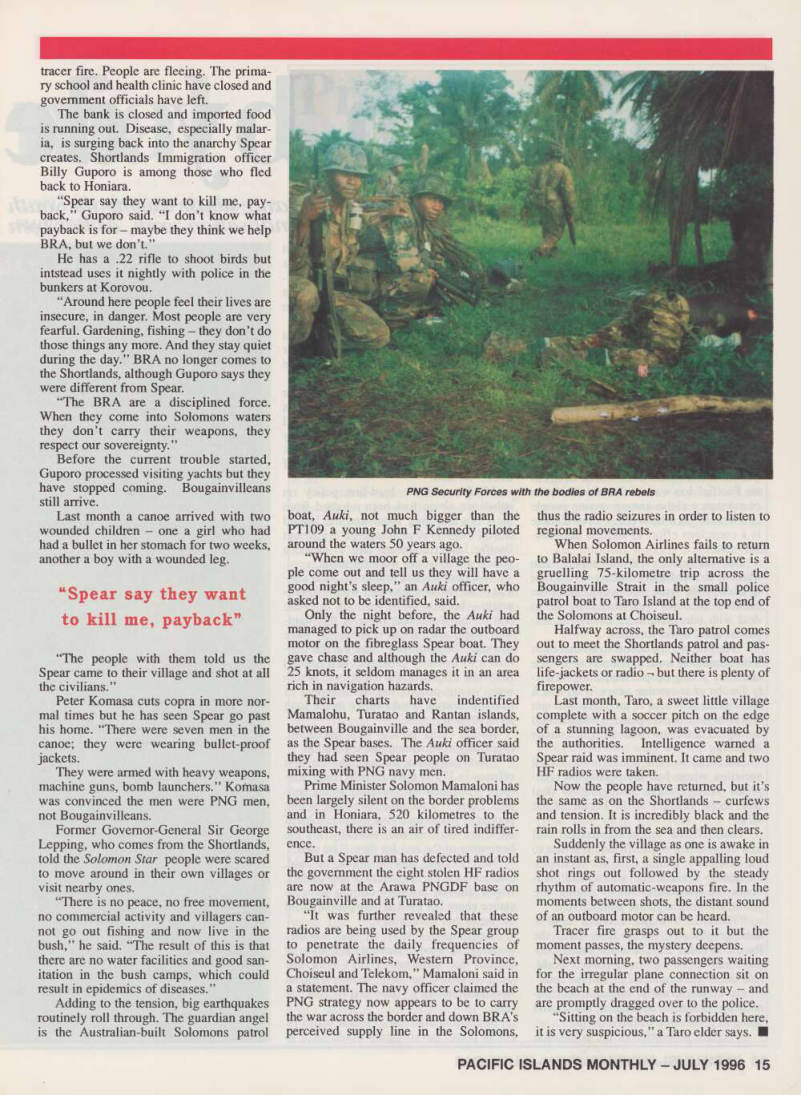
PNG Security Forces with the bodies of BRA rebels