Human rights
pp. 12-13 · Read in the full issue

By a Special Correspondent
Reports of human rights violations on Bougainville have once again been hot in the news in recent months - resulting from increased activi ties of both the Papua New Guinea
Security Forces and Bougainville
Revolutionary Army rebels since the lift ing of the ceasefire on March 23.
Although details of the many reports of abuses, committed by both the security forces and BRA, remained unconfirmed, strong indications exist that the violations are continuing. Among the many reports, recently, on May 7, Bougainvillean lead ers expressed outrage over the alleged ill treatment of former member of parlia ment and provincial secretary Sam Tulo and provincial peace co-ordinator James Togel by defence force soldiers. Both men, who are the key facilitors of the gov ernment’s peace efforts, suffered phsyco logical effects after being held at gunpoint by soldiers.
Tulo was detained for reporting ill treatment of Buka and Northwest Interim Authority people to the government fol lowing the lifting of the ceasefire and the imposition of a restriction of trade, travel and bulk orders of foodstuff. Togel was held for planning a trip the Solomon Islands to see Bishop Gregory Singkai of the Catholic Church. Tulo and other Buka leaders were subjected to similar treat ment by BRA members during the heat of the crisis. The two leaders were later released, however, at about the same time.
It was also reported that a security forces non-commssioned officer and four resis tance fighters were in BRA captivity in Oria, South Bougainville. They were captured in late April and reported to be in captivity since then.
The seriousness of the situations was
highlighted by Wewak MP and outspoken
human rights layer Bernard Narokobi on May 8. Narokobi was particularly critical of the involvement of the military in the detention and interrogation of civilians on Bougainville. He said; “Bougainville is still under civilian authorities’ control. It has not been handed over to military con trol.”
Narokobi, the appropriate authority to oversee the Bougainville situation, was the police commissioner.
“It is highly dangerous and definitely
unconstitutional to be acting in de facto as if the province is under an emergency. It is not the military that is at fault, it is the government. The government must give clear instructions and guiding principles
about how and where the military is engaged,” he said. Narokobi said if the government wished to engage the military in full, it must declare a state of emergen cy or make new laws to make the police force, defence force and the correctional services work as one force. “In the absence of that, I must warn that we are bordering on a very serious violation of human rights,” he said.
Concern has also been sparked by what appeared to be stunning revelations by the United Nations Human Rights Commission in a report released in May.
The report, by special rapporteur Waly N’diaye, who visited Bougainville in
October 1995, highlighted gross disregard of people’s rights, mainly by the Papua New Guinea Security Forces in the exe cution of their duties. Among other viola tions, the report said between the begin ning of 1991 and October 1995, at least 64 persons were believed to have been
extrajudicially executed by the Papua
New Guinea Defence Force, some of them being beaten or cut with knives.
“Other victims have been tied to the back of trucks and dragged along the road before being shot and killed. Bodies are reported to have been dumped at sea while others are said to have been covered with rubber tyres and burnt,” the report
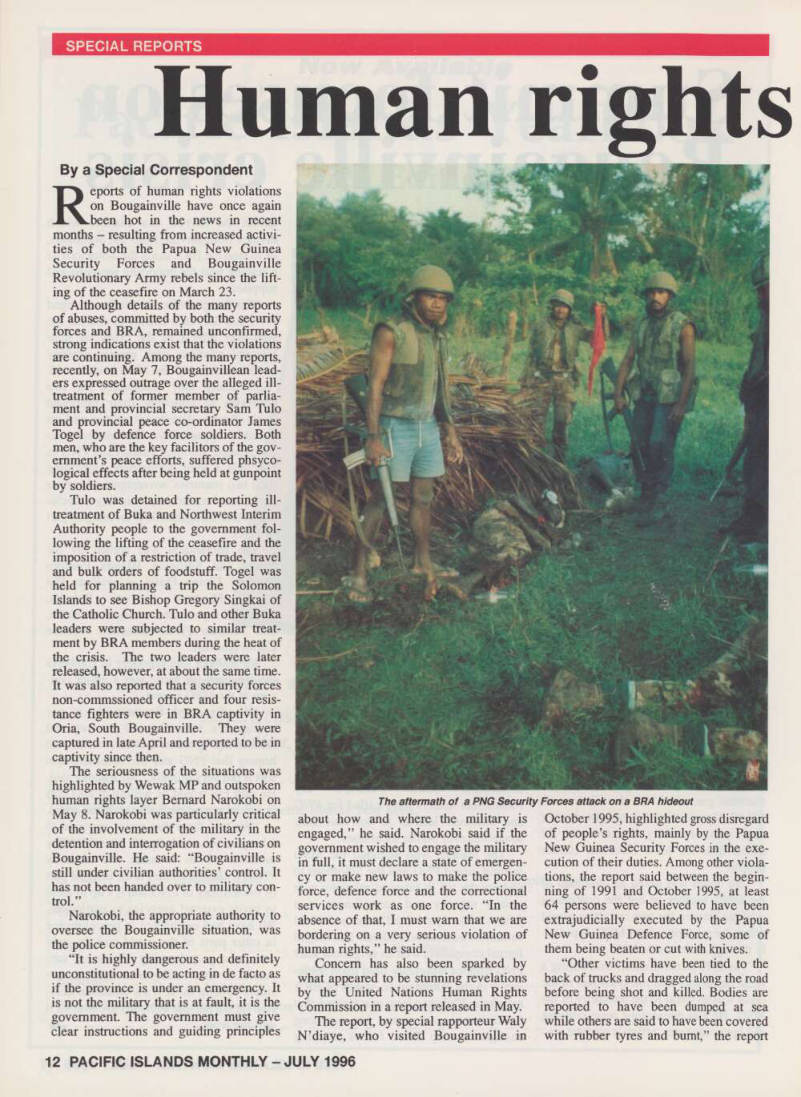
The aftermath of a PNG Security Forces attack on a BRA hideout
said. It said people killed extrajudicially included “members or suspected mem bers of the BRA”.
“Individuals attempting to cross over to Solomon Islands, including unarmed civilians, have also been the victims of extrajudicial executions by the PNGDF,” the report said.
Allegations were made that some peo ple in care centres did not have freedom of movement and were subject to torture, harassment and ill-treatment by those in charge of care centres, security forces and rebels who attacked the centres and killed persons living in them.
Apart from the UN allegations, what remains unarguably true is that while some factual information can be estab lished about the number of security forces injured or killed in action on Bougainville, the same cannot be said for the BRA casualties. Although the allega tions may appear serious, they may not in fact be so if reports about Prime Minister Sir Julius Chan’s comments on PNG’s international image following a UN human rights session in March carry any
truth. The PM described as “positive” discussion between a PNG delegation and UN representatives during the 52nd ses sion of the Human Rights Commission in Geneva, Switzerland. The comments draw into question the position of the UN Human Rights Commission over the seri ousness of the allegations in its report.
Sir Julius said the response was posi tive towards PNG’s record in upholding human rights, and on the peace process embarked on Bougainville. “It is now becoming more evident to the interna tional community that our peace efforts on Bougainville were deliberately sabo taged by a new few criminal elements
hell-bent on destroying a lasting peaceful
resolution for their own self-centred greed,” he said.
He said the voice of the so-called BRA sympathisers, posing as non-govemment organisations, was fading readily as indicative of the lack of willingness by the members of the commission to enter tain rhetoric and hypocrisy on the Bougainville situation. “To put the record straight, when the 52nd session opened in
late March, Bougainville was a non-con troversial issue on an already bloated agenda focusing on violations of human rights around the world. The world is tired of finger-pointing. What they demand are unbaised reports on efforts undertaken by governments and by the global community as a whole. On Bougainville, as we have stated numerous times, the chronology of extensive peace initiatives was reflected accordingly as
transparent, participatory and genuine,”
Sir Julius was reported as saying.
He also announced government’s decision to establish a National Human Rights Commission. He said this was a major step towards institutionalisation of its efforts in promoting and protecting the rights of people.
Among other areas of concern, the alleged rights violations on Bougainville are likely to be the key focus for the com mission. It is hoped the commission will help put the record straight as to who is telling the truth about the abuses on the island. ■