No barrier
pp. 57-58 · Read in the full issue
Yachting
No barrier to adventure
By Sally Andrew
As the sun began to break over the hills of Waiheke Island, a glee of dolphins gambolled into the anchorage. They must have heard our chain rumbling up from the depths of Matiatia Bay.
The morning air was cold. I bundled up in long Johns and foul weather gear, hat and gloves and slowly sipped a cup of hot tea.
We motorsailed for an hour before feel ing awake enough to hoist the spinnaker.
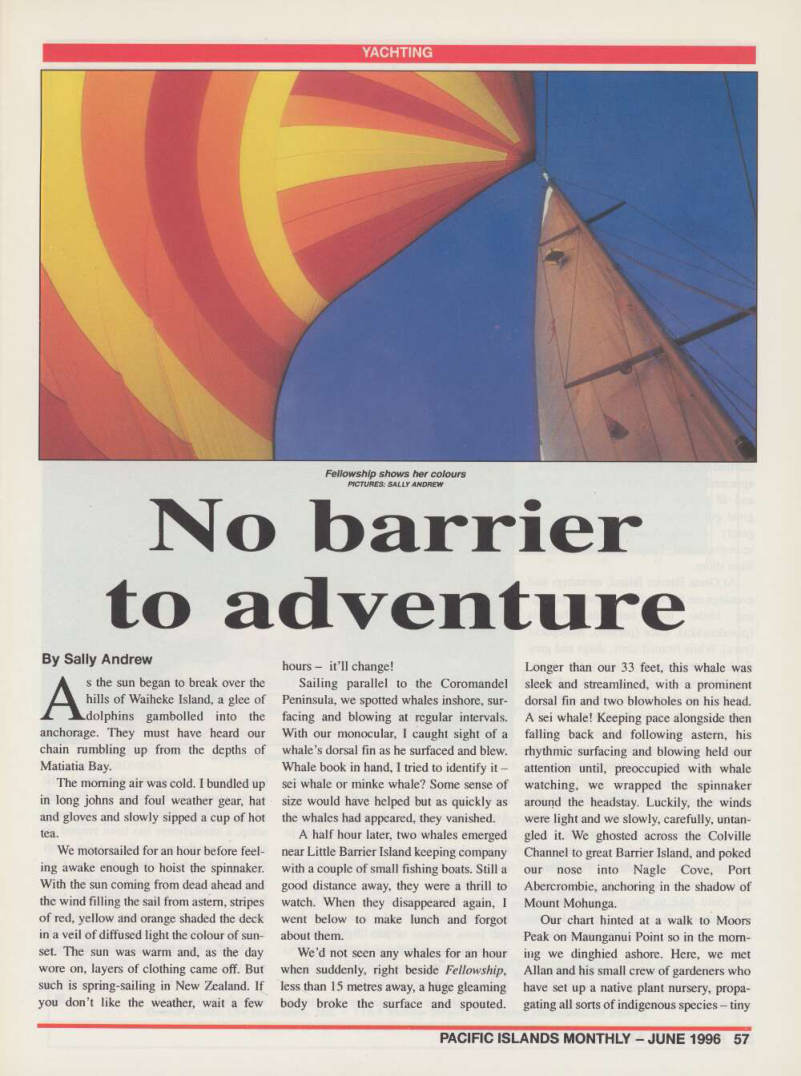
With the sun coming from dead ahead and the wind filling the sail from astern, stripes of red, yellow and orange shaded the deck in a veil of diffused light the colour of sun set. The sun was warm and, as the day wore on, layers of clothing came off. But such is spring-sailing in New Zealand. If you don’t like the weather, wait a few
hours - it’ll change!
Sailing parallel to the Coromandel Peninsula, we spotted whales inshore, sur
facing and blowing at regular intervals.
With our monocular, I caught sight of a whale’s dorsal fin as he surfaced and blew.
Whale book in hand, I tried to identify it sei whale or minke whale? Some sense of size would have helped but as quickly as the whales had appeared, they vanished.
A half hour later, two whales emerged near Little Barrier Island keeping company with a couple of small fishing boats. Still a good distance away, they were a thrill to
watch. When they disappeared again, I
went below to make lunch and forgot about them.
We’d not seen any whales for an hour when suddenly, right beside Fellowship, less than 15 metres away, a huge gleaming body broke the surface and spouted.
Longer than our 33 feet, this whale was sleek and streamlined, with a prominent dorsal fin and two blowholes on his head.
A sei whale! Keeping pace alongside then falling back and following astern, his rhythmic surfacing and blowing held our attention until, preoccupied with whale
watching, we wrapped the spinnaker
around the headstay. Luckily, the winds were light and we slowly, carefully, untan gled it. We ghosted across the Colville Channel to great Barrier Island, and poked our nose into Nagle Cove, Port Abercrombie, anchoring in the shadow of
Mount Mohunga.
Our chart hinted at a walk to Moors Peak on Maunganui Point so in the morn ing we dinghied ashore. Here, we met Allan and his small crew of gardeners who have set up a native plant nursery, propa gating all sorts of indigenous species - tiny
Fellowship shows her colours
Pictures: Sally Andrew
cabbage trees, pohutakawa trees, flax plants, nihau palms, Norfolk pines, all of which are being transplanted around the cove. The planting of more flax would cre ate new nesting areas for blue penguins.
The hills were alive, not with music, but with gorse and kowhai trees singing out in full blooming yellow; sheep, lambs and rabbits skipping up and down precari ous trails; horses and cows slurping water out of bath-tub troughs. An old road led to a rocky outcrop and vies of the Pacific Ocean and the islands of the Hauraki Gulf.
After our walk, we embarked on a coastal mission to look for dinner. We rowed around tiny Oyster Island and its one tall Norfolk pine, then across to a promising low-water islet to harvest green lipped mussels. The swell was non-exis tent, the water like polished glass, I beached the dinghy and scooted around the point, eyes zeroing in on the biggest of mussels. Engrossed in my foraging, I was startled when a school of dolphins
appeared, blowing and jumping, singly
and in groups, splashing at times with great gushing geysers of white water, or
gently slipping through the water with
scarce a sound. They were barely 10 feet from shore.
At Great Barrier Island, mornings and evenings are filled with a chorus of gossip ing birds: tuis, bellbirds, fantails
(piwakawaka), kaka (parrots), moreporks
(ruru). White fronted terns, shags and grey ducks (parera) quietly survey the shore line. Meanwhile, brilliant blue kingfishers (kotare) dart from bush to tree and back again, gannets dive headlong into the water then bob back up and oyster catchers prowl around the shallows at low tide. At sunset we sat in the cockpit, serenaded by blue penguins braying in shoreline nests made of grasses and sticks (in caves and under rocks), in burrows under tree stumps, and in small bushes and flax.
Departing Nagle Cove in the early
morning light, we headed to Port Fitzroy and anchored at Kaiarara Bay. From here, we could hike to the top of Hirakimata (Mt. Hobson). Boots laced up, we left our dinghy ashore at Blairs Landing and went
walking.
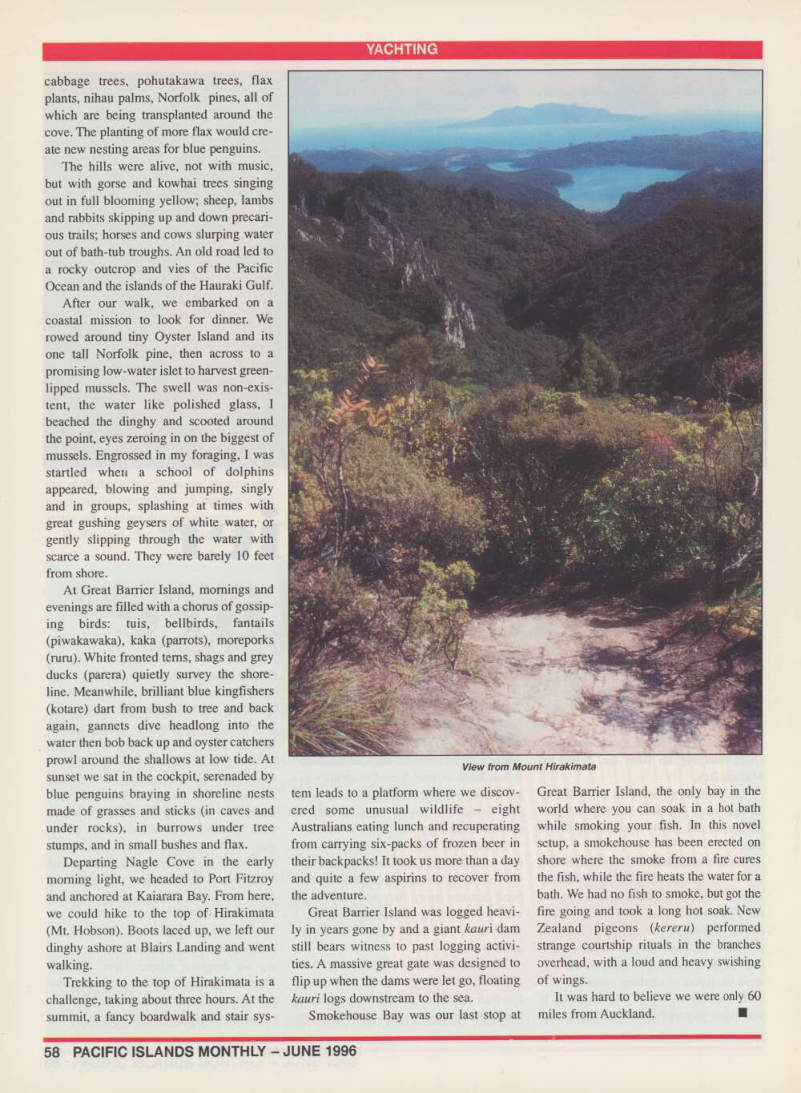
Trekking to the top of Hirakimata is a challenge, taking about three hours. At the summit, a fancy boardwalk and stair sys-
tern leads to a platform where we discov ered some unusual wildlife - eight Australians eating lunch and recuperating from carrying six-packs of frozen beer in their backpacks! It took us more than a day and quite a few aspirins to recover from the adventure.
Great Barrier Island was logged heavi ly in years gone by and a giant kauri dam still bears witness to past logging activi ties. A massive great gate was designed to flip up when the dams were let go, floating kauri logs downstream to the sea.
Smokehouse Bay was our last stop at
Great Barrier Island, the only bay in the world where you can soak in a hot bath while smoking your fish. In this novel setup, a smokehouse has been erected on shore where the smoke from a fire cures the fish, while the fire heats the water for a bath. We had no fish to smoke, but got the fire going and took a long hot soak. New Zealand pigeons ( kereru ) performed strange courtship rituals in the branches overhead, with a loud and heavy swishing
of wings.
It was hard to believe we were only 60 miles from Auckland. I
View from Mount Hirakimata