of the trail
pp. 54-56 · Read in the full issue
Sports
At the end of the trail
By Atama Raganivatu
There are few inhabited centres around the civilised world which provide greater contrasts than Nukunuku and Widnes.
Nukunuku is a traditional Tongan vil lage where little has really changed this century and the pace of life remains leisurely. An administrative centre, it is known locally for its large Wesleyan sec ondary school and, conversely, as the site of a massacre during the 1837 civil war.
Widnes lies in the heart of bustling, heavily-industrialised north-west England.
Its major claims to fame are a huge chemi cal plant, as the place where American singer-songwriter Paul Simon wrote his wistful classic Homeward Bound and for being the base of the Widnes Rugby League Football Club.
However, there is a link between the two. It takes the substantial form of recent ly-retired rugby player Emosi Koloto - or “Moose”, as Widnes RLFC supporters affectionately call him.
Koloto was bom in Nukunuku, the son of a clergyman attached to the Wesleyan secondary school, and only left when in his mid-teens; ostensibly to provide moral support for his brother who had won a scholarship to attend college in Hamilton, New Zealand.
Koloto’s rugby union career, which had already shown much promise in Tonga, began to blossom in the new environment.
A key member of the powerful Palmerston North Boys’ High School XV, he repre sented New Zealand Secondary Schools in 1983.
Soon after leaving PNBHS, Koloto was called up for first-class duty and his formi dable frame (six feet in height, sixteen stones in weight) quickly became a famil iar and fearsome sight around New
Zealand’s premier rugby union grounds.
His forte in those days was a powerful surge upfield, which would require several
tacklers to halt, followed by the perfect presentation of the ball for team-mates fol lowing up. Almost single-handedly, he kept Manawatu in the National Championship Division One.
Koloto had originally intended to return to Tonga permanently upon completing his secondary school education and spent a couple of New Zealand off-seasons in the Kingdom during the mid 1980’s. This was sufficient time for Tongan Rugby Union officials to regard him as a local resident and they included the dynamic young num ber eight in their national side which made a brief tour to Western Samoa.
However, soon after returning from Apia, Koloto decided that his immediate future lay in New Zealand and, due to the policy the TRU then had in place which
prohibited overseas-based players appear
ing in their sides, he set his sights upon becoming an All Black.
Believing that a move away from unfashionable Manawatu would aid his international aspirations, Koloto accepted an offer to move to Wellington. Without their star player, Manawatu were relegated from Division One and have yet to return.
Had he been attached to a more glamorous side sooner, an All Black call-up would,
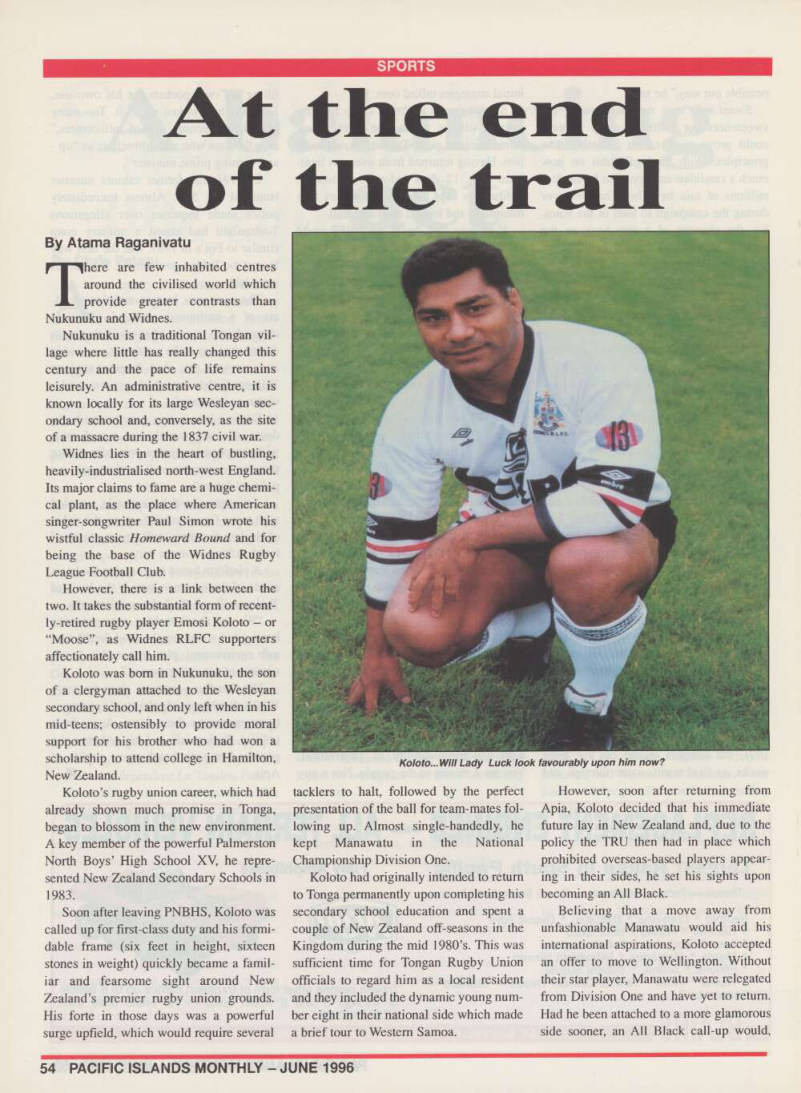
Koloto...Will Lady Luck look favourably upon him now?
surely, have been a certainty and, alas, circumstances did not permit him suffi cient time to force his way into rugby union’s most famous line-up whilst serv ing Wellington. - An appearance for the capital city’s representative side against the touring Welsh national team in 1988 changed Koloto’s life. He demolished the helpless Welshmen that afternoon and amongst those awestruck by his performance was Widnes coach Doug Laughton, who watched the game on television in Britain and then booked a plane flight to New Zealand.
Koloto’s sole source of income then came from doing maintenance work in clubrooms. When Laughton waved Widnes’ chequebook under his nose, he found himself facing a dilemma.
Bitterly disappointed when failing to win a berth in New Zealand’s World Cup winning side the previous year, Koloto had been informed off-the-record by an All Black selector that he was on course to gain a place in their next touring party as understudy to the legendary Wayne “Buck” Shelford. But, Widnes’ proposi tion was simply too good to reject and the opportunity to become the first Tongan All Black had to be spumed. Six years later, that honour went to Jonah Lomu.
Koloto has never had any real reason to regret his move. He instantly became a firm favourite amongst Widnes fans and, almost as rapidly, earned respect through out British rugby league circles - to whom he was a complete unknown until landing amongst them. With him in their ranks, “The Chernies” won a string of honours, including two British Premierships, two Charity Shields and one Lancashire Cup.
All of these were captured before Koloto gained a place in the New Zealand national side. It amazed many that the Kiwi selectors were so tardy in drafting him. He was certainly keen enough in chasing caps and spent two British close seasons Down Under, playing for the Wainuiomata club of Wellington, press ing his claim. The second of these stints, in 1991, bore fruit.
He eventually wore the black jersey of his adopted country on five occasions.
The most memorable of these was a
record-breaking 24-8 win over world champions Australia in Melbourne.
Tragically, a recurring neck injury pre
vented Koloto from gaining any subse quent honours on either domestic or inter national fronts. It had already kept him out of Widnes’ 1989 World Cup
Championship winning combination and,
four years later, destroyed his only chance to appear in British rugby league’s annual
showpiece, the Challenge Cup final at
Wembly. Less than 12 months after mak ing a hard-earned Kiwi debut, he was regarded as too fragile for further appear ances.
In 1993, Widnes’ club doctor advised him to quit the game. However, he battled on for another two seasons. Being classi fied as insufficiently fit to be even consid ered for Tonga’s World Cup campaign last year proved to be the final straw that per suaded him to hang up his boots. Denial of opportunities to reward his devoted admir ers in Nukunuku with some sterling dis plays while wearing the Kingdom’s red jersey was a bitter disappointment.
Realisation that the people back in
Nukunuku were eagerly keeping abreast of his exploits was always a motivating factor for Koloto.
“My home village is never far from my mind whenever I prepare for a game,” he once said.
“I am aware all those there have fol lowed my career closely from its outset and am very conscious I am representing them, as well as myself.”
But, the warm-hearted Widnes towns folk, who long ago adopted “Moose” as one of their own, will miss Koloto just as much as the NukunuKuans.
Amongst Koloto’s legion of fans is cur rent English national team coach Phil Larder, who succeeded Laughton as Widnes coach in 1992. He paid the follow ing tribute recently; “Emosi was more than just a rugby league player, he was a magi cian. He had uncanny vision - he would angle towards the comer flag and then pop a real precision pass inside without look ing and you’d wonder: ‘How on earth could he have done that? I don’t know of another forward, in league or union, who had his handling skills. He had fingertip
control of the ball and could almost make it talk.’”
Laughton, however, preferred to
remember Koloto’s versatility. “Emosi had clever hands,” he agreed. “But, there was also an extraordinary balance and the abil ity to produce both brilliant side-steps and excellent dummies.”
With just a little more luck, Koloto would now be acknowledged far and wide as one of the truly greats in either rugby league or rugby union; possibly both. Yet, it seems likely he will only be truly revered in Nukunuku and Widnes. Koloto, though, can have few regrets as he looks back over his career.
His concern is now the future. For sev eral years, he expressed a desire to coach rugby league in Tonga. But, having recent ly married a Widnes girl and nearing the completion of a university degree in finance, Koloto has several other options to consider.
Whatever lies ahead of Emosi Koloto, let us hope that Dame Fortune is a little more sympathetic to him in this than she was during his rugby career. ■