Changes in the air
p. 40 · Read in the full issue
The “Pacific Wave” is a symbol of Air New Zealand’s changes to the way it operates and looks, said Pacific Islands region manager Greg Shanaghan.
Air New Zealand announced a wave of change, a new way, and a new attitude for the airline, he said, focusing more and more on customer service.
Shanaghan said the airline and travel industry was very competitive with cus tomers having many choices when decid ing on which airline to travel with.
“Giving the best standards of service and product is the way we can make Air New Zealand the customers’ first choice,” he said.
He said the reason for the changes was to create a contemporary design which reflected the airline’s South Pacific origin.
“A clean white body and the wave sym bol are a contemporary treatment - the meeting of sea and shore around the islands of the Pacific,” he said.
“The choice of Korn, slightly modified to soften its profile, is essential to reflect Air New Zealand’s heritage.”
“The graduated colour on the tail is a bold statement which depicts both the air line’s colour palette and the balance between the sea and the sky,” he said.
The airline plans to enhance future communication through new lettering which is cleaner, classic and more readable and legible.
“The “Pacific Waves” running through the band also symbolise the wave of change running through Air New Zealand,” Shanaghan said.
The strongest signal of the airline’s changes is the wave on the exterior of the aircraft. However, changes have also included progressively refurbishing the jet fleet and enhancing the quality of service in all areas of business.
The changes that can be expected are the new painted aircraft exterior, which will happen progressively as aircraft
become available for servicing and the refurbishment of the interior of its interna tional fleet.
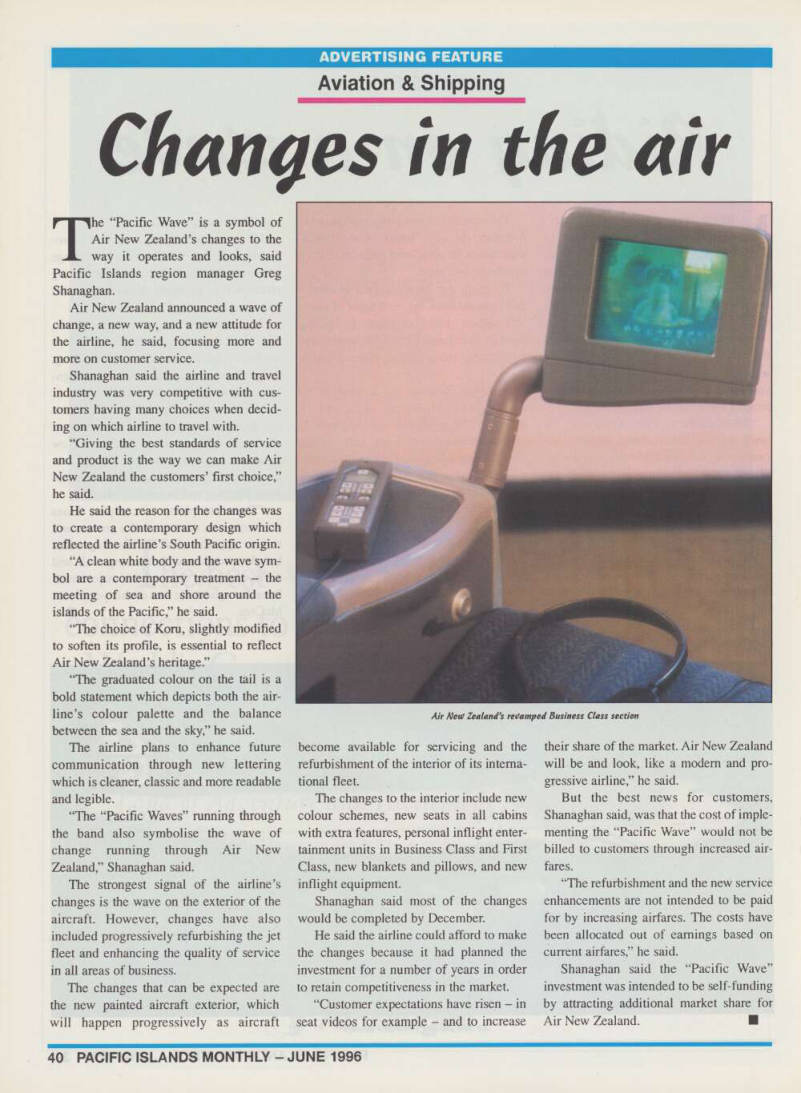
The changes to the interior include new colour schemes, new seats in all cabins with extra features, personal inflight enter tainment units in Business Class and First Class, new blankets and pillows, and new
inflight equipment.
Shanaghan said most of the changes would be completed by December.
He said the airline could afford to make the changes because it had planned the investment for a number of years in order to retain competitiveness in the market.
“Customer expectations have risen - in seat videos for example - and to increase
their share of the market. Air New Zealand will be and look, like a modem and pro gressive airline,” he said.
But the best news for customers, Shanaghan said, was that the cost of imple menting the “Pacific Wave” would not be billed to customers through increased air fares.
“The refurbishment and the new service enhancements are not intended to be paid for by increasing airfares. The costs have been allocated out of earnings based on current airfares,” he said.
Shanaghan said the “Pacific Wave” investment was intended to be self-funding by attracting additional market share for Air New Zealand. ■
Air New Zealand's revamped Business Class section