Riding on a wave
p. 39 · Read in the full issue
More than a year’s careful plan ning was behind the launch of the “Pacific Wave” to introduce Air New Zealand’s new customer service features and new-look livery, says the
company’s managing director Jim
McCrea.
After several months of preliminary research, work started in earnest at the beginning of 1995 when Davies/Baron won the airline’s design contract through a
competitive tendering process.
“What started as a project to meet the needs of our international airline cus tomers has developed into one that covers all our domestic and international opera tions in the air and on the ground,” McCrea said.
“This happened because we recognised the power of the “Pacific Wave” to involve all our people in the process of enhancing customer service and because we realised an integrated approach across all our busi ness activity would be needed to deliver the kind of start-to-end care our customers have been seeking,” he added.
The majority of key projects required to introduce the key “Pacific Wave” initia tives would be completed over the next 18 months to two years.
By then, Air New Zealand estimates that it would have incurred costs of about $5O million, which it sought to re-coup through its enhanced customer appeal and by winning more market share from its rivals.
Air New Zealand has a total of 10 Boeing 747’5, 11 Boeing 767’5, and 12 Boeing 737’s to repaint and refurbish to varying degrees before the bulk of the physical upgrading work is completed.
The project to refurbish Air New Zealand International cabin interiors is expected to be finished by the end of the year.
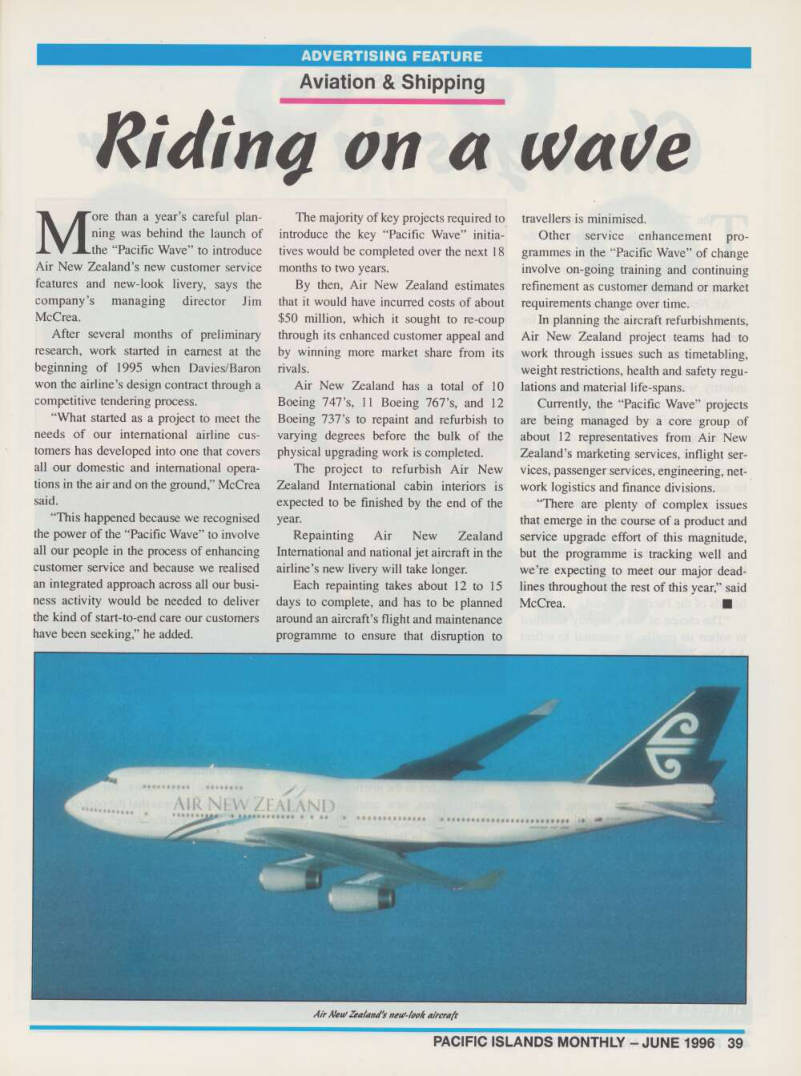
Repainting Air New Zealand International and national jet aircraft in the airline’s new livery will take longer.
Each repainting takes about 12 to 15 days to complete, and has to be planned around an aircraft’s flight and maintenance programme to ensure that disruption to
travellers is minimised.
Other service enhancement pro grammes in the “Pacific Wave” of change involve on-going training and continuing refinement as customer demand or market requirements change over time.
In planning the aircraft refurbishments.
Air New Zealand project teams had to work through issues such as timetabling, weight restrictions, health and safety regu lations and material life-spans.
Currently, the “Pacific Wave” projects are being managed by a core group of about 12 representatives from Air New Zealand’s marketing services, inflight ser vices, passenger services, engineering, net work logistics and finance divisions.
“There are plenty of complex issues that emerge in the course of a product and service upgrade effort of this magnitude, but the programme is tracking well and we’re expecting to meet our major dead lines throughout the rest of this year,” said McCrea. ■
Air New Zealand’s new-look aircraft