Rabaul,
pp. 34-35 · Read in the full issue
after the fury
By Jimmy Hall
Rabaul, once a popular port amongst cruisers to Papua New Guinea, suf fered a setback in September 1994, when a volcanic emption buried the city under two metres of ash, dirt, mud and stone. Located at the eastern end of New Britain Island, Rabaul has been called one of the most picturesque harbours of the world, and is no stranger to volcanic activ
ity.
Just after sunrise on September 19, the two volcanoes, Tavurvur and Vulcan, erupted. It was a catastrophic disaster for the citizens of Rabaul, most of whom lost everything they couldn’t carry with them
during the hurried evacuation. But the eruption was also just another subterranean belch in an area with a long and eruptive history.
Situated on what geologists call the Bismarck Microplate, New Britain is one of the least stable places on the planet, experiencing thousands of earthquakes a year. The locals have a saying that an erup tion will happen once every lifetime. And volcanologists agree this recent eruption won’t be the last.
The harbour of Rabaul sits in a deep volcanic bay formed during a 536 AD eruption that spewed so much debris into the atmosphere it darkened the sky over
Europe.
And the violence never stopped.
In 1937, Vulcan erupted killing 500 people. With such a past and a prediction for more of the same, one wonders if relo cating isn’t a better plan than rebuilding.
However, with such an ideal harbour and many buildings and piers that survived the eruption, they say there is no option but to carry on. And if an eruption happens every 50 years, well, Rabaul is so nice it’s just something that must be endured.
Although it may be a while before Rabaul attracts the tourists it once did, there is no reason for cruisers to avoid the port. The anchorage was not affected and it
is still a port of entry. Fuel, water, and propane are readily available. Hardware stores, machine shops, and grocery stores have reopened. Many of the businesses have relocated to nearby Kokopo and if what you need isn’t in Rabaul it may be just down the road. (I even had my video
camera repaired).
Banks (ANZ, Westpac, PNGBC) are in Kokopo, as well as the Post Office and telephones. These services will eventually be restored in Rabaul. Even plans for sal vaging the Yacht Club are in the works. In the meantime, the Kaiwuna Hotel, now up and running and just minutes from the anchorage, has a bar, restaurant and swim
ming pool.
No, there is definitely no reason for a yacht to cancel Rabaul from its cruising itinerary. In fact, quite the opposite may be true.
Walking through parts of the city that haven’t yet been rebuilt is fascinating.
With the weight of the falling ash and mud being equal to that of wet concrete, the devastation was awesome. Large buildings of steel I-beam construction are now unidentifiable masses of twisted metal.
The entire banking district and millions of Kina were buried, some of the money too deep to recover and now under 24-hour guard. Parking lots are full of cars buried to their roof tops.
In more than a blink of her lifetime, Mother Nature, in the form of Taia - God of the volcano, has destroyed almost three generations of hard work. It may sound a bit morbid but in the wake of natural dis aster, often lies the impressive spectacle of devastation. This is certainly true of Rabaul.
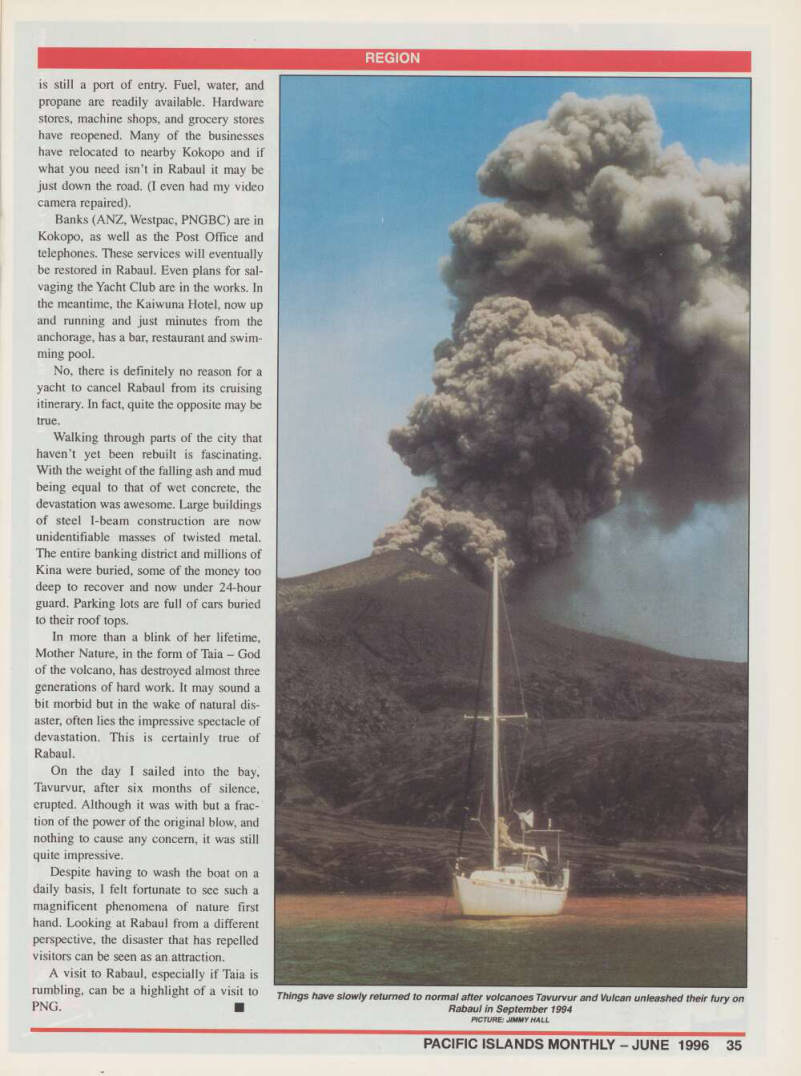
On the day I sailed into the bay, Tavurvur, after six months of silence, erupted. Although it was with but a frac tion of the power of the original blow, and nothing to cause any concern, it was still
quite impressive.
Despite having to wash the boat on a daily basis, I felt fortunate to see such a magnificent phenomena of nature first hand. Looking at Rabaul from a different perspective, the disaster that has repelled visitors can be seen as an attraction.
A visit to Rabaul, especially if Taia is rumbling, can be a highlight of a visit to
Png. ■
Things have slowly returned to normal after volcanoes Tavurvur and Vulcan unleashed their fury on Rabaul in September 1994