islands sex scandal
pp. 32-33 · Read in the full issue
Courts
Nobel laureate in islands sex scandal
By David North
Winning the Nobel Prize is one of the world’s highest honours.
Being accused of being a pae dophile (sexual abuser of children), is not.
Daniel Carleton Gajdusek, many of whose acknowledged scientific triumphs and apparent sexual conquests took place in the Pacific Islands, sadly, falls into both categories.
The 72-year-old Nobel laureate in Medicine, who works for the prestigious National Institute of Health (NIH) just out side of Washington, DC, has been charged with abusing one of the dozens of children
he brought back to the States to live with him after numerous trips through the South Pacific. Among the places he visited were the Federated States of Micronesia, Palau, Papua New Guinea and the Solomons.
The young man in this case, now in his early twenties, was a 14-year-old when Gajdusek “adopted” him and brought him to the US from Micronesia. Gajdusek (pronounced gah-doo-sek) had spent much time in Yap State of FSM and in various parts of PNG.
The young man, co-operating with the Federal Bureau of Investigation (FBI), is
said to have called Gajdusek on the phone and asked if he knew what a paedophile was; the reply was: “I am one.”
Gajdusek had never, as far as local authorities are concerned, adopted anyone.
Gajdusek’s medical discoveries were regarded as remarkably important by his peers hence the Nobel Prize but are dif ficult to describe, many dealt with degen erative brain diseases, such as the widely publicised (if not widely-spread) Mad Cow Disease, that has shocked Great Britain, and greatly reduced the consump tion of British beef. In fact, Gajdusek had just returned from an international confer
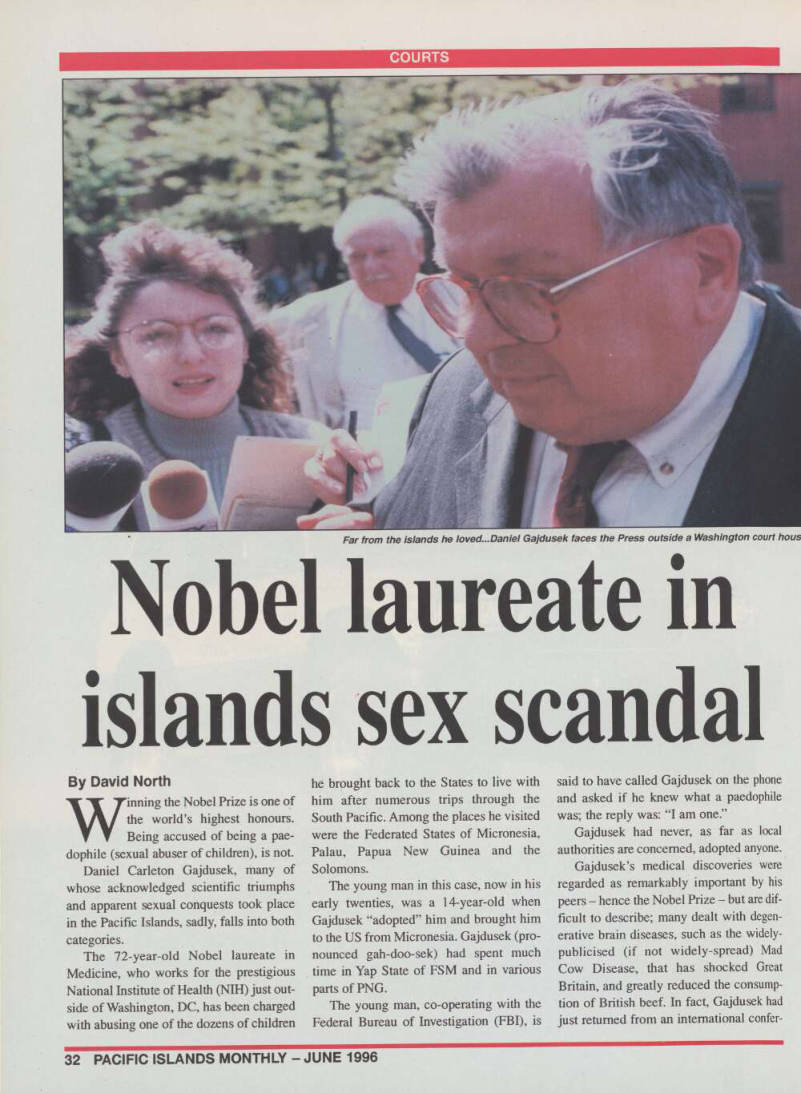
Far from the islands he loved...Daniel Gajdusek faces the Press outside a Washington court hous
ence on the subject, when the police arrest ed him outside his home in suburban Maryland.
A graduate of Harvard Medical School, he received his Nobel award for his research into neurological viruses. One of these was kuru, a condition which troubled PNG health officials for years; he explored the possibility that it was passed along through ritual cannibalism. Another sub ject of his research was the Creutzfeldt- Jakob disease, the human form of Mad Cow Disease; he was convinced it could be conveyed from animals to humans.
His work in the islands also included studies of neurological disorders in the Solomon Islands, including taking blood samples from among the 650 residents of Bellona (known as Mu Ngiki) a Polynesian-inhabited island in the largely Melanesian Solomons; the island lies 180 kilometres south of Guadalcanal.
Gajdusek was initially jailed with bail set at SUS 1,000,000. This was subsequent ly reduced to $U5350,000 and that sum was quickly rounded up by friends and col leagues.
He is now at home, awaiting trial.
Many of his peers at NIH rallied around him and called the charges ridiculous; the agency itself has, in effect, been silent.
Gajdusek is single, never married, and currently not in very good health, an argu ment his lawyers used to reduce bail.
Whatever else he may or may not have done with his island proteges, he apparent ly helped many of them to complete uni versity in the US and many of them subse quently returned to the islands to become leading citizens, according to the Washington Post.
One of these success stories, Josede Figirliyong, a former professor at the University of Guam, said in an interview with the Post, that he had lived with the physician for three years and that the older man had never made any advances to him.
PlM' s review of his written work in the National Library of Medicine and else where turned up two different kinds of prose: impenetrable scientific writing, apparently indecipherable to all but a few fellow neurologists, and free-flowing accounts of travel in the remoter parts of PNG and Palau that showed a strong inter est in the homosexual behaviour of young males.
For example, he studied a medical con dition he found among the “Hagahai, a 260-member group occupying an area totalling 750 square kilometres... along the northern banks of the Yuat River Gorge in Madang...” He said that this group, which had no contact with the West until 1983, had probably arrived in PNG centuries before the rest of the PNG people and were thus of special medical interest (because of minimal contact with other populations).
So far, so good, but when he talks about the science of the trip, the going gets tougher: “...two weeks after cocultivation with umbilical cord blood mononuclear cells, virus-specific intracytoplasmic fluo rescence was observed... this resulted... in the establishment of a long-term T-cell line, designated PNG-1 which expressed CD2 (99 per cent), CD3 (99 per cent)... and HLA-DR (90 per cent) surface mark ers...”
Readers wanting more on this experi ment should consult Proceedings of the National Academy of Science, USA February, 1991, pp. 1446-1450.
Gajdusek’s travel journals, however, are
more (as the scholars like to say) accessi ble. This from his description of a trip to PNG in 1969: “Nov. 3, Wabiri Hau Klap. The boys are interested in semen and on being friendly, holding hands with them or sitting inti mately beside them they reach for one’s genitals... They are trained to masturbate and fellate the adult males... Here too, when asked for words pertaining to sex or sexual anatomy everyone (in a group of boys) laughs and young boys run off. On the other hand, their overtures and actions make it clear that they know of and prac tise a great deal of sexual activity with the men...”
Two days later at Sedado Village (in PNG), he wrote: “...the boys present the young boys to the police and myself as sexual partners... they are not ashamed and quite openly solicit among the boys and men. The use of the tongue protruded from (the) mouth somewhat curled to indicate fellatio is a gesture they make publicly, and is new to me...”
In 1961, writing from Koror Island (Palau), and as quoted by the Post : “How much there is to gain if the fun and joy of childish play can be left uninhibited in adult life, without semantic twists into cat egories of bawdiness, perversion, lewd ness, sensuality, eroticism, unnaturalness, masochism and sadism.”
He often wrote, apparently approvingly, of tribes that do not attach disapproving western points of view about sex between men and boys.
According to those who have examined the Nobel Prize winner’s travel journals carefully, there are never any indications that he acted on the apparent easy avail ability of sexual relations with the young sters, but his prose certainly indicates a strong interest in the subject.
US law enforcement authorities appar ently had tried, in earlier years, to build a case against Gajdusek, but never could find anyone who would accuse him of sex ual abuse.
Whether the current charges will hold up in court is anyone’s guess, but at 72, ail ing from hypertension, and facing what may be a long and unpleasant trial in Maryland state courts, the Nobel laureate has probably made his last trip to the remote villages of the South Pacific. ■