Fiji notches
pp. 52-53 · Read in the full issue
narrow victory
By Andrew Kacimaiwai
Bright sunshine, large crowds and
improved performances from
Pacific Island teams combined to make the fourth Fiji International Sevens tournament in Suva in mid-March a mem orable event.
The tournament received a fairytale ending in the main final when Fiji met up with its Sevens arch-rivals New Zealand.
Fiji just managed to hold on to win 22-21.
And for other regional teams, there was a lot of satisfaction to be savoured as well.
The Cook Islands tasted success in the Tanoa (cup) championship final with a narrow 15-12 win over an improved
Solomon Islands side in the final.
In their opening game, the Solomons side shocked their more fancied Western Samoan opponents with a display of copy book Samoan-like tackling before suc cumbing 26-5 to them.
The defence was a strong trademark of the Solomon Islanders, not quite equalled by their attacking abilities.
In the main (Tabua) quarter-finals, a tough Papua New Guinea side made life difficult for beaten finalists New Zealand, going down 27-5. The PNG seven showed they would not be a walkover in the tour nament’s opening game when they lost to eventual winners Fiji 26-0.
A young Tongan team drew 14-14 with
Australia in pool play and went on to defeat Western Samoa 12-7 in the Tabua quarter-finals before making New Zealand work hard for their 21-7 win.
The Tongans were a crowd favourite with their courtesy, bowing to the crowd before each of their games.
The tournament final was a classic, a New Zealand development side up against the Waisale Serevi-led Fiji national side where Fiji just managed to win 22-21.
Fiji’s 1995 Hong Kong Sevens rep
Waisiki Masirewa played for New Zealand, and was later named in both the Fiji and New Zealand Sevens squad for this year’s three-day tournament in the
British colony.
Masirewa opted for New Zealand forc ing Fiji selectors to look for a replacement in the Fiji squad otherwise unchanged from the Fiji International Sevens line-up.
But more questions were raised than were answered about Fiji’s ability to win at Hong Kong after its home win against New Zealand.
The final began badly for Fiji when a Fiji defender, aiming to kick the ball into touch, over-ran it and New Zealander Damien Karauna picked it up to go over to score to a disbelieving roar from the crowd. Don Smith converted to make it 7- 0.
Two minutes later, Fiji struck back when Serevi took a quick penalty tap and breached the defence to send Lemeki Koroi in to score to roars of jubilation.
Serevi converted to draw even 7-7.
Fiji struck again minutes later when Serevi weaved through mid-field defence and made a break down the middle with new rep Setareki Tawake in support.
Serevi drew the NZ defender and passed to Tawake for him to go over in the comer.
Koroi struck again just on half-time from a Serevi pass on the NZ 22-metre line to score in the comer despite a despairing covering tackle from Masirewa.
Fiji led 17-7 at half-time.
New Zealand were quick to make amends in the second half when speedster Aaron Hamilton made a break, supported by Masirewa who passed the ball to his
captain, Owen Scrimgeour, in the tackle of two defenders. Smith converted and at 17- 14 the final was very much alive again.
Aminiasi Naituiyaga then collected a loose ball on the ground and sprinted in to score even as Masirewa came down on top of him.
Hamilton then replied with a late try which was converted to make the final scoreline read 22-21 at full-time.
However, had New Zealand not blown its cool by questioning the local referee’s decisions several times, the result could have been very different as two of Fiji’s tries came off quick penalty taps while Scrimgeour was busy arguing with referee Sakaraia Vuki.
Scrimgeour later admitted he should never have argued with Vuki, and put it down to a learning experience.
The Fijians also played in different jer seys apart from the national black and white colours of Fiji.
There was an Australian-Fijian side (comprised of Fijians living in Australia and featuring former Australian Wallaby Ilivasi Tabua) and a New Zealand-Fijian side.
Japan had the services of Fijian lock Bruce Ferguson and ex-Fiji rep Paula Nawalu while Hong Kong had former provincial rep Moape Ravuvu in its line up.
Participating teams came from as far away as Uruguay, Canada and the United
States while the only debutante was Hong Kong, guided by former Fiji rugby techni cal adviser George Simpkin.
Sixteen teams took part, 14 of them national sides - Fiji, Canada, Japan, Papua New Guinea, Australia, Tonga, Hong Kong, Cook Islands, Western Samoa, NZ- Fijians, USA Atlantis, Solomon Islands, New Zealand, Australian-Fijians, Republic of China (Taiwan) and Uruguay.
The two-day tournament drew what is likely to be the biggest ever attendance for any sports tournament in Fiji this year, even larger than the inaugural Super League World Nines held three weeks prior which had been badly affected by a torrential rain storm.
The narrow win raised concern in the minds of some Fiji fans, particularly after New Zealand named its Hong Kong Sevens squad.
In the New Zealand squad features the likes of Jonah Lomu, ex-Fiji reps Joeli Vidiri and Masirewa, Eric Rush, Joe Tauiwi (another member of the NZ squad to Fiji), Glen Osborne, Dallas Seymour, Christian Cullen, Bradley Fleming and Peter Woods.
These players have been specifically released from the professional Super 12 rugby tournament and have made the Kiwis automatic favourites to match Fiji’s achievement of three consecutive wins in the prestigious tournament. ■
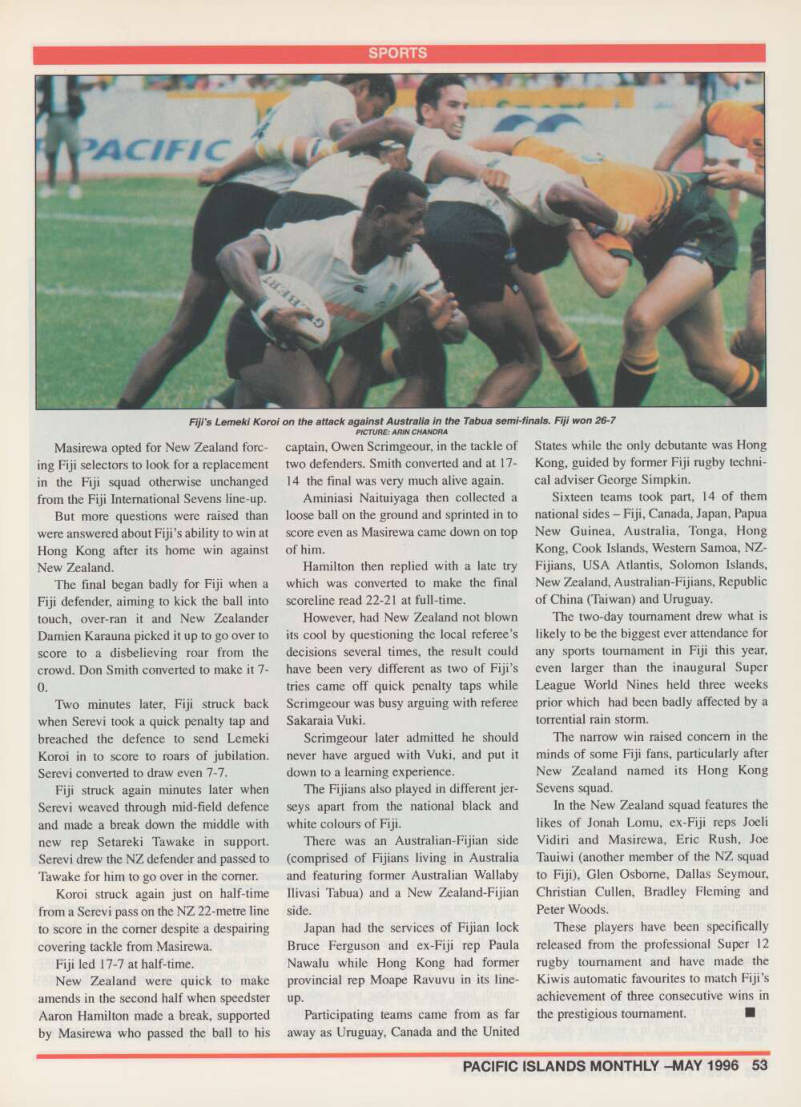
Fiji’s Lemeki Koroi on the attack against Australia in the Tabua semi-finals. Fiji won 26-7