magic
pp. 50-51 · Read in the full issue
Sports
All Black magic
But the Kiwi hat-trick does not come easy
By Paula Tagivetaua
The 1996 Cathay Pacific Hong Kong
Bank International Sevens tourna ment finished with victory to New Zealand and a loss to Fiji, but the Fijians gained despite the 19-17 Cup Final loss.
New Zealand emulated Fiji’s hat-trick record from 1990-1992, although Fiji has won seven times and New Zealand six.
And amidst the triumphs, controversies and disappointment the message to sevens followers was that Fiji magic had gripped the world again after four luckless years.
Fans will talk about how Hong Kong based New Zealand referee Ross Mitchell awarded a penalty try to NZ after he
penalised Fiji skipper Waisele Serevi for
“intentionally tripping” Christian Cullen.
This cost Fiji seven vital points.
They will talk about how winger Peter Woods was not penalised for shepherding
Cullen, momentarily halting a Fijian play
er’s concentration in the Kiwis in-goal area and giving Cullen the split- second he needed to break through and enable New Zealand to score through Waisiki Masirewa.
They will talk about how Fiji was not given a penalty try after Serevi was pulled from behind by Woods as they were going for a loose ball on the tryline.
They will talk about how Cullen, a vir tual unknown, stole the limelight with a dash of brilliance to end up as the tourna ment’s top try scorer, top points scorer and the tournament’s best player.
But while Cullen may have stolen the show Serevi says he still has a score to set tle with New Zealand and Hong Kong.
“I will play at the Japan sevens, the World Cup playoffs, the World Cup next year and the Hong Kong Sevens in 1998
until I can’t run or until the selectors decide my days are over and drop me. The team we have is a good one and should be retained for next year,” he says.
The light at the end of the tunnel is
brighter now for Fiji. Coach Rupeni
Ravonu was satisfied with how his men
played.
“They played together for the first time at such a high-pressure tournament and produced results. I am happy. Give them more time and they will take Fiji back on top. This is a good sign for the future,” he says.
New Zealand skipper Eric Rush admit
ted they were lucky to win and that Ravonu had a “good bunch of boys”.
“If Serevi had kicked off, they would have won because my men were shat tered,” he says.
In retrospect, the 1996 Hong Kong Sevens from March 29-31 was the most peaceful in its 21-year history, with only one of the 40,000 beer-soaked delirious fans arrested for indecent assault.
The Mexican wave was revived but tra dition was broken when for the first time in a Fiji-All Black final, the cibi and the haka were not performed.
Charlie Chaplin, armed with bowler hat
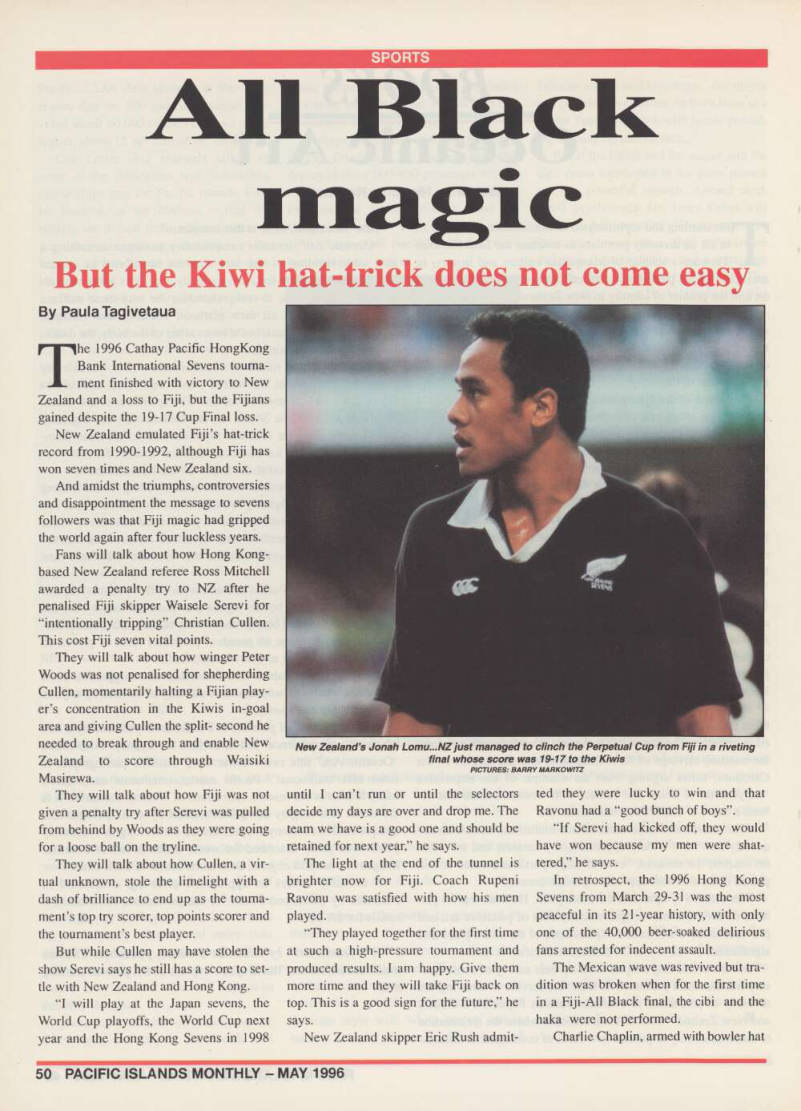
New Zealand’s Jonah Lomu...NZ just managed to clinch the Perpetual Cup from Fiji in a riveting final whose score was 19-17 to the Kiwis
Pictures: Barry Markowitz
and walking cane tackled Jonah Lomu but was picked up one-handed and dumped on
the ground.
A total of 2591 points were scored over the three days and more than 350,000 pints of beer were downed but there were no streakers.
More than 12,000 chefs, waiters and staff from the Holiday Inn Golden Mile Hotel served more than 95,000 litres of soft drinks, 5000 hot dogs and 10,000 hamburgers for fans at the sevens.
“Catering for the 40,000 capacity crowd is like operating 200 restaurants,” said Terry Mannion, the hotel’s food and beverage assistant manager.
The hotel operates three kitchens at the
Hong Kong Stadium which provides a
range of dishes to the public and also a running buffet for the 24 teams.
The atmosphere and exuberant spirit synonymous with the Sevens was even more contagious. The fun, frivolity and good nature remained and the weather was steaming, as was the capacity crowd.
Lomu was dubbed with a superlative; this one was on a banner which said, “Look out. King Kong is in Hong
Kong... Jonah”.
On the field, Thad Hill of the United States had the dubious distinction of being one of the few players to be sent off in a
Hong Kong Sevens tournament.
Hill was ordered off by New Zealand referee Paddy O’Brien for throwing a punch at Argentina’s Augustino Pichot during their plate quarter-final.
For the first time, the four home unions were represented. England reached the Cup semi-finals where they were whipped 42-19 by New Zealand.
Ireland lost 49-0 to New Zealand and Wales led Fiji 12-0 but lost 28-12 in the Cup quarters, and Scotland lost in the plate quarters to France 15-7 in a five-nations grudge match.
The plucky Papua New Guineans lost to Namibia in the bowl semis and the Paulo Nawalu-coached Japan side beat Namibia in the final.
Tonga lost to Fiji, beat Thailand and Hong Kong 17-12 but because of the new format of six pools, met Hong Kong again in the plate quarters and lost by the same score it beat Hong Kong with.
France won the plate 45-12 from Hong Kong.
Western Samoa won its pool but was beaten by reigning world sevens champi ons England 27-7 in the Cup quarters.
Australia continued its losing streak to Fiji, losing 24-7 in the Cup semis.
A new format where the scoring team kicked off at the restart had most players as sixes and sevens throughout but it was a respite for the minnows.
Tradition remained at the Sevens, Sri Lanka still has not won a game in the last
10 years and the new world one-day crick et champions were joined by Kwang-Hua Taipei, Singapore and Thailand but the minnows are still sentimental favourites of the crowd.
The Australian team is still booed by the crowd when they entered the ground, continuing the tradition started at the first Sevens in 1976 after Fijian player Jo Rauto was sent off for retaliating after an Aussie punched him. The crowd booed when the referee sent the Fijian off instead of penal ising both players.
The expectations and lore that dubbed the Sevens as the greatest rugby show on earth continued. Fans wanted to see whether Serevi still had his magic, won dered when Sri Lanka will ever win a tro phy and still debated on how much beer a jug holds.
In the end, Hong Kong will still attract players and fans after confirmation by Stuart Leckie, chairperson of the Hong Kong Rugby Football union “that the Sevens will be held again in 1998,1999 and beyond 2000” even after Hong Kong reverts to Chinese rule next year.
That is confirmation that the populous island colony, christened by Lord Palmerston as a barren rock in 1841 when the British flag was first planted there, will continue to let its hair down and enjoy one week every year when Hong Kong’s econ omy blossoms. ■
Fiji skipper Waisele Serevi
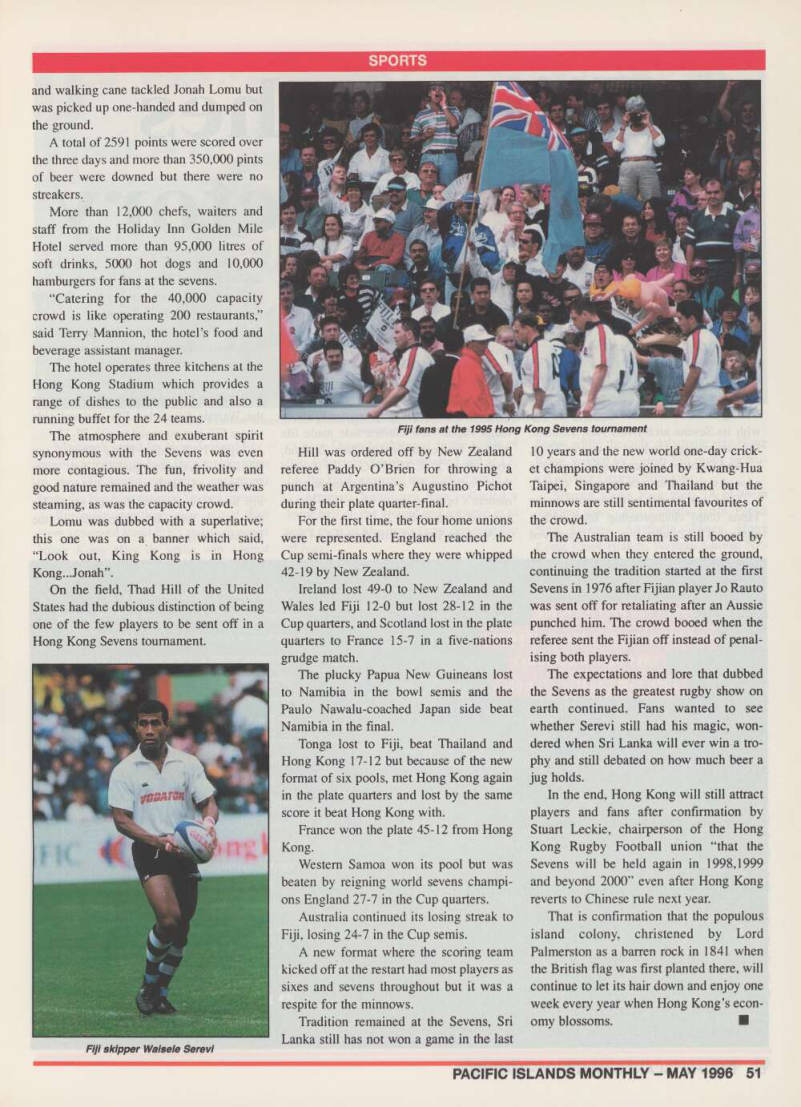
Fiji fans at the 1995 Hong Kong Sevens tournament