of the cruise business
pp. 46-48 · Read in the full issue
The ups and downs of the cruise business
By David North
(CLlA), and the region’s 1995 total was a drop of close to 200,000 bed days from the previous year’s all-time high of 763,824 such days. Further, bed days and port days are not the same (many days, particularly in the Pacific, are spent getting from one island to another.) Finally, these CLIA statistics do not measure precisely the number of cruise passenger visits to the Pacific’s islands as they seem to lump New Zealand and Australia (but not Hawaii) into the South Pacific. On the other hand the CLIA data does not include some cruise ships active in the region, such as those headquartered in PNG and in the Galapagos Islands, and perhaps many others as well.
Let’s get back to the good economic news about those millionaires arriving in Kiribati. I do not know the net worth of each passenger on the Seaboum Pride, the ship they are using, but I do know that the ship’s management claims that it runs the
On September 24, 200 cruiseship bome millionaires will arrive on Kiribati’s Christmas Island after three days at sea, eager to stretch their legs
and presumably willing to spend some
money in the local economy.
Later they will visit several ports in French Polynesia, and will also stop in Western Samoa, American Samoa, the Cooks, Fiji, Vanuatu, and New Caledonia.
Industry records now show that there were 574,216 “bed days” of cruising in the South Pacific in 1995 - a “bed day” is a paying customer on a ship for 24 hours.
That’s a lot of visitors bringing a lot of money to the islands.
That’s the good news.
The bad news is that the South Pacific, in 1995 had only one per cent of the world’s “bed days” as recorded by the Cruise Lines International Association
most expensive, and most luxurious cruis ing operation in the world.
The average cost per day per passenger is close to SUS9OO, and you can not sign up for less than 14 days at a time, and most people on board are couples.
If you and your spouse can afford $U525,200 for a two-week cruise (SUS9OO x 2 x 14) you probably are a mil lionaire. (Half-a-million invested conserv atively at five per cent produces only $U525,000 in the course of a year.) And when 200 people with that kind of money arrive in port it is good news for local economy. The passengers will eat and drink, they will use taxis, they will visit town and buy stuff (from postage stamps to handicrafts); if there is a local museum with an admission charge they will cheer fully pay to visit it. The ship itself may need some supplies, too.
As we suggested some time ago, cruise ships represent a side-effect free, if unpre
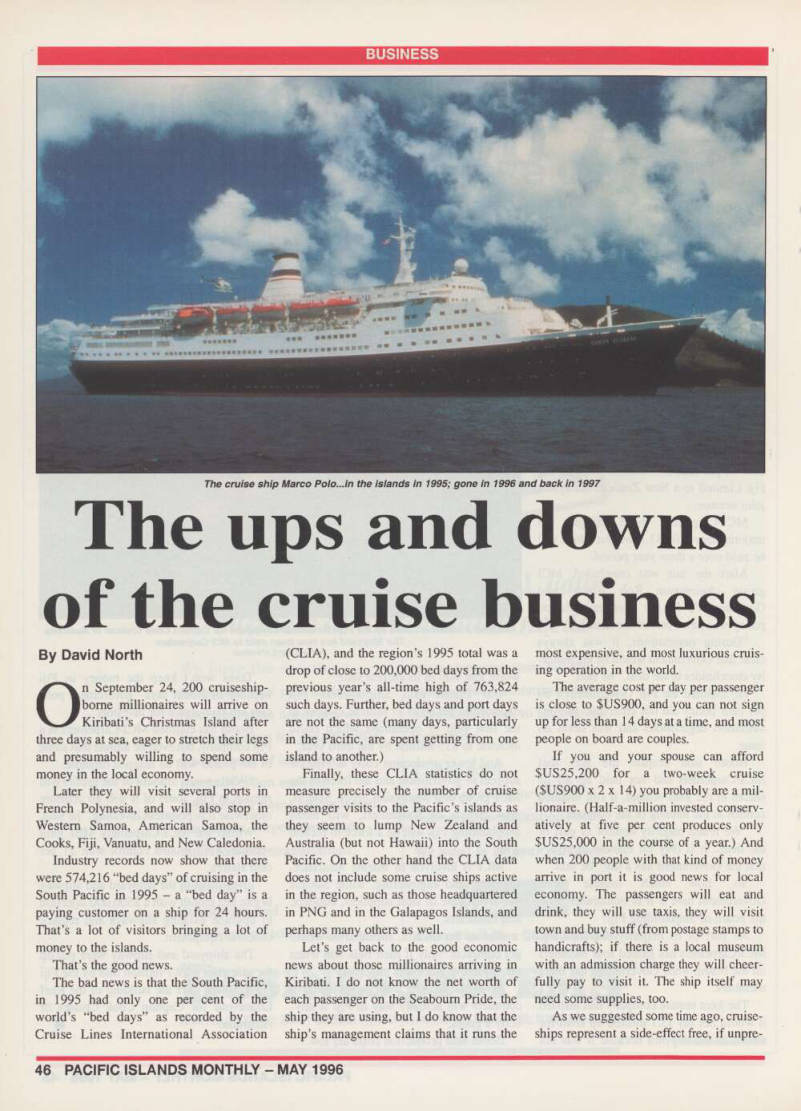
The cruise ship Marco Polo...in the islands in 1995; gone in 1996 and back in 1997
dictable, source of First World money.
There is no need to destroy the rainforest or endanger the coral reef, there is no need to expand the infrastructure or worry about conflicts over land tenure policies; the ship comes, money is spent, and then the ship leaves.
But the ships are maddeningly beyond the control of the island establishments.
The ups and downs of the cruise busi ness - as well as some stabilising factors can be seen from the itineraries of six spe cific vessels working the South Pacific.
They are the afore-mentioned, ultra-luxuri ous Seaboum Pride, the floating university on the Universe Explorer, the off-again, on-again Marco Polo, all sources of unpre dictability; then there is the stabilising presence of the Golden Princess, Club Med 2, and Wind Song. Let’s look at the implications for the islands of each of these, in turn.
The Seabourn Pride will be in Hawaiian waters in mid-September, and will sail to Tahiti after the visit to Christmas Island. It will then cruise through the islands, arriving in Australian on October 25. After spending a couple of weeks in Australia and New Zealand ports, it will return to the islands with a visit to Tonga on November 16, followed by stops in the Cooks, Western Samoa and French Polynesia, and then back to Hawaii.
It will be this vessel’s first visit to the South Seas, which is good news for the region, but will the Seaboum Pride, with its millionaire customers, come back to the Pacific in the future? It is too soon to tell.
It is equally good - but perhaps equally transitory - news that the floating universi ty is making its first trip to the South Pacific.
The two ships bring different opportu nities to local merchants, and different strategies are in order. The median age of the Seaboum Pride’s passengers will be 65 or so. They will have travelled broadly before this trip, and they will be sedate and non-adventurous guests. The floating uni
versity will bring a far-larger, far-younger,
and not-as-affluent crowd to a shorter list of island ports. The students will be more adventurous, they will be in each port for several days, and there will be more scuba diving and nightclubing than among the Seaboum Pride folk.
The Institute for Shipboard Education, a wing of the University of Pittsburgh (located far from any ocean), is the sponsor of the floating university. It has been oper ating for twenty-five years, but never before in the South Pacific.
The expected 560 undergraduates can secure academic credits for their months at sea. They will be accompanied by 54 fac ulty and staff, presumably a choice assign ment, and will be sailing on the 23,500 ton Universe Explorer. The schedule, which dovetails neatly with the Northern Hemisphere’s academic summer vacation, calls for departure from a Mexican city just south of San Diego on May 22, visits to Tahiti from June 1 through 4, stops in Australia and New Zealand, a stay in Suva from June 28 through July 1, and then on to Hawaii and back to the States.
The cruise manager said since the Universe Explorer was a faster ship than
the vessel originally planned for the voy age, there was also room for another stop in the islands, perhaps Pagopago.
Will the Universities of Pittsburgh and of the South Pacific reach out to each other during the stay in Fiji? Will professors from the ship and USP visit each others’ classrooms? Will public and private sector leaders in Tahiti, Fiji, and American Samoa make an effort to persuade the ship to return annually? Time will tell.
What is clear, however, is that the Marco Polo will not be in the Pacific this year, as it was last year, and will be again next year. Cruise ships, like airplanes, are quite capable of taking their business else where, and the Orient Lines has decided that the grass is greener, in 1996, in the Mediterranean.
The defection of the Marco Polo - or any other ship of its size - plays havoc with the number of bed days in the South
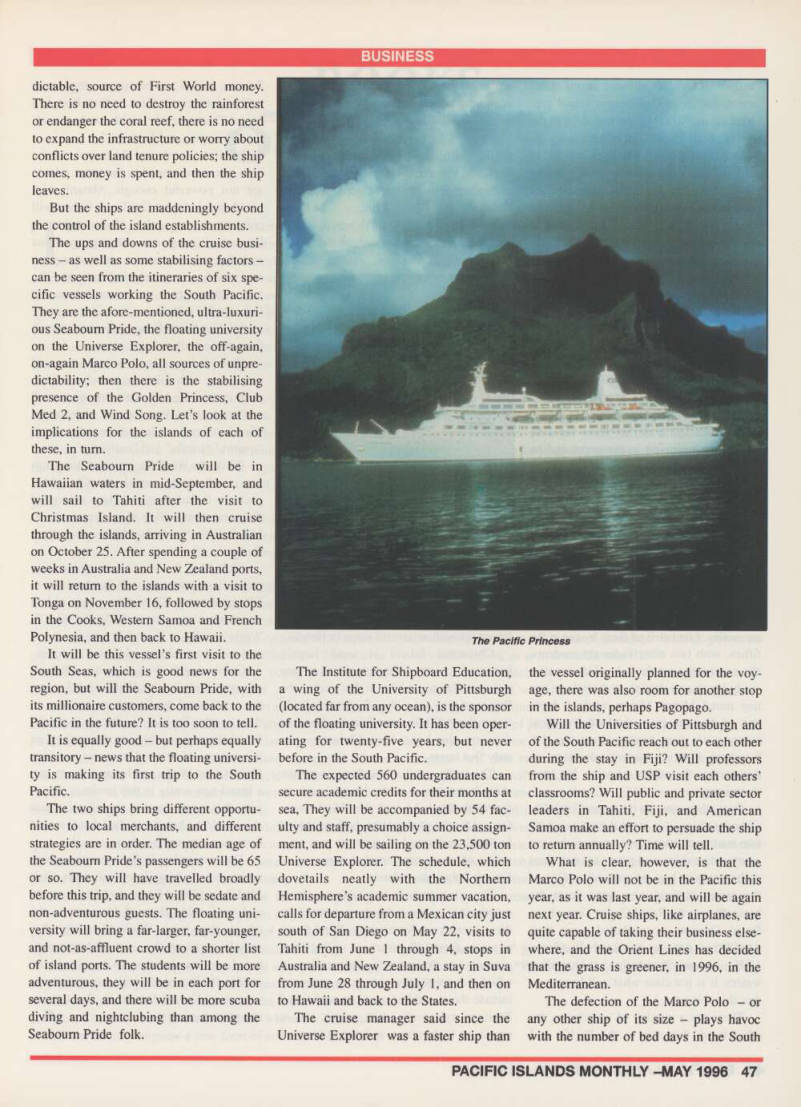
The Pacific Princess
Pacific. CLIA data showed in the 1995 season that the 800-passenger vessel pro vided about 80,000 of the bed days in the region, about 15 per cent of the total.
One cruise ship manager talked of some of the difficulties with scheduling cruise ships into the Pacific islands. First he touched on the obvious - that the islands are distant from major centres of population, and that once the ship is in the region, it often has to travel several days between ports.
Then he spoke a little about the charac teristics and interests of the cruisers.
“They are older, they have money, and most of them live in warm climates in the US, like Florida and California; mean while, most port days in the islands are beach days - and time in the sun on the beaches is not all that interesting to them.”
His message was that there must be something intriguing in the ports, and he was enthusiastic about Napier, a city on the North Island of New Zealand.
“In the thirties the entire town was wiped out by an earthquake or a volcano or something (it was an earthquake) and they had to rebuild it from scratch. It has the highest percentage of art deco buildings of any place in the world. Now there’s some thing to see in Napier...”
The mention of Napier stirred sleeping memories. I had arrived there by car in the fifties, with two other Fulbright students.
We missed the art deco, but I do recall a seedy hotel, and driving in the rain in our tiny rental Morris Minor; while I drove one of the others read aloud the local newspaper’s long report about the US Supreme Court’s historic decision to desegregate the public schools... but back to cruising.
One other note on the unpredictability of cruise ships: it is a cut-throat, competi tive business; often there seem to be too many cruise ships, and prices are cut; lines go bankrupt or buy out each other. One of the recent victims, now gone from the business, was the Royal Cruise Line whose Royal Odyssey contributed more than 44,000 bed days to the South Pacific in 1995; it worked mostly in Australian waters. It is not clear what will happen to this ship this year.
There are a number of vessels, on the other hand, that stay in the Pacific and
cruise primarily in the islands; they bring economic benefits to the islands that can be counted on, year after year.
Perhaps the largest of these operations
is the Princess Line, which in 1995 deployed three 600-800 passenger vessels into the South Pacific, the Golden Princess, the Island Princess and the Pacific Princess. The three of them chalked up about one-third of the year’s bed days in the region.
“if you can afford $25,200 for a two week cruise, you probably are a
millionaire.”
For example, the Pacific Princess was scheduled in January and February of this year to make three 11-day cruises, two from Tahiti to Hawaii, and one the other way around. These trips included port days in Moorea, Bora Bora, and Christmas Island, as well as several stops in Hawaii.
Christmas Island is used largely because it is one of the few places to stop between Hawaii and Tahiti; but neither the Princess line nor the Seabourn Pride linger there. While most Princess line port days are nine hours long, Christmas gets only five hours.
The really stabilising influences are the ships home-based in the islands, such as the Club Med 2 and the Wind Song.
Owned by the rival system, both are based in Tahiti, and spend most of the year on a series of short trips to the same set of French Polynesian islands.
There is a perhaps inevitable emphasis on romance in the publicity generated by these operations. For example, Wind Song,
an up-to-date, 148-passenger sailing ship,
promoted a Valentine’s Day cruise in which “couples may choose to renew or initiate their wedding vows in traditional Tahitian style with white pareas, native music, a high priest and the giving of
Tahitian names and bilessings... the mayor will perform ceremomies on Bora Bora in a quaint Tahitian churclh with locals provid ing the singing and fainfare...”
But if the locals amd the mayor and the high priest mentionedl in the press release
are not powerful emough...Aboard ship,
noted psychologist D)r. Tracy Cabot will conduct her popular ‘Discoveries in Romance’ sessions... the programme includes a questionnaiire and a computer analysis for recommended actions. The press release goes om to emphasise that Cabot holds a Ph.D.
At least Wind Sonjg provides a break from those endless beach days.
Club Med’s publiciist writes in terms of swimming with dolphiins, horseback rides, deep-sea fishing (all e>xtra charge) as well as “troops of skilled dlancers, singers and “fire handlers” while avoiding the words “quaint,” “locals,” and “native.”
While the Wind Song’s week-long out ing is all on the vessel, the Club Med package includes several days at one of their resorts as well as some time at sea. It has facilities at both Moorea and Bora Bora.
Club Med 2 is a five-masted sailing vessel (with power as well) that holds up to 386 passengers. Only three years old, it was built at a cost of SUS 125,000,000.
While usually in French Polynesia, it has also sailed to and around New Caledonia.
Continuing the French theme it lists its country of registry as Wallis and Futuna, the smallest of the French possessions in the South Pacific. I knew that the
Marshalls register ships (concentrating on
the largest of the oil tankers) as does Vanuatu, but Wallis and Futuna was, to me, a brand-new entity in this business. I sup pose that is yet another way that a cruise ship could be helpful to the islands would be to pay registry fees there as well.
The bottom line is that no matter where registered, or how described, both Club Med 2 and Wind Song do bring a steady and predictable flow of business to the islands they serve. While there are other vessels pursuing this sort of home-port based cruising elsewhere in the islands, the insular Pacific needs still more of them, year-around work-horses in the tourist attraction business. ■