A done deal
p. 45 · Read in the full issue
Business
By Sophie Foster
When Fiji’s Rabuka-led coalition came to power in 1993, its pri vatisation policy stated that in any attempt to sell off public enterprise, 50 per cent shares would be retained by Government.
However, three years down the track, this policy seems to have changed with the sale of the majority of the Government Shipyard and Slipway to a joint venture
backed by foreigners.
Fiji relinquished control of the shipyard
and slipway on March 27, when it signed over 51 per cent of shares in Shipbuilding Fiji Limited to a New Zealand/Malaysian
joint venture.
MCI/Carpenters MBf bought out
majority shares for $3.1 million which will be paid over a three-year period.
After the sale was concluded, MCI group chairperson Rob Booth said Government’s 50 per cent privatisation policy was never part of the deal.
“During negotiations, it was always clear that Government would be the minor ity shareholder in the deal,” he said.
He claimed the Fiji Government’s 50 per cent policy did not enter into the pri vatisation negotiations and was never an issue.
Booth said despite the fact that MCI/Carpenters had not paid up all its shares in the joint venture, it still retained control in the running of the business.
“We retain majority control as part of the deal.. It is only on matters of policy that the Government has a say,” he said.
So, how much muscle does Government have if it is outnumbered on the board of Shipbuilding Fiji?
As part of its majority shareholding, MCI/Carpenters has gained four members on the board, while Government has three members.
The joint venture company had insisted it would not pay $3.1 million up front for shares in the shipyard because it was not
worth that sum in its current state.
But Booth said Shipbuilders Fiji expected to get up to $7 million in work in the first year of operations which could increase to $l5 million by the third year.
And lower production costs in Fiji, the support of government and the force of the MCI group and Malaysian group Sateras, new owners of Carpenters, will mean Shipbuilding Fiji will be a force to reckon with.
MCI is involved in marine insurance, shipping, and engineering, while Sateras has a vast base of steel suppliers, builders, and financiers.
But as Booth said, subsidiaries would get contracts “only if their bids win when the tendering process is underway”.
How much profit from these lucrative contracts will actually stay in Fiji is any body’s guess.
Booth said production costs are low.
Taxes won’t keep the money in Fiji because as Booth says “government poli cies are favourable for investors”.
Booth has claimed MCI/Carpenters is a Fiji company, but even he admits that some, of the profits will be shipped offshore.
“While a vast amount of the profits will remain in Fiji, some of it will go offshore otherwise it is pointless investing,” he said.
Within the MCI/Carpenters MBf joint venture, MCI retains control with 51 per cent shares.
Investment in the shipyard and slipway began last month with a $500,000 injection to upgrade existing slipways and replace obsolete equipment.
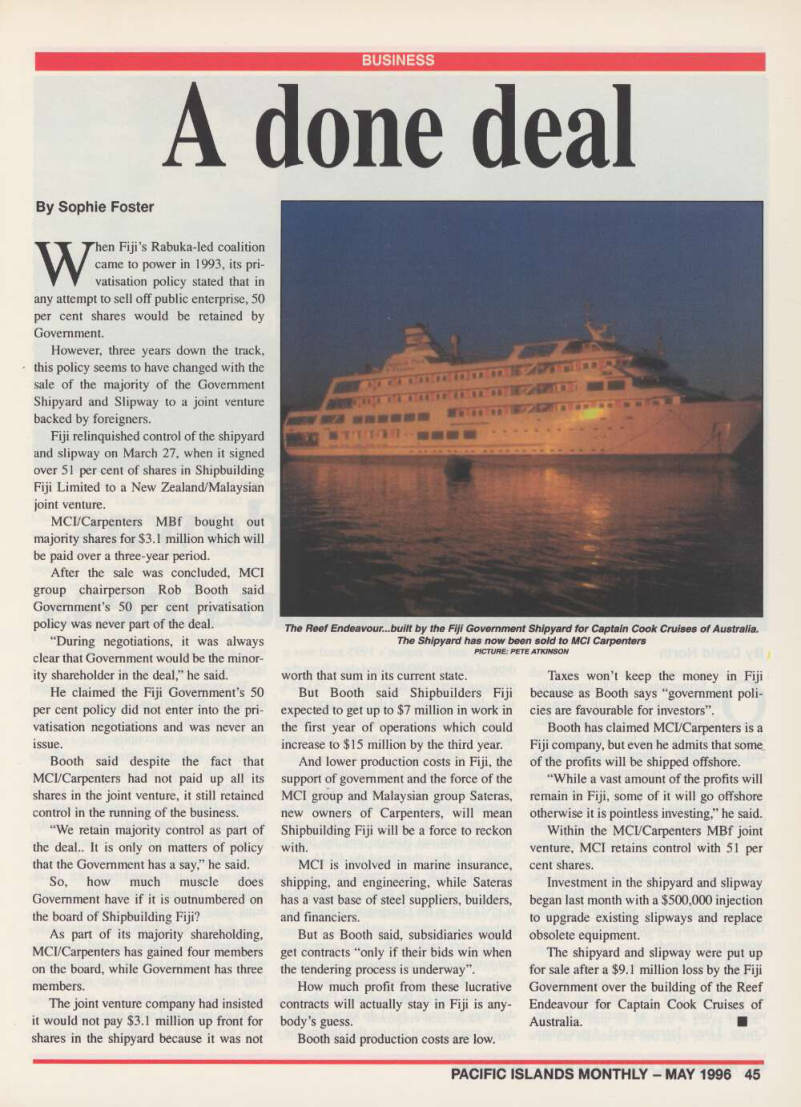
The shipyard and slipway were put up for sale after a $9.1 million loss by the Fiji Government over the building of the Reef Endeavour for Captain Cook Cruises of Australia. ■
The Reef Endeavour...built by the Fiji Government Shipyard for Captain Cook Cruises of Australia.
The Shipyard has now been sold to MCI Carpenters