Yesterday’s
pp. 48-49 · Read in the full issue
Opinion
Yesterday’s man no more
Landslide, avalanche, political mass execution. As the votes in Australia’s March 2 Federal elec tion were counted, commentators turned to ever more florid expressions in an attempt to encapsulate the scale of the defeat of Prime Minister Paul Keating’s
Labour government.
Seven ministers, including Pacific Island Affairs Minister, Gordon Bilney, and Attorney-General, Michael Lavarch, knew they had lost their seats before the night was over and more had their worst fears con firmed in the days that followed.
Early in the evening, it was clear that seats were falling to the Liberal- National Party Coalition in all states, even Victoria. The Coalition emerged with a majority of more than 20 seats in the 148- seat parliament.
For a man who was dumped from his party’s leadership in 1989, over looked in 1993 after John Hewson’s disastrous electoral defeat and again in 1994 when Alexander Downer was elected leader, it was a sweet victory - and he was jubilant.
Howard, the ideological warrior
of the 70’s and 80’s, a fervent believer in economic rationalism, hard-line industrial relations policies and social conservatism had shaken off his tag as “yesterday’s man” and remade himself as a moderate.
His priorities now are almost exclu sively domestic, reforming the industrial relations system, tackling youth unem ployment and dealing with controversial issues such as privatisation of one-third of Telstra, which will run into trouble in the Senate where the Democrats hold the bal ance of power.
Unlike any Australian Prime Minister since the early 70’s, John Howard has not
had a strong interest in foreign affairs.
While he has nominated better relations with Asia as a top priority, he is likely to leave most of the details to other ministers.
For the Pacific, Howard’s most impor tant ministerial appointments are in Trade, Foreign Affairs and Defence. In Foreign Affairs, Howard appointed Alexander
Downer, a former diplomat who has been shadow Foreign Affairs Minister since 1995 when he was dumped as Liberal leader for stumbling badly on policy issues after only a few months in office.
Trade has gone to the National Party leader, Tim Fischer, who is also Deputy Prime Minister, and Defence to lan MacLachlan, the former president of the powerful National Farmers Federation.
The lesser Ministry of Defence Industry, Science and Personnel has gone to the feisty, Bronwyn Bishop. As well, Howard has introduced a new junior post of Parliamentary Secretary for Foreign
Affairs which has been filled by little 1 known, NSW right-winger, Andrew Thompson.
The new government’s approach to the Pacific Islands was outlined just before the election by Alexander Downer in the Coalition’s foreign policy.
The major change is the axing of the
role of Pacific Islands Affairs Minister and returning of responsibil ity for the Pacific to the Foreign Affairs Minister - a move Downer has hailed as an upgrading in the priority placed on relations with the region.
The policy described the South Pacific as an area of “special interest” to Australia. Like Bilney, Downer is interested in resource issues (particu larly logging and fishing) and is like ly to continue the policy of pushing regional governments for more action to ensure their resources are devel oped in a sustainable way. In doing so, however, he will exhibit a softer tone. In his policy document, Downer noted that Australia is able to play a
leadership role in the region adding,
in an obvious dig at Paul Keating and Gordon Bilney, that it should do this “through assistance and constructive
advice, rather than assuming the role of pious lecturer”. In an attempt to take account of the diversity of circumstances within the region, the new Foreign Affairs Minister plans more attention to bilateral relations.
Downer’s only visit to the region as shadow Foreign Affairs Minister was to Papua New Guinea, a country he regards as having been neglected by ministers in the Labour government. His policy promises the new government will place “a significantly higher priority” on assist ing PNG to address its economic difficul ties and to resolve the war on
Australia
Jemima
Garrett
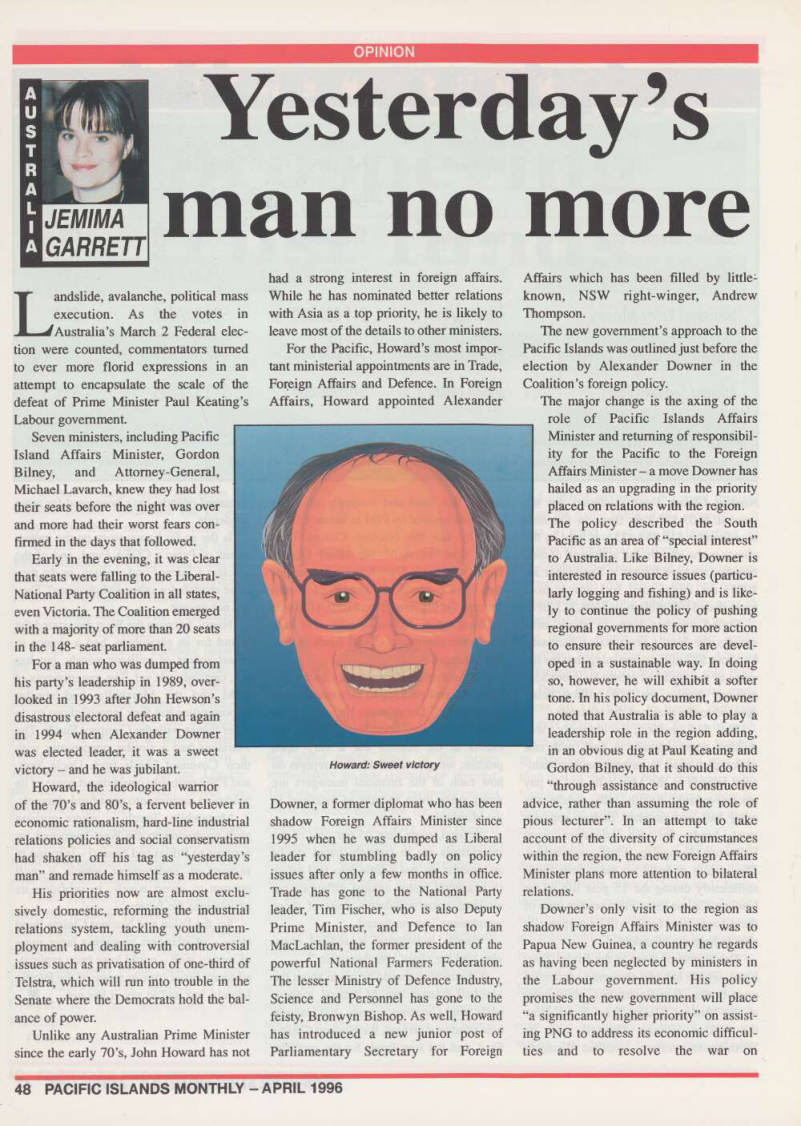
Howard: Sweet victory
Bougainville. Downer will continue the change in Australia’s aid delivery from budget support to specific project aid but plans to review current plans to ensure Australian aid helps to strengthen the PNG economy. Downer is also keen to see Australian aid play a more important role in the Bougainville Restoration Programme.
The focus of the Coalition’s aid policy is on grassroots poverty alleviation through sustainable economic develop ment and Downer has foreshadowed a major review of Australia’s aid effective ness which will assess whether these goals are being met.
In the Pacific Islands, the policy says the object of Australian aid must be to encourage “increasing self-sufficiency and economic prosperity”. In order to achieve that the Coalition government plans to: ♦Focus on community level develop ment rather than provision of large infra structure projects which may be better completed on the basis of private or public sector financing; ♦Continue to assist with surveillance of
the island states fishing zones and create opportunities for sharing more technical information and facilities; ♦look at more aid co-ordination to the region with Japan.
Trade with the region was not covered in detail but the policy did note that Australia has a trade surplus with the Pacific Islands of over $B5O million and promises to assist with the expansion of regional export capacity by reviewing the South Pacific Regional Trade and Economic Agreement (SPARTECA) “to examine options for improving the free flow of trade and investment”.
While there will be changes of empha sis, in most respects, the Howard govern ment’s stance towards the South Pacific seems fairly similar to that of the former Keating government. The big unknown factor is whether Alexander Downer will get time to focus real attention on the region.
The Coalition has nominated closer engagement with Asia as its highest prior ity but across the region media coverage of the Howard victory has made it obvious
that the Coalition has a lot of work to do to win the same respect that Paul Cheating achieved. In many quarters, the Coalition is perceived as Anglophile and more focused on Europe. Howard’s 1988 remarks about Asian immigration have not been forgotten and Alexander Downer is not well-known. In a region where warm relations between leaders are crucial to diplomatic success Downer is starting a long way back.
At home Downer also has problems, in an unusual step, John Howard has saddled him with an arrangement in which his
department, the Department of Foreign
Affairs and Trade, reports to two minis ters, himself and Trade minister, Tim Fischer. This has the potential to become an administrative nightmare. Downer and Fischer come from different political par ties and have differences over crucial issues such as the pace at which protection for local industries should be wound back.
Downer’s office says he will take prece dence in decision-making within the department but in Cabinet it will be Tim Fischer who has seniority. ■