prospering
pp. 46-47 · Read in the full issue
Micronesia' s prospering trust funds
By David North
Tired of reading about island gov ernments going broke? Then turn your attention to the financial situ ation of two Micronesian trust funds, with a total value of about $U5200,000,000 and growing.
They are the Marshall Islands Nuclear Claims Fund and Palau’s Compact Trust Fund.
Neither of these funds get taken by conmen (unlike Nauru and the Cooks).
They avoid risky real estate deals that sometimes work, and often do not (prob lems again faced by both Nauru and the Cooks). There is no threat of bankruptcy despite the infusion of many millions of US dollars (as there is in the FSM State of Chuuk, the former Truk).
Further, there are no scandals; none of the money is invested in pet schemes of island politicians, none of it goes to money-losing national airlines - problems of many island nations - and absolutely none of it is invested in show business.
Nauru’s well-publicised losses from a multi-million dollar bet on the London musical “Leonardo” helped defeat the government last year.
Finally, there are no secrets. Anyone interested can secure all the investment results, and can find out who is doing what with the public funds involved.
Palau apparently learned something from the negative experiences of other island states. In particular, it noticed what happened to the large chunks of US money that went to the Marshalls and FSM following the signing of the Compact of Free Association with
Washington.
FSM and the Marshalls have largely
used their Compact funds, which are stretched out over 15 years, to expand the size and generosity of their governments.
Much money has been wasted, and there is little invested to assure the future prosper ity of these islands. And with the annual payments moving down this year (as the tenth anniversary of sovereignty approaches) FSM and the Marshalls are facing tough financial times.
u ...None of the money is invested in pet schemes of island politicians...
Palau asked, and the US agreed, to “front-load” the funding process, giving the island nation much of the money immediately so that it could be invested.
This was done and Palau promptly created a five-member board for the Compact of Free Association (COFA) Trust Fund. It retained the Honolulu office of Merrill Lynch, the Wall Street powerhouse, to assist the COFA board in the management of the $66,000,000 placed in the Trust Fund.
The system is chock-full of checks and balances; Merrill Lynch neither holds the money - that is done by custodian banks nor does it make investment decisions that is done by five money managers selected by the COFA board and Merrill Lynch.
The fund managers, in term, can only invest Palau’s funds in publicly-listed stocks and bonds, and thus avoid both real estate ventures, and investments in island specific ventures. And every one of the
players is audited regularly.
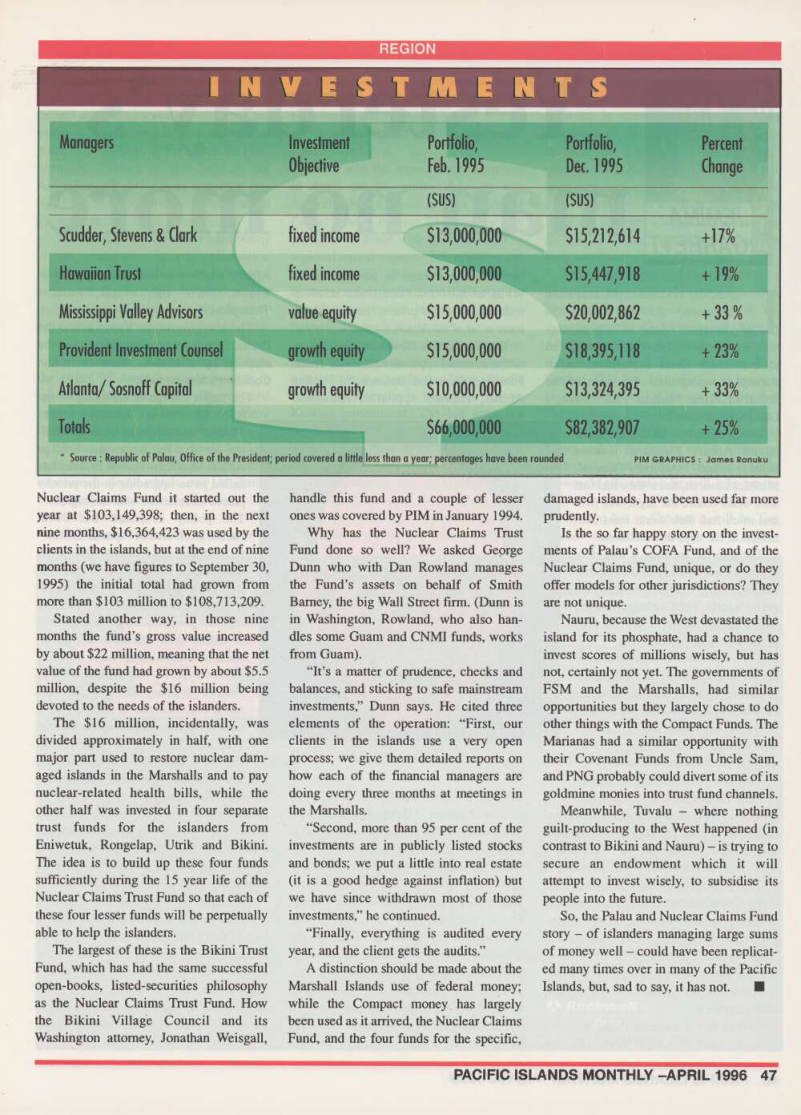
In the first not-quite full year of Palau’s investment operations, its $66 million grew to more than $B2 million. This was an almost 25 per cent increase. Some of the increase was in the forms of dividends and interest payments, but most resulted from the rising value of the securities - it was a good year to be investing in American financial markets.
“Although Palau cannot expect to con sistently earn that return, this has been a propitious beginning, and over the next 15 years the country hopes to realise an aver age annual return of 12-15 per cent,”
Margaret Mary King, Economic Adviser
to President Kuniwo Nakamura, told PIM.
Palau has chosen five financial man agers, all US firms, to handle different aspects of its investments. Two work with fixed-income investments (that is, bonds); as expected, their rate of return was less than that of the three other managers who focused on equity investments (that is, stocks). The gains of each of the five man agers are shown in the table.
In addition to the COFA fund, described above. Palau has more than $lO4 million in other (US-granted) funds invested in a similar way. These funds, which are drawn down to meet various governmental expenses, must be invested in shorter term financial instruments than the COFA fund, and, for that reason, earn less; it was about nine per cent last year.
Meanwhile, a much older Micronesian trust fund continues to benefit from its stocks and bonds. In the case of the
I Nvestments
Nuclear Claims Fund it started out the year at $103,149,398; then, in the next nine months, $16,364,423 was used by the clients in the islands, but at the end of nine months (we have figures to September 30, 1995) the initial total had grown from more than $lO3 million to $108,713,209.
Stated another way, in those nine months the fund’s gross value increased by about $22 million, meaning that the net value of the fund had grown by about $5.5 million, despite the $l6 million being devoted to the needs of the islanders.
The $l6 million, incidentally, was divided approximately in half, with one major part used to restore nuclear dam aged islands in the Marshalls and to pay nuclear-related health bills, while the other half was invested in four separate trust funds for the islanders from Eniwetuk, Rongelap, Utrik and Bikini.
The idea is to build up these four funds sufficiently during the 15 year life of the Nuclear Claims Trust Fund so that each of these four lesser funds will be perpetually able to help the islanders.
The largest of these is the Bikini Trust Fund, which has had the same successful
open-books, listed-securities philosophy
as the Nuclear Claims Trust Fund. How the Bikini Village Council and its
Washington attorney, Jonathan Weisgall,
handle this fund and a couple of lesser ones was covered by PIM in January 1994.
Why has the Nuclear Claims Trust Fund done so well? We asked George Dunn who with Dan Rowland manages the Fund’s assets on behalf of Smith Barney, the big Wall Street firm. (Dunn is in Washington, Rowland, who also han dles some Guam and CNMI funds, works from Guam).
“It’s a matter of prudence, checks and balances, and sticking to safe mainstream investments,” Dunn says. He cited three elements of the operation: “First, our clients in the islands use a very open process; we give them detailed reports on how each of the financial managers are doing every three months at meetings in the Marshalls.
“Second, more than 95 per cent of the investments are in publicly listed stocks and bonds; we put a little into real estate (it is a good hedge against inflation) but we have since withdrawn most of those investments,” he continued.
“Finally, everything is audited every year, and the client gets the audits.”
A distinction should be made about the Marshall Islands use of federal money; while the Compact money has largely been used as it arrived, the Nuclear Claims Fund, and the four funds for the specific,
damaged islands, have been used far more prudently.
Is the so far happy story on the invest ments of Palau’s COFA Fund, and of the Nuclear Claims Fund, unique, or do they offer models for other jurisdictions? They are not unique.
Nauru, because the West devastated the island for its phosphate, had a chance to invest scores of millions wisely, but has not, certainly not yet. The governments of FSM and the Marshalls, had similar opportunities but they largely chose to do other things with the Compact Funds. The Marianas had a similar opportunity with their Covenant Funds from Uncle Sam, and PNG probably could divert some of its goldmine monies into trust fund channels.
Meanwhile, Tuvalu - where nothing guilt-producing to the West happened (in contrast to Bikini and Naum) - is trying to secure an endowment which it will attempt to invest wisely, to subsidise its people into the future.
So, the Palau and Nuclear Claims Fund story - of islanders managing large sums of money well - could have been replicat ed many times over in many of the Pacific Islands, but, sad to say, it has not. ■
Managers Investment Portfolio, Portfolio, Percent Objective Feb. 1995 Dec. 1995 Change
(Sus)
(Sus)
Scudder, Stevens & Clark fixed income $13,000,000 $15,212,614 +17% Hawaiian Trust fixed income $13,000,000 $15,447,918 + 19% Mississippi Valley Advisors value equity $15,000,000 $20,002,862 + 33% Provident Investment Counsel growth equity 1 $15,000,000 $18,395,118 + 23% Atlanta/ Sosnoff Capital growth equity $10,000,000 $13,324,395 + 33% Totals $66,000,000 $82,382,907 + 25% * Source : Republic of Palau, Office of the President; period covered a little less than a year; percentages have been rounded pim graphics ; James Ranuku