The price of French
pp. 10-12 · Read in the full issue
arrogance
By Sophie Foster
On January 29, French president Jacques Chirac announced the “definitive” end to nuclear testing in the Pacific.
The announcement came 48 hours after France detonated its sixth underground nuclear device on Fangataufa Atoll in French Polynesia.
The explosion was six times the size of the atom bomb dropped on Hiroshima in Japan during World War 11.
Last September, France broke a mora torium on testing and indicated it would conduct up to eight blasts in the Pacific.
The tests sparked world-wide condem nation from governments, individuals and organisations including the United Nations which passed a resolution last December calling for an immediate end to all nuclear testing.
France persisted however, saying the tests were essential for its future nuclear programme.
“Today, I have the feeling of having accomplished one of my most important duties by giving France, for decades to come, the capability for its independence and security,” Chirac said in announcing an end to the tests.
But while the tests may have served to secure “independence” for France, the same may not be said for its territories in the Pacific.
For the indigenous people of French Polynesia, the end of testing has renewed their hopes for self-determination with the release of the Mururoa and Fangataufa test sites.
The French government has indicated it will close its military sites in French Polynesia because it will now rely on com puter simulated results for its nuclear arse nal.
Forty-eight hours after Chirac stated the end of nuclear testing, the French National Assembly voted on legislation to increase the autonomy of French Polynesia.
The legislation outlines economic, social and cultural independence for the territory giving local authorities control over travel and communication links and the authority to regulate mining and sea rights.
It also states the local language will be given official status, along with French, after 153 years of colonisation.
But despite this, the legislation fails to highlight political independence for the territory.
The local pro-independence party stance has held that local autonomy within the territory was a “trap” to diffuse the self-determination questions emerging with the 1996 elections.
The day after the end of testing was
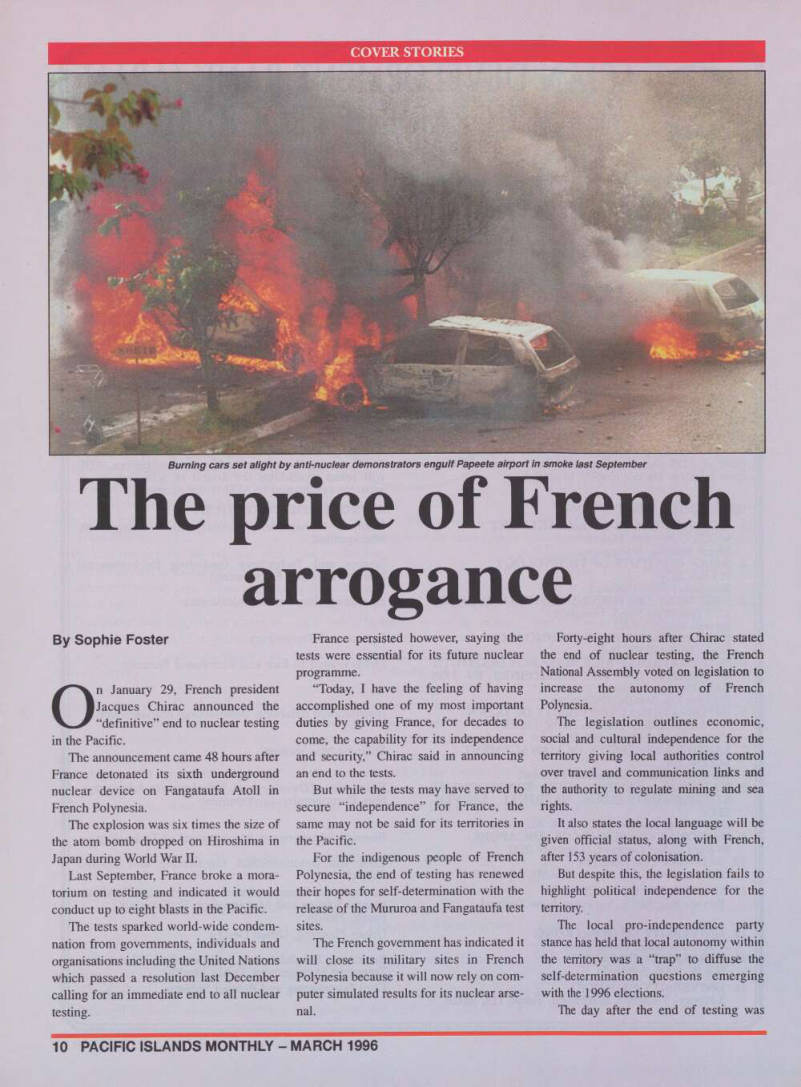
Burning cars set alight by anti-nuclear demonstrators engulf Papeete airport in smoke last September
declared, president of the territorial gov ernment in French Polynesia and “politi cal ally of explosions”, Gaston Flosse said Chirac pledged to return Mururoa and Fangataufa to French Polynesian control “in the state in which they started”.
Flosse said Chirac had agreed to a compensation package of SUS2OO million a year for the next 10 years for French
Polynesia.
The settlement has been described as
compensation for “economic problems”
resulting from the end of the nuclear tests.
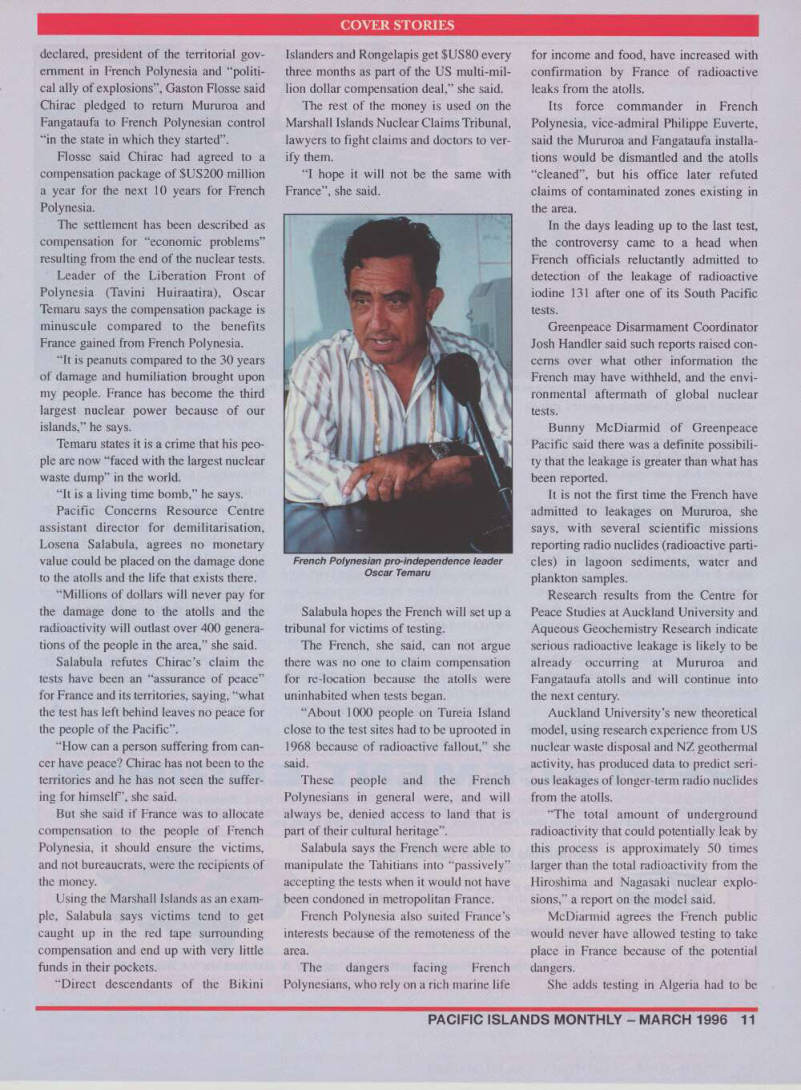
Leader of the Liberation Front of Polynesia (Tavini Huiraatira), Oscar Temaru says the compensation package is minuscule compared to the benefits France gained from French Polynesia.
“It is peanuts compared to the 30 years of damage and humiliation brought upon my people. France has become the third largest nuclear power because of our islands,” he says.
Temaru states it is a crime that his peo ple are now “faced with the largest nuclear waste dump” in the world.
“It is a living time bomb,” he says.
Pacific Concerns Resource Centre assistant director for demilitarisation, Losena Salabula, agrees no monetary value could be placed on the damage done to the atolls and the life that exists there.
“Millions of dollars will never pay for the damage done to the atolls and the radioactivity will outlast over 400 genera tions of the people in the area,” she said.
Salabula refutes Chirac’s claim the tests have been an “assurance of peace” for France and its territories, saying, “what the test has left behind leaves no peace for the people of the Pacific”.
“How can a person suffering from can cer have peace? Chirac has not been to the territories and he has not seen the suffer ing for himself’, she said.
But she said if France was to allocate compensation to the people of French Polynesia, it should ensure the victims, and not bureaucrats, were the recipients of the money.
Using the Marshall Islands as an exam ple, Salabula says victims tend to get caught up in the red tape surrounding compensation and end up with very little funds in their pockets.
“Direct descendants of the Bikini
Islanders and Rongelapis get SUSBO every three months as part of the US multi-mil lion dollar compensation deal,” she said.
The rest of the money is used on the Marshall Islands Nuclear Claims Tribunal, lawyers to fight claims and doctors to ver ify them.
“I hope it will not be the same with France”, she said.
Salabula hopes the French will set up a tribunal for victims of testing.
The French, she said, can not argue there was no one to claim compensation for re-location because the atolls were uninhabited when tests began.
“About 1000 people on Tureia Island close to the test sites had to be uprooted in 1968 because of radioactive fallout,” she said.
These people and the French Polynesians in general were, and will always be, denied access to land that is part of their cultural heritage”.
Salabula says the French were able to manipulate the Tahitians into “passively” accepting the tests when it would not have been condoned in metropolitan France.
French Polynesia also suited France’s interests because of the remoteness of the area.
The dangers facing French Polynesians, who rely on a rich marine life
for income and food, have increased with confirmation by France of radioactive leaks from the atolls.
Its force commander in French
Polynesia, vice-admiral Philippe Euverte,
said the Mururoa and Fangataufa installa tions would be dismantled and the atolls “cleaned”, but his office later refuted claims of contaminated zones existing in the area.
In the days leading up to the last test, the controversy came to a head when French officials reluctantly admitted to detection of the leakage of radioactive iodine 131 after one of its South Pacific tests.
Greenpeace Disarmament Coordinator Josh Handler said such reports raised con cerns over what other information the French may have withheld, and the envi ronmental aftermath of global nuclear tests.
Bunny McDiarmid of Greenpeace Pacific said there was a definite possibili ty that the leakage is greater than what has been reported.
It is not the first time the French have admitted to leakages on Mururoa, she says, with several scientific missions reporting radio nuclides (radioactive parti cles) in lagoon sediments, water and
plankton samples.
Research results from the Centre for Peace Studies at Auckland University and Aqueous Geochemistry Research indicate serious radioactive leakage is likely to be already occurring at Mururoa and Fangataufa atolls and will continue into the next century.
Auckland University’s new theoretical model, using research experience from US nuclear waste disposal and NZ geothermal activity, has produced data to predict seri ous leakages of longer-term radio nuclides from the atolls.
“The total amount of underground
radioactivity that could potentially leak by
this process is approximately 50 times larger than the total radioactivity from the Hiroshima and Nagasaki nuclear explo sions,” a report on the model said.
McDiarmid agrees the French public would never have allowed testing to take place in France because of the potential
dangers.
She adds testing in Algeria had to be
French Polynesian pro-independence leader Oscar Temaru
stopped in 1965 after that country gained
its independence.
The French began tests on Mururoa and Fangataufa in 1966, and to this day have not fully disclosed details surround ing the area.
McDiarmid says it is important that a “truly independent” team of scientists study the area.
“Mururoa is now one of the largest high level nuclear waste dumps on the planet. It is like a time bomb,” she says.
In response to pressure for an indepen dent team of scientists to survey the test sites, the French government has autho rised the International Atomic Energy Agency (IAEA) to carry out a study of Mururoa and Fangataufa atolls for after effects of the blasts.
But environmental groups including Greenpeace have disputed the IAEA’s
appointment because France used its earli er studies to back its claim of non-effect.
For now, French Polynesian opposition and church leaders are more concerned that France stick to its word that the tests are over.
Chirac says France will sign the South Pacific Nuclear Free Zone Treaty and the Comprehensive Test Ban Treaty banning all nuclear tests in 1996.
However, Temaru is sceptical and says France “would not hesitate to resume her nuclear experimentation should world events turn sour”.
He says it is difficult to trust a govern ment whose “word of honour” was responsible for the Rainbow Warrior inci dents in New Zealand and Noumea.
Temaru says the “struggle for indepen dence” will continue despite an end to testing and the beginning of local autono
my.
When, and if, French Polynesia gains its independence, the option to sue the French government for damages in the International Court of Justice will be open to them.
Meantime, governments around the globe including the US, Australia and New Zealand have stated they are willing to reconsider blackmarks placed on France when the tests began last year.
The South Pacific Forum also says it will ask its members to review the suspen sion of France as post-Forum dialogue partner.
But there is no doubt that, even if the rest of the world forgives France, the French Polynesians will not forget the legacy France has left behind. ■
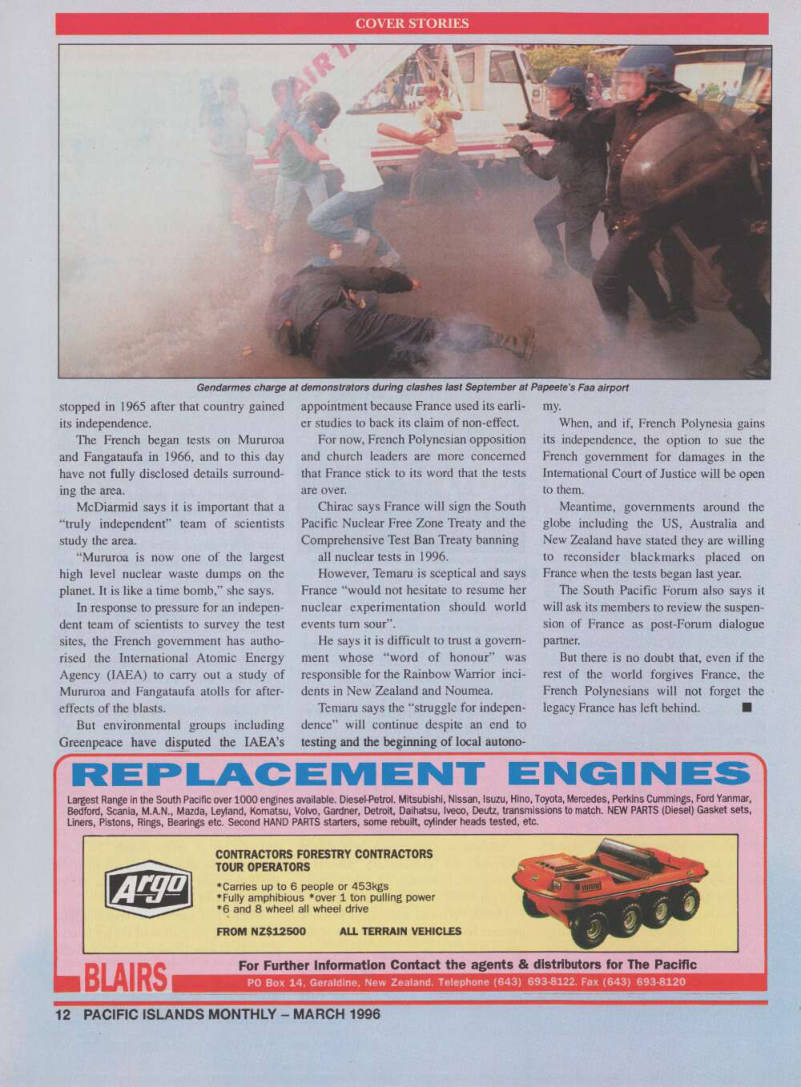
Gendarmes charge at demonstrators during clashes last September at Papeete’s Faa airport