developing
pp. 6-8 · Read in the full issue
Cover Stories
Is France
a new nuclear warhead?
By Alfred Sasako
In January France ended more than three decades of using the South Pacific as a test site for its nuclear weapons programme. It seems it has now gathered the necessary data to enable it to switch to computer simulation.
At least, that’s the pretext France has used to conduct the tests.
But no one, except the French, will ever know the truth behind the necessity of the tests when computer simulation can easily perform such a role.
Paris’ comprehensive nuclear testing programme began in the mid 1960’s when it abandoned a similar programme in Africa.
Since 1966, it has been carrying out both its atmospheric and underground tests at the Pacific Experiment Centre (CEP) at Mururoa, France’s idyllic, windswept outpost in the South Pacific.
The first atmospheric test with a yield of 200 kilotons was conducted on a barge inside the tranquil waters of Mururoa lagoon on July 2, 1966. The second, with a similar yield, was detonated by an air craft at an unknown altitude, about 85
kilometres east of Mururoa.
However, following severe internation al criticism, Paris called off the atmos pheric tests and switched to underground testing in 1971.
By January 29 this year, when France finally announced the end of its nuclear testing programme, it had detonated more than 180 devices on both Mururoa and Fangataufa Atolls.
Of these, 41 were atmospheric tests undertaken within a eight-year period up to 1974. At least 11 of these blasts had an average yield of 1000 kilotons, according to figures released by the French Defence Ministry last July.
By comparison, the yield (force) of the bombs France used in the Pacific are six times more powerful than those dropped on the Japanese cities of Hiroshima and Nagasaki some 50 years ago.
Paris continues to insist its nuclear test programme is intended to perfect its nuclear system for its submarine fleet and to ensure the condition of its stockpiles are in a state of readiness and accuracy.
According to the French, this cannot be ascertained by computer simulation, hence the necessity to conduct the tests.
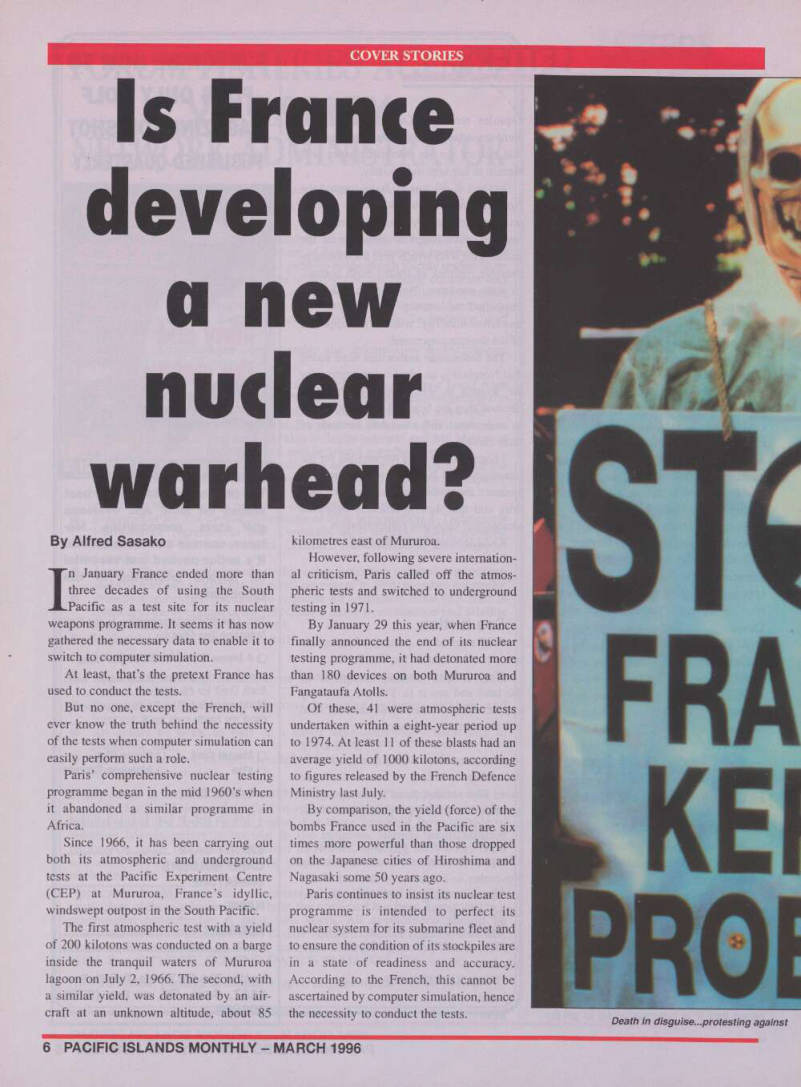
Death in disguise...protesting against
However, reports state the power of France’s last test may have put the finish ing touches to the development of a new nuclear warhead.
The French military shunned sug gestions to this effect.
But despite the denial, experts are less convinced.
One of these experts is Dr Patricia Lewis, Director of the Verification Technology Information Centre in London.
Lewis appeared before a recent
European parliamentary public hearing on
nuclear testing. Her damning conclusion was contained in a report prepared by the former Prime Minister of Tuvalu, Bikenibeu Paeniu, who represented the South Pacific Regional Environment Programme (SPREP) at the hearing.
The conclusion by Lewis is that, “it is possible for the French to obtain the data they need for the development of their nuclear warheads from computer simula tions without doing any more tests.”
According to Lewis, all that the French need to know could easily be obtained by feeding data obtained from previous tests into a computer. In other words, there is no need to continue the tests because scientif ic technology available today could sim
ply do the job.
When asked why France insisted on conducting its nuclear weapons tests in the face of international condemnation, she said: “perhaps the French are developing a completely new nuclear warhead.”
As far as Lewis is concerned, this seems to be the only laudable explanation for France’s act of defiance and arrogance.
“There is really no need for a final series of tests now that computers can sim ply do the job,” Lewis was quoted as say
ing.
Given the fact that France has conduct ed more than 180 tests including 41 atmospheric tests on Mururoa and Fangataufa, there certainly is sufficient data lying about somewhere.
And so cynicism abounds. For instance, no one doubts the ingenuity of the French mind. Its advances in modem
technology are beyond question. To sug
gest that France is lagging behind in com puter technology, and therefore it needs to conduct the tests “manually”, is akin to
suggesting that the Chinese are still learn ing to grow rice.
So it seems the truth behind the French 1995/96 series of nuclear tests will forev er remain shrouded in state secrecy, except to the French establishment.
Resumption of French nuclear tests in the South Pacific last September stirred a shockwave of anger around the world.
In the Pacific, the South Pacific Forum was swift in its action to respond to France’s second test last October 2 by sus pending France from its annual Post- Forum Dialogue Partners.
The upcoming South Pacific Forum in Majuro, Marshall Islands later this year, will decide whether to allow France back in.
In Europe, the resumption of French
nuclear testing prompted the European
parliament to summon, for the first time, its five committees to convene a public hearing on nuclear tests. Immediately, the committee on environment, public health and consumer protection; committee on social affairs and employment; committee on development and co-operation; com mittee on research technological develop ment and energy and committee on for eign affairs and security, swung into action.
Their objective was to ascertain from the experts, the necessity for the nuclear tests, its impact on health and the environ ment. It was also intended to come up with long-term measures to deal with its adverse effects, especially on humans and the environment.
But unknown to many in the Pacific, the week-long hearing has uncovered what many in the region have hitherto only suspected, as far as the health of the people of Tahiti and their environment is concerned.
Up to 500 people packed the European
parliament building in Brussels daily.
Experts spoke on the effects of nuclear testing on health and the environment while military-minded experts, defended the French nuclear test programme.
Of the three French experts invited to appear before the hearing, only one made it. Commander Jacques Cousteau was to have spoken on the impact (of nuclear tests) on developing countries, with spe cial emphasis on the tourism industry and
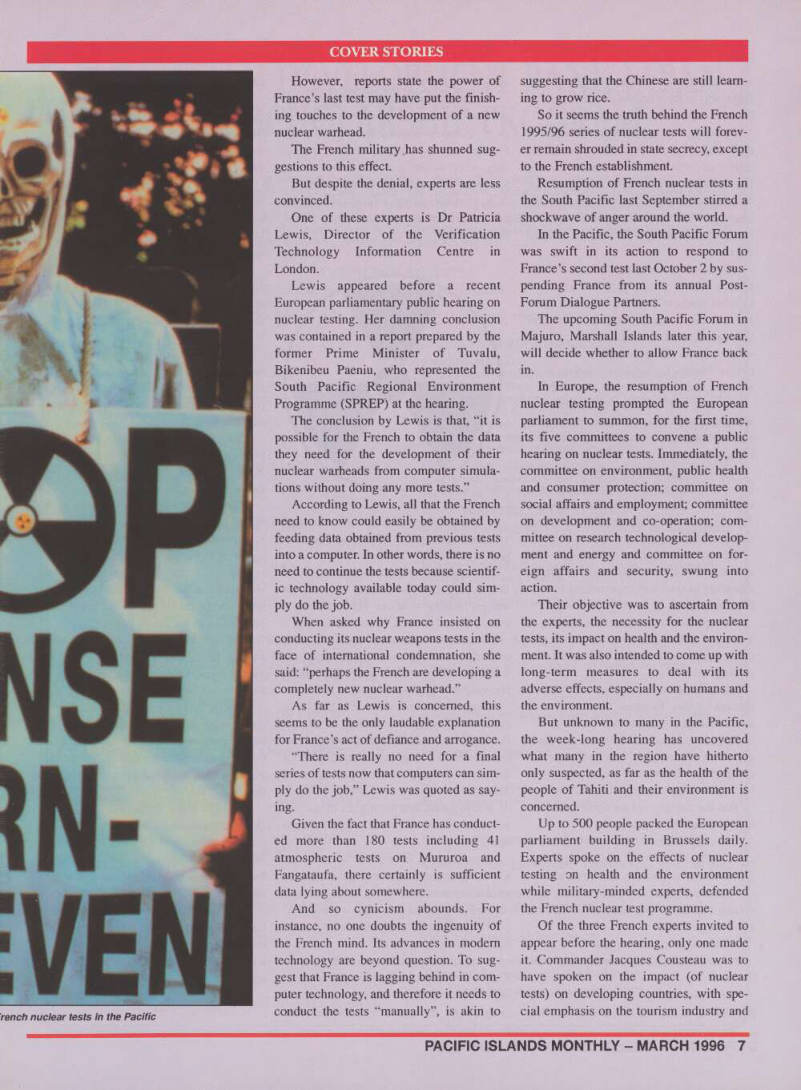
[?]rench nuclear tests in the Pacific
Alain Barthoux, Director of Testing in Paris, was to have been a co-speaker (with Lewis) on real tests versus simulations.
Pierre Lellouche, a former member of the French National Assembly and former staff of the French Institute for International Relations in Paris was the only Frenchman who appeared before the hearing. He vigorously defended the French government’s decision to conduct the tests.
His cohort, who spoke in favour of the French nuclear testing programme, was a Colonel Andrew Duncan, a retired mem ber of the International Institute for Strategic Studies in London.
He argued the tests were necessary to enable France to “explicitly arrive at an accurate and reliable nuclear warhead.”
Because of the rising anti-nuclear cru sade in Europe, the European parliament also authorised two missions to visit both Paris and Tahiti prior to the hearing.
Janssen, a spokesperson for the second European Commission fact-finding mis sion which visited French Polynesia and Paris in September, was the first to appear before the hearing.
He told the hearing the mission was refused permission to look at the results of a number of tests and experiments both in Paris and Tahiti.
The mission was also refused access to a range of data and information relating to the series of nuclear tests. The reason was military secrecy.
Members of the mission were “rushed through” other facilities that they were able to see, according to him.
Janssen concluded his mission’s find ings were not complete “due to lack of full co-operation from the French authorities both in Paris and Tahiti.”
But the findings of an earlier mission to Tahiti were an eye-opener.
The July mission was sent to investi gate the health status of the local popula tion and the impact on the environment and to determine any correlation with French nuclear testing in nearby Mururoa
and Fanagataufa.
On health, the mission found: • a serious lack of information on pub lic health; • no epidemiological data on the local population of French Polynesia since the
start of nuclear testing; • the last epidemiology study on the local population was conducted in 1965; • no cancer register had been kept by France since the start of nuclear testing, only when health was transferred to the territorial government was one started; • the mission was refused information on the number of cases of cancer of the thyroid gland;
• the people of Tahiti want close sur veillance of exposure of the local popula tion to radiation; • ciguatera (fish poisoning) has increased dramatically since the start of nuclear testing - about 5000 cases per year, indirectly linked to nuclear testing; • there is evidence of social disorder caused by immigration to Papeete, the main island of Tahiti, from the atolls, resulting in high unemployment rates.
Overall, the mission found it difficult to conclude that nuclear testing in French Polynesia was harmless and strongly rec ommended a “long-term surveillance of the health status of the local population of Tahiti.”
It also found that the impact of nuclear testing on the environment is equally dam aging.
According to its report, “even if the testing is stopped tomorrow, there is the need to monitor the test sites in order to determine volcanic and tidal wave activi ties and such monitoring should be carried out on a long-term basis.”
It said the United States and the United Kingdom shifted their tests away from atolls because they found the structural integrity of the atolls are not safe for
uiderground testing.
The mission also stated that since the stirt of nuclear testing on Mururoa, land sides and compaction have occurred sub stintially causing 50 per cent of the atoll to shk.
It said the volcanic stability of the atoll hts been greatly disturbed with 78 per cent bcreholes dug under the subterrain of Miruroa. This could cause overlap of the fisures caused by the blasts.
“Mururoa Atoll is now more fragile thn ever and very unstable. This could crate a massive tsunami (tidal wave) sbuld the landslide continue,” mission fond.
“There is strong possibility that radoactive isotopes could leak into the su rounding ocean due to the overlap of fisures from the boreholes, and contami nae the food chain.”
Other experts who appeared before the heiring spoke of the lack of data on the hedth status of French Polynesians who art working on the test sites.
They agreed with the conclusion by the World Health Organisation (WHO) that it is mpossible to say that nuclear testing is hamless to human health.
Former Prime Minister Paeniu who alsD spoke at the hearing, made particular reference to the effects of nuclear testing ontourism in the South Pacific.
But a Vanuatu travel agency reported hadng to cancel 20,000 bookings for Taliti immediately after the rioting in Papeete last September.
In Fiji, where tourism is the number one foreign exchange earner, there was widespread concern when tourist arrivals from Japan reportedly fell by 30 per cent because of fear of radiation fallouts from the French nuclear tests.
To allay these fears, the Fiji Visitors Bureau mounted a special promotional drive in Japan last October, in a bid to assure travel agents and tour wholesalers that Fiji is relatively safe from nuclear fall outs.
Whether real or imagined, tourists’ fears appear to confirm what many island leaders dread; sooner or later, the islanders
will begin paying heavily for France’s
arrogance. B