Rugged red rock
pp. 57-58 · Read in the full issue
by the sea
By Sally Andrew
Fellowship sailed East from Noumea through the Canal Woodin and into the Baie de Prony. Only a day out of Noumea, I felt lightyears away from the noise and bright lights of the city.
A walking trail a Rade de 1 ’Est led up to a lighthouse where, from the top, we could see He des Pins to the South and far up the eastern lagoon to the north. Havannah Pass looked deceptively calm. Tradition has visiting yachtspeople spelling their boat names in white shells on the red earth and encircling the name with a rock bor
der. Near Mischief, we contributed our own graffiti message.
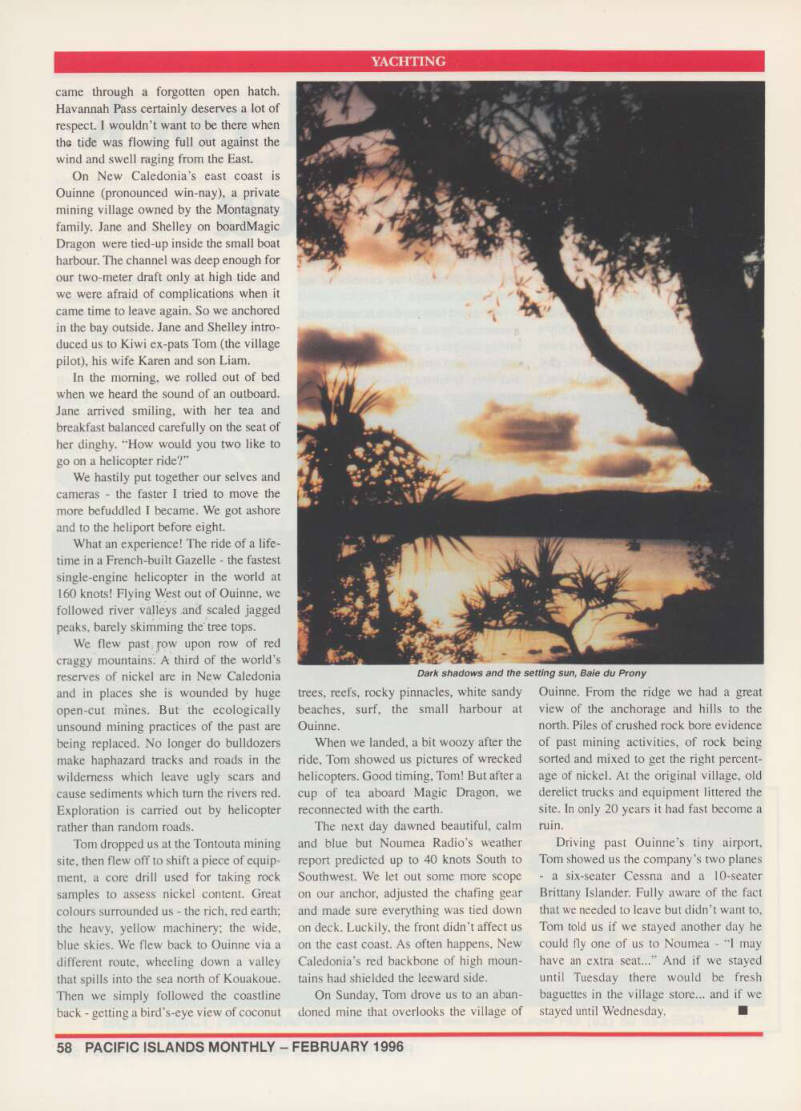
We stayed high on the hill until sunset, mesmerised by the transition of light. The setting sun gave a golden glow to the sky and water, and hard black shadows to land and trees. It turned the red gash of road burgundy.
In the morning, we pulled up the anchor and headed to Rade du Nord where ruins date back to New Caledonia’s French penal colony days. Huge trees now grow inside these derelict buildings and roofs have fallen away. Up the river are
rock pools, both placid pockets and tubs of wild whirling bubbles and waterfalls.
Fresh water wells out of the beach, just above the tide line. A barrel, deep in the sand, captures the flow. Often at a premi um, here was an endless supply of water for washing and drinking.
With no wind to leave Baie du Prony, we fired up the engine and motored east in flat water until we hit Havannah Pass. A 3.6 knot favourable current kept us mov ing, but the incoming swells made the water dance. What a washing machine!
We got pooped by a monster wave which
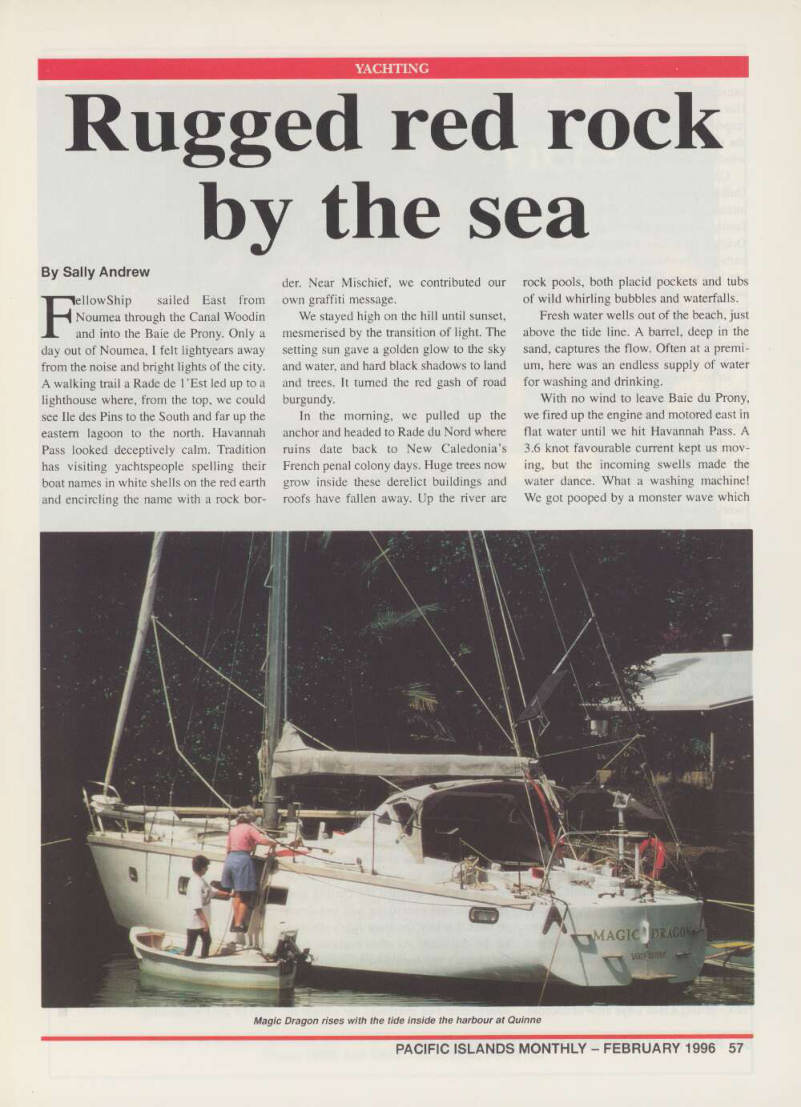
Magic Dragon rises with the tide Inside the harbour at Quinne
came through a forgotten open hatch.
Flavannah Pass certainly deserves a lot of respect. I wouldn’t want to be there when the tide was flowing full out against the wind and swell raging from the East.
On New Caledonia’s east coast is
Ouinne (pronounced win-nay), a private
mining village owned by the Montagnaty
family. Jane and Shelley on board Magic Dragon were tied-up inside the small boat harbour. The channel was deep enough for our two-meter draft only at high tide and we were afraid of complications when it came time to leave again. So we anchored in the bay outside. Jane and Shelley intro duced us to Kiwi ex-pats Tom (the village pilot), his wife Karen and son Liam.
In the morning, we rolled out of bed when we heard the sound of an outboard.
Jane arrived smiling, with her tea and breakfast balanced carefully on the seat of her dinghy. “How would you two like to go on a helicopter ride?”
We hastily put together our selves and cameras - the faster I tried to move the more befuddled I became. We got ashore and to the heliport before eight.
What an experience! The ride of a life time in a French-built Gazelle - the fastest single-engine helicopter in the world at 160 knots! Flying West out of Ouinne, we followed river valleys and scaled jagged peaks, barely skimming the tree tops.
We flew past ; row upon row of red craggy mountains. A third of the world’s reserves of nickel are in New Caledonia and in places she is wounded by huge open-cut mines. But the ecologically unsound mining practices of the past are
being replaced. No longer do bulldozers
make haphazard tracks and roads in the wilderness which leave ugly scars and cause sediments which turn the rivers red.
Exploration is carried out by helicopter rather than random roads.
Tom dropped us at the Tontouta mining site, then flew off to shift a piece of equip ment, a core drill used for taking rock samples to assess nickel content. Great colours surrounded us - the rich, red earth;
the heavy, yellow machinery; the wide,
blue skies. We flew back to Ouinne via a different route, wheeling down a valley that spills into the sea north of Kouakoue.
Then we simply followed the coastline back - getting a bird’s-eye view of coconut
trees, reefs, rocky pinnacles, white sandy beaches, surf, the small harbour at Ouinne.
When we landed, a bit woozy after the ride, Tom showed us pictures of wrecked helicopters. Good timing, Tom! But after a cup of tea aboard Magic Dragon, we reconnected with the earth.
The next day dawned beautiful, calm and blue but Noumea Radio’s weather report predicted up to 40 knots South to Southwest. We let out some more scope on our anchor, adjusted the chafing gear and made sure everything was tied down on deck. Luckily, the front didn’t affect us on the east coast. As often happens. New Caledonia’s red backbone of high moun tains had shielded the leeward side.
On Sunday, Tom drove us to an aban doned mine that overlooks the village of
Ouinne. From the ridge we had a great view of the anchorage and hills to the north. Piles of crushed rock bore evidence of past mining activities, of rock being sorted and mixed to get the right percent age of nickel. At the original village, old derelict trucks and equipment littered the site. In only 20 years it had fast become a ruin.
Driving past Ouinne’s tiny airport, Tom showed us the company’s two planes - a six-seater Cessna and a 10-seater Brittany Islander. Fully aware of the fact that we needed to leave but didn’t want to, Tom told us if we stayed another day he could fly one of us to Noumea - "I may have an extra seat...” And if we stayed until Tuesday there would be fresh baguettes in the village store... and if we stayed until Wednesday. ■
Dark shadows and the setting sun, Baie du Prony