again
pp. 55-56 · Read in the full issue
Yachting
Warriors once again
By Sally Andrew
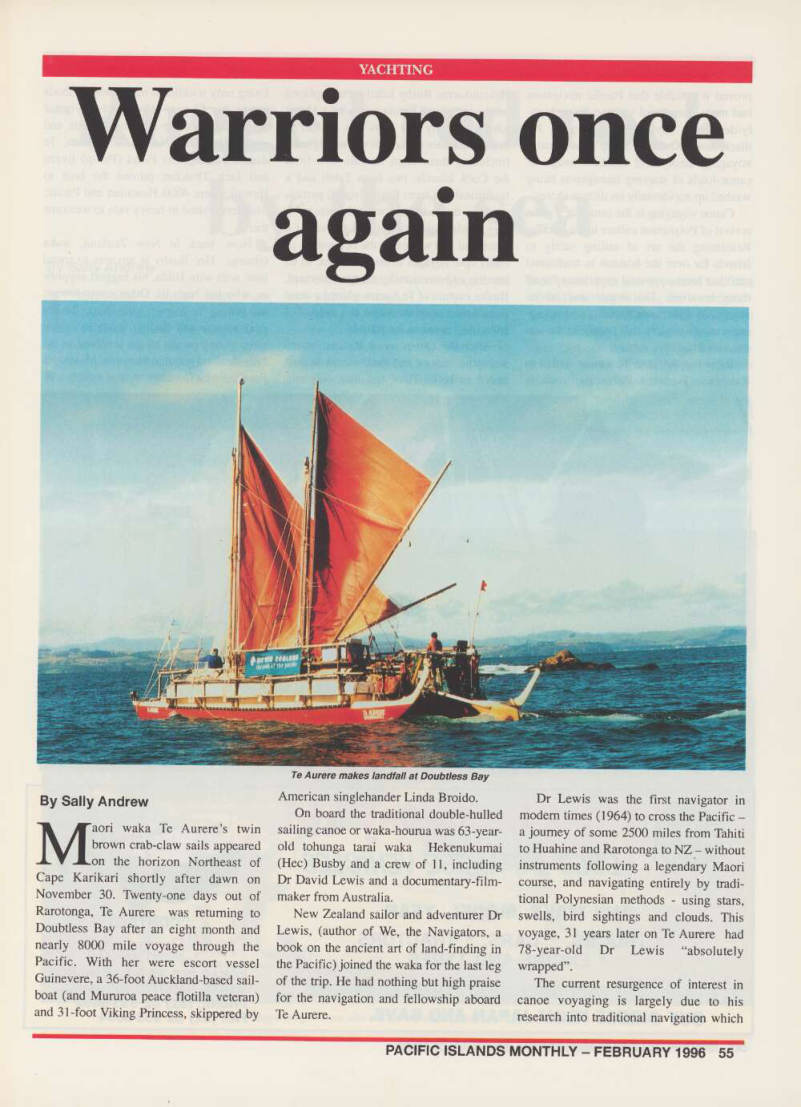
Maori waka Te Aurere’s twin brown crab-claw sails appeared on the horizon Northeast of Cape Karikari shortly after dawn on November 30. Twenty-one days out of Rarotonga, Te Aurere was returning to Doubtless Bay after an eight month and nearly 8000 mile voyage through the Pacific. With her were escort vessel Guinevere, a 36-foot Auckland-based sail boat (and Mururoa peace flotilla veteran) and 31 -foot Viking Princess, skippered by
American singlehander Linda Broido.
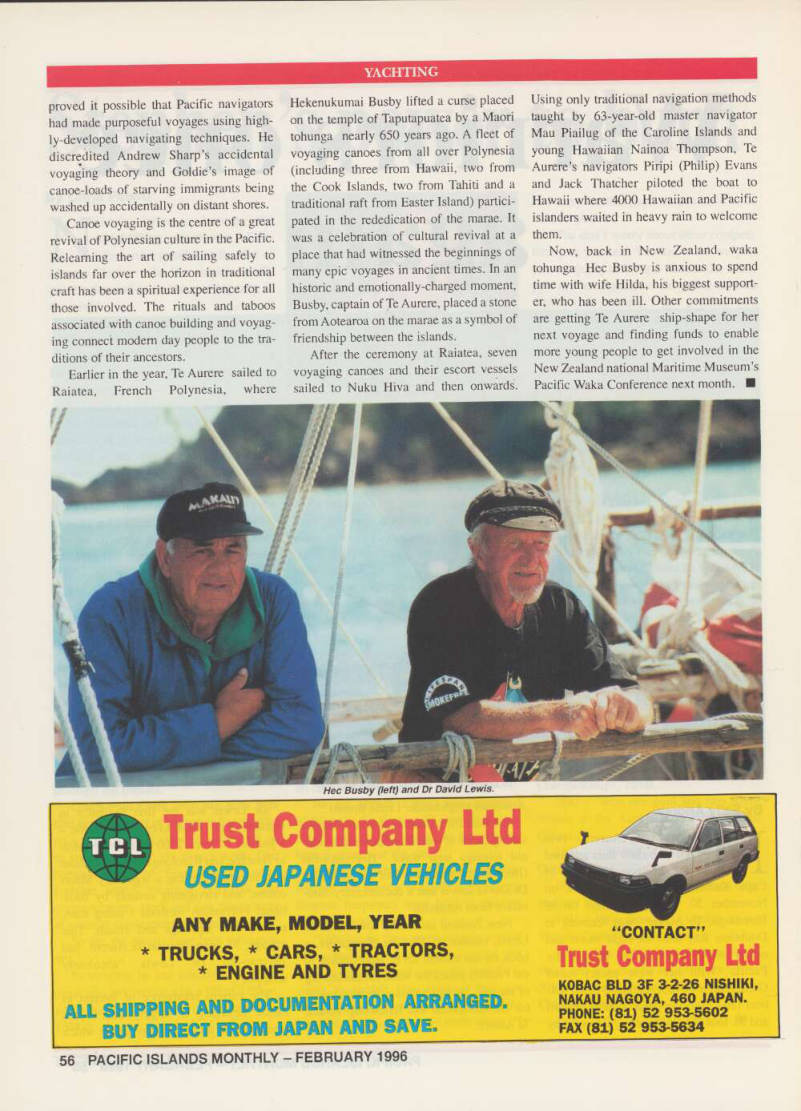
On board the traditional double-hulled sailing canoe or waka-hourua was 63-yearold tohunga tarai waka Hekenukumai (Hec) Busby and a crew of 11, including Dr David Lewis and a documentary-filmmaker from Australia.
New Zealand sailor and adventurer Dr Lewis, (author of We, the Navigators, a book on the ancient art of land-finding in the Pacific) joined the waka for the last leg of the trip. He had nothing but high praise for the navigation and fellowship aboard Te Aurere.
Dr Lewis was the first navigator in modem times (1964) to cross the Pacific a journey of some 2500 miles from Tahiti to Huahine and Rarotonga to NZ - without instruments following a legendary Maori course, and navigating entirely by tradi tional Polynesian methods - using stars, swells, bird sightings and clouds. This voyage, 31 years later on Te Aurere had 78-year-old Dr Lewis “absolutely wrapped”.
The current resurgence of interest in canoe voyaging is largely due to his research into traditional navigation which
Te Aurere makes landfall at Doubtless Bay
proved it possible that Pacific navigators had made purposeful voyages using high-
ly-developed navigating techniques. He
discredited Andrew Sharp’s accidental voyaging theory and Goldie’s image of canoe-loads of starving immigrants being washed up accidentally on distant shores.
Canoe voyaging is the centre of a great revival of Polynesian culture in the Pacific, Relearning the art of sailing safely to islands far over the horizon in traditional craft has been a spiritual experience for all those involved. The rituals and taboos associated with canoe building and voyaging connect modem day people to the traditions of their ancestors.
Earlier in the year, Te Aurere sailed to Raiatea, French Polynesia, where
Hekenukumai Busby lifted a curse placed on the temple of Taputapuatea by a Maori tohunga nearly 650 years ago. A fleet of voyaging canoes from all over Polynesia (including three from Hawaii, two from the Cook Islands, two from Tahiti and a traditional raft from Easter Island) participated in the rededication of the marae. It was a celebration of cultural revival at a place that had witnessed the beginnings of many epic voyages in ancient times. In an historic and emotionally-charged moment, Busby, captain of TeAurere, placed a stone from Aotearoa on the marae as a symbol of friendship between the islands.
After the ceremony at Raiatea, seven voyaging canoes and their escort vessels sailed to Nuku Hiva and then onwards.
Using only traditional navigation methods taught by 63-year-old master navigator Mau Piailug of the Caroline Islands and young Hawaiian Nainoa Thompson, Te Aurere’s navigators Piripi (Philip) Evans and Jack Thatcher piloted the boat to Hawaii where 4000 Hawaiian and Pacific islanders waited in heavy rain to welcome them.
Now, back in New Zealand, waka tohunga Hec Busby is anxious to spend time with wife Hilda, his biggest support er, who has been ill. Other commitments are getting Te Aurere ship-shape for her next voyage and finding funds to enable more young people to get involved m the New Zealand national Maritime Museum’s Pacific Waka Conference next month. ■
Hec Busby (left) and Dr David Lewis.