Who’s next PM?
p. 58 · Read in the full issue
Politics
By Chris Peteru
TEASER: It’s not who is going to win and who is going to lose, but how much I am going to beat you by - ANON A government officially accused of being corrupt and poorly managed would usually by election time have voters wav ing them goodbye at the ballot box.
However, Western Samoa’s ruling Human Rights Protection Party (HRPP) looks a clear winner in the upcoming April general elections, despite questions over whether the only human rights they have protected are their own and their political allies’.
The whole issue of alleged shaky deals, money-making scams, and government skullduggery was brought to light in a 1993 tabled report by the (now suspended) controller and chief auditor Sua Rimoni Ah Chong.
Most Samoans are aware of the number of questionable practices an elected administration gets up to anyway.
The real sticking point for die Tofilau Eti Alesana government, was being seen internationally as a democracy with dis honest intentions. Just like Wall Street bond salesman being found out for insider trading.
As Sua battles on in court to have him self and his report vindicated, come elec tion time the effect on the government vote would be the equivalent of dating Whitney Houston, and discovering she had heavy duty athletes foot. Bad, but not disastrous.
Riding a monster 19-seat majority in the 49-member legislative assembly, the
government is helped along enormously
by an opposition that in the last five-year term, has largely been keeping the bench es warm for the next group of unfortunates to land on.
The Samoa National Development Party (SNDP) makes up the largest of the four opposition groups. Its leader Tuiatua Tupua Tamasese is a direct descendant of the Samoan monarchy. A one time prime minister, he possesses formidable oratory skills. But his complete failure to organise anything resembling a viable political alternative, ensures the HRPP an easy road to the treasury benches.
The opposition, with no party mani festo or shadow ministers to speak on issues of the day during debate in the house, has over the years given them a look of solid impotence.
One result of this has seen at least three opposition MPs cross the floor and join the government.
In between sessions, Tuiatua is fre quently overseas on the university lecture circuit. Whether this is the winning recipe for the SNDP to become government is unlikely; as is the notion of a blue-blooded politician ever again becoming prime min ister.
As if being routed in parliamentary debates was not enough, the opposition has little to crow about in the terms of eco nomic development or significant legacies from their last term in office in 1987.
The one chink in the HRPPs armour for re-election, is the ailing health of PM Tofllau, which over the months has steadi ly gone into decline.
Speculation that he was on the verge of retiring, came to nought when the 71 -year old announced his intention to stand again, following the Commonwealth Head of Government Meeting in New Zealand in November. Tofilau added that he was pre pared to remain P.M if that was what the Party wanted.
Insiders believe that Tofilau, a 36 year Parliamentary veteran and the longest serving PM, needs to stay on as leader to keep a number of rampaging egos in the check - and the party from splitting.
The Polynesian attitude of respecting elders means that only divine intervention can stop the prime minister from extending his record eight-year term as leader come April. But that’s if he can last the distance, without starting to sound like Ronald Reagan in his twilight years as president.
On a official state dinner in Brazil, Reagan stood up and solemnly proposed a toast “to the wonderful people of Bolivia”.
For Tofilau major heart surgery, fol lowed in the past 18 months by treatment for gastro-intestinal bleeding, eye surgery and an operation on his prostate gland have concerned party supporters, knowing the importance of having a leader, who if not young and drug free is old and vigor ous. If for whatever reason the PM can’t make it to the ballot box starting line, the odds of the HRPP falling over itself in a
stampede for the leadership and damaging
its election chances markedly increases.
The two most likely to press for the leadership are deputy prime minister Tuilaepa Sailele Malielegaoi and agricul ture, forest and fisheries minister Misa Telefoni Retzlaff.
Both want the job badly.
Aside from giving the finat'"okayTor millions of dollars to be channelled into the infamous Polynesian Airlines debacle, he has methodically overseen a period of
infrastructural development and progress unmatched by any other administration in the tiny nation’s history.
Short, shrewd and blunt, Tuilaepa may not be the kind of man you want your sis ter to take a liking to. In Samoan terms, he has the respect of most while his loyalty to the PM is unquestioned. Equally short and shrewd, Misa Retzlaff is a millionaire businessman turned cabinet minister. A former lawyer, Misa arrived in parliament at the last election in 1990 on the SNDP ticket. Unable to secure the party leader ship he quickly switched camps and was given a cabinet post for his efforts.
Perceived as hardworking, honest and effective he enjoys the traditional support of the affluent half-caste community and a growing number of farmers. In contrast to Tuilaepa who has a healthy disregard for the media, Misa has consciously cultivated a high-profile image in his bid for the lead ership.
Ironically, the photogenic minister vig orously defended the controversial Printers and Publishers Act when passed by government, forcing journalists to reveal their sources if taken to court, or think it over in jail. As the usual ritual involving hundreds of thousands of tala in “gifts”, passes from eager candidates to win votes continues, in reality HRPP could start working on policies for the next five years tomorrow. The SNDP has all but thrown in the election towel. A lack of a creditable opposition means the erosion of a robust process and the emer gencc )5f a'ppe-party state in all but name.
Just capital of Apia is a , prominent joad that crosses island for miles, dissectiiig bpfen fieldjs, fresh crops and new developpiqhts.
The SNDP road sign is a lot shorter and travels directly past the country’s only prison and ends at the country’s biggest rubbish dump.
For the 1996 election anyway, that real ly says it all. ■
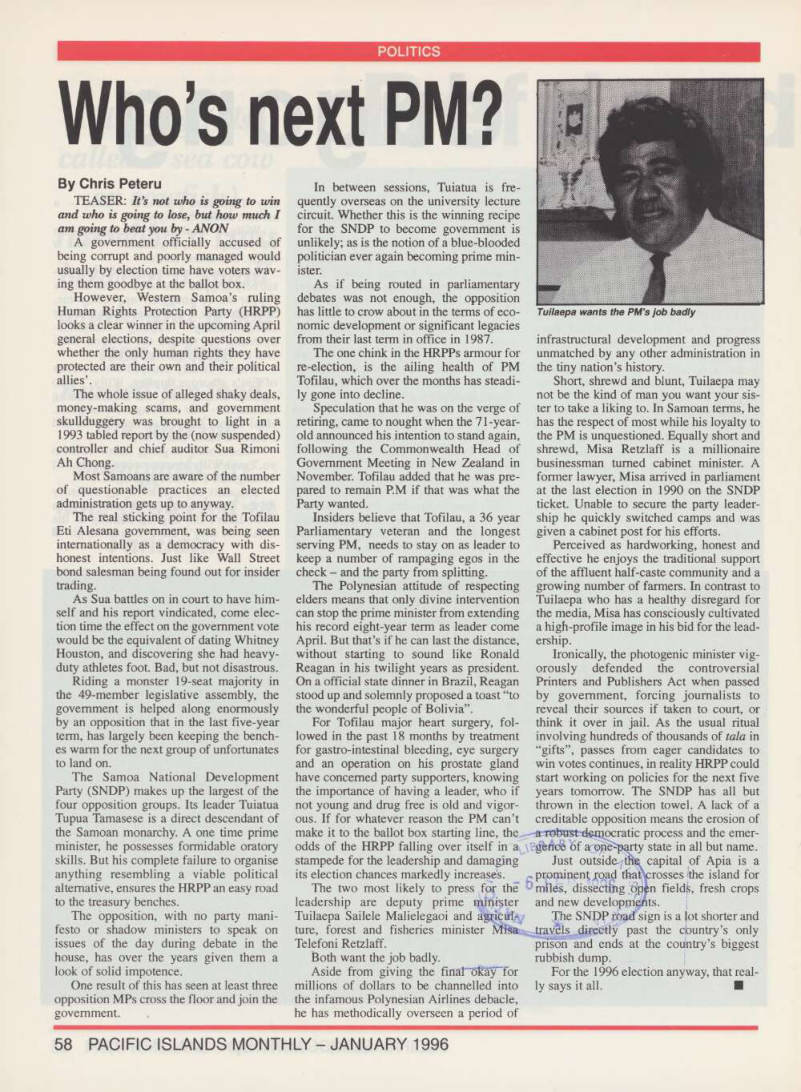
Tuitaepa wants the PM’s job badly