APEC and trade policy
pp. 18-19 · Read in the full issue
Business
For more than five years the Forum Secretariat has been involved in the rapidly accelerating process of Asia- Pacific economic integration through Asia Pacific Economic Co-operation Council (APEC). The function that the Forum Secretariat has been given in APEC has been that of observer - a notetaker, tagging along in a process that looks very much like it will take the whole of the Asia- Pacific Basin into a trade block in the next quarter century. Six or seven years ago, when APEC was just a high-flying talk shop for academics and then subsequently political leaders in the Asian basin, Australian Foreign Affairs, which was the parent of the organisation, assured every one that APEC was not a trade block, had no intention of ever becoming one and that anyone who thought otherwise was com pletely naive or, at worst, some sort of con spiracy theorist. Almost everyone who cared to listen to the academics that were involved in APEC heard that the protesta tions of Foreign Affairs in Canberra was clearly a case of the “wench who doth protest too much”. When US President Bill Clinton emerged in 1993 from the Seattle APEC meeting and announced that by 2020 the countries of the Asia-Pacific region to form a trade area no-one was the slightest surprised. The decision was reconfirmed by APEC leaders again last year in Indonesia and now serious work is beginning on the implementation of the
proposal following the APEC meeting in
Osaka in November 1995.
The APEC trade area proposal is not the only proposal for an Asian trade integra tion. Asean, the Association of South East Asian Nations, is also moving on a trade area by 2005 and the Australians and New Zealanders are busily moving to try and enter an extended Asean block that includes them both. Both Australia and New Zealand have made it quite clear that their future lies with Asia and are integrat ing their economies as well as their popu lations with that of Asia as rapidly as the internal policies will permit.
But where does this leave the Pacific Islands? The islands are once again merely observers - mere objects in the making of their own history with leaders who are unwilling or unable to form anything that even faintly resembles a coherent and con sistent trade policy position. The islands, especially in terms of their trade policy, are by no means a homogeneous collection.
The Papua New Guineans, true to their ‘look North’ policy, are also concentrating on Asia as their main markets as well as the main source of capital for their future
development. PNG, for whatever else can be said, is an aggressive members of international trade fora and participates as the only Pacific Island member of APEC. It has also joined the World Trade Organisation as well as being one of the most active proponents of regional trade agreements like the Melanesian Spearhead Group Trade Agreement. The Solomon Islands and Vanuatu have also pursued bilateral and multilateral trade liberalisation with their neighbours. The Solomon Islands is now the third of the Pacific Island countries to have joined the World Trade Organisation and Vanuatu is in the process of negotiating a much-delayed bilateral trade agreement with Fiji.
The most successful example so far of trade liberalisation is the Melanesian
Spearhead Group Trade Agreement, signed
in 1993. When the negotiations for this trade agreement began in the early part of the decade it looked like the only trade that would occur in Melanesia would be bullets between the Solomon Island and PNG across the straits separating the western province of the Solomon Islands and Bougainville. However, despite what was the most inhospitable political climate for trade treaty negotiations the three MSG partners, reflecting in part an unusual willingness to co-operate despite the political turmoil, signed a limited three-commodity agreement. The treaty, while limited, was a
tribute to the on-going ability of the MSG states to co-operate and to see their eco nomic interests. Under the terms of the MSG agreement, PNG, Solomon Islands and Vanuatu agreed to allow tea from PNG, Solomon Island canned tuna and Vanuatu beef into their markets duty free.
For Vanuatu, this was almost meaningless as, in PNG, its main target market, their margin of preference was almost nothing.
In the wake of the agreement what did develop was a trade in beef between Solomon Islands and Vanuatu where
Vanuatu enjoyed a significant margin of
trade preference over Australian beef.
Many observers felt that the MSG trade agreement would become just another meaningless international trade agreement that so many Pacific Island countries sign.
Pacific leaders love signing agreements and, if you talk to legal draftsmen, they will tell you their vaults are full of agree ments that were a waste of good treaty paper because no-one even remembers they were signed. Much to everyone’s shock, this year, the MSG heads of govern ment agreement extended the new trade agreement to over 140 tariff lines. For the first time it looks like the MSG leaders may actually be serious about trade liberal isation rather than just offering token ges tures. In part though, the broadening of coverage of the agreement is a result of the fact that very little trade developed as a
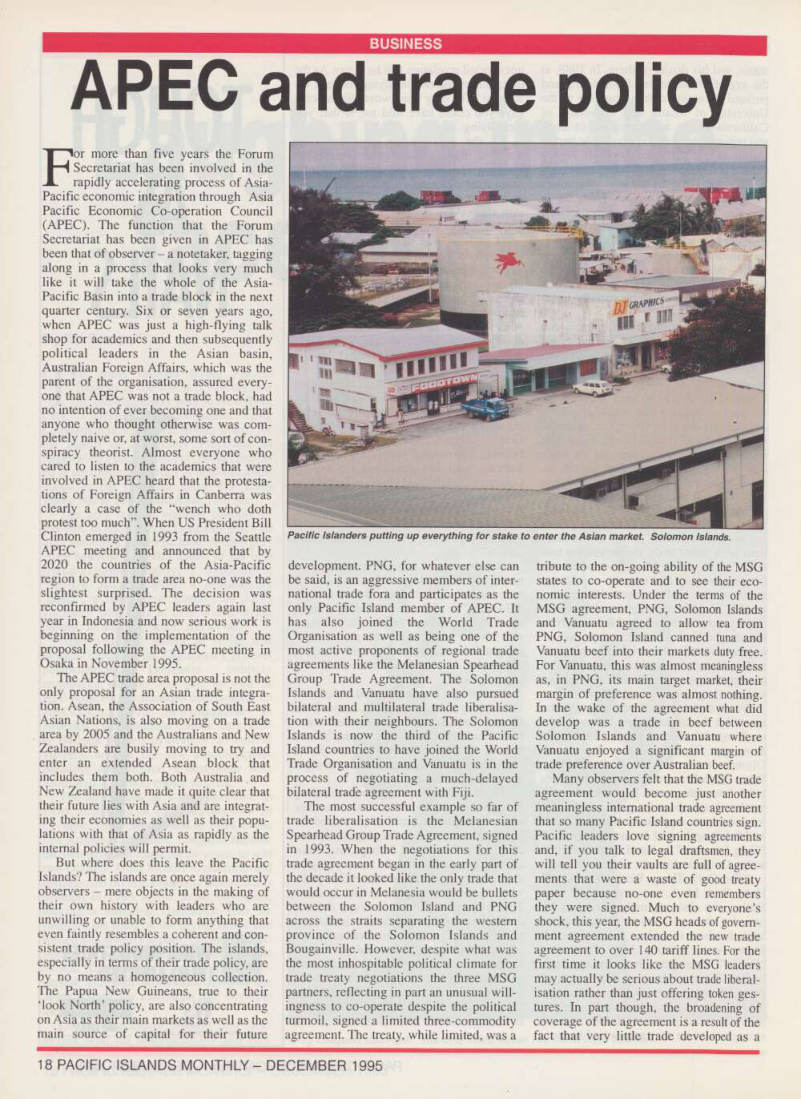
Pacific Islanders putting up everything for stake to enter the Asian market. Solomon Islands.
result of the initial trade agreement - espe cially with PNG. The problem with trade agreements is that the only time they bene fit anyone is when prices decrease because trade is occurring between a more efficient country and a less efficient one. But, if the less efficient country is producing the good that is being imported then the workers and their employers will be hurt as a result of the trade agreement. For the moment there has been no pain and there is still no evi dence that the MSG leaders or any other Pacific Island leaders are willing to allow consumers to benefit from cheaper imports at the expense of local production, despite all the treaties and pious pronouncements about regionalism and trade liberalisation.
But the MSG is not the only group that is moving to liberalise trade. PNG and Fiji have signed a very limited agreement with a small number of commodities, including coffee. Fiji, despite numerous invitations to join the MSG, declined. The reason is that despite what appears to many outsiders as a superficial physical similarity between Fijians and Melanesians, culturally Fijians are Polynesians. More importantly, the tra ditional power centre of Fiji, the Lau Group of islands, and Bau Island are all Polynesian and the ruling elite, while hav ing economic interests in Melanesia, sees its traditional cultural roots in Polynesia.
The Fiji position has been to attempt to negotiate bilateral trade agreements with its trading partners. Unlike so may other policies in the region, Fiji’s policy bilater alism has grown from a conscious policy decision of the Fiji Government. The poli cy has resulted in a number of treaties but each is of very limited economic value. Fiji must be applauded for leading the way in trade liberalisation, however, the bilateral approach has numerous difficulties. While Fiji wants biletral trade agreements with Australia, New Zealand and each of the many Pacific states it has little capacity to negotiate and monitor them. As a result, there are agreements with Tonga, that have recently been signed, agreements with Vanuatu, that are still pending, and there has been a long standing trade agreement with Tuvalu on artifacts. Fiji has just announced its intention to negotiate a sep arate treaty with Australia. It will be inter esting to see what Fiji can possibly obtain in such negotiations over and above the free trade access it already has into the Australian market. But the very limited trade agreements that Fiji is negotiating with its island neighbors will only be ben efits to Fiji and will only be of any real use once there are wider free trade agreements.
Wide-ranging treaties are difficult and their
negotiation is very time consuming, requir
ing large amounts of skilled manpower on both sides.
The tokenism of limited two and three commodity trade agreements, while result ing in some political mileage is of little
economic use and is probably illegal under WTO (GATT) rules. As both Fiji and PNG are WTO members they will have to notify GATT that they have signed a limited pref erence trade agreement. GATT only accepts these agreements if it is clear that they are intermediate stages on the way to more general trade agreements. It will sim ply not be possible for Fiji to negotiate these types of agreements and keep them on the books for long without negotiating the much tougher free trade agreements.
All this hedging against real free trade begs a much bigger question regarding the future of the Pacific Island states in APEC and in its relations with its bigger Asian and Pacific trading partners. The negotia tions on trade liberalisation within the Pacific Islands region have begun but they are not yet at the stage where they are seri ous. Most observers do not feel that, at least for the foreseeable future, the island leaders will be serious because of the domestic considerations.
However, the big question that trade policy makers in the islands are not con fronting is what will the islands will do as Asean and APEC move to become free trade areas, especially as Australia and New Zealand join. Can we afford to stay out? Almost certainly not because we will be excluded from the huge boom in trade that will almost certainly occur. In order to join in we will have to liberalise as well and the liberalisation of trade and lowering of trade barriers that will be needed in order to participate is much more pain and adjustment than the island states are cur rently willing to accept.
The islands must adjust to a freer trad ing environment and the best way is to begin with ourselves. Whenever anyone raises the question of Pacific Island trade areas the cynics always respond that we cannot sell coconuts to each other. (In fact, we actually do). Trade liberalisation, even in the islands, will create opportunities that no-one can foresee but these will only come when we create unified markets. We are too small to survive in the long term as micro units that we inherited from our colonial masters. The long term is quickly arriving and our growth rates are dropping along with our prospects for the future.
Once again, trade liberalisation and region alism are beckoning as a preparatory stage before the much bigger adjustment we must make in twenty five years to free trade with the rest of Asia. If our leaders are unwilling to make what are minor eco nomic adjustments to accommodate freer trade with other islands how are we to respond to the far greater challenges loom ing as a result of Asia-Pacific integration?
It is time for history to create leaders with vision for a future and if history does not create these leaders then we should be hon est and tell our children that their best hope is to emigrate. ■