face of death
pp. 16-17 · Read in the full issue
Profile
Laughing in the face of death
By Ed Rampell
The most famous living Pacific Islander in the world is starring in a hit Off-Broadway play in New York
City. Olympic gold-medalist Greg
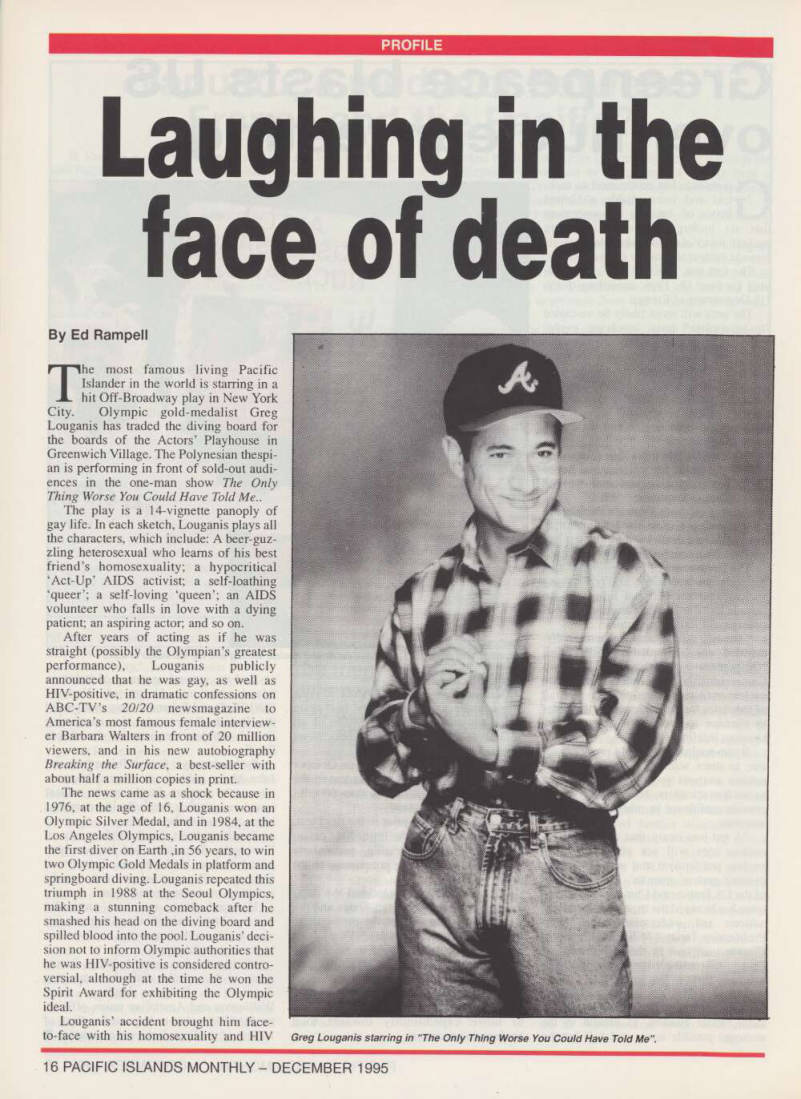
Louganis has traded the diving board for the boards of the Actors’ Playhouse in Greenwich Village. The Polynesian thespi an is performing in front of sold-out audi ences in the one-man show The Only Thing Worse You Could Have Told Me..
The play is a 14-vignette panoply of gay life. In each sketch, Louganis plays all the characters, which include: A beer-guz zling heterosexual who leams of his best
friend’s homosexuality; a hypocritical
‘Act-Up’ AIDS activist; a self-loathing ‘queer’; a self-loving ‘queen’; an AIDS volunteer who falls in love with a dying patient; an aspiring actor; and so on.
After years of acting as if he was
straight (possibly the Olympian’s greatest
performance), Louganis publicly
announced that he was gay, as well as HIV-positive, in dramatic confessions on ABC-TV’s 20120 newsmagazine to America’s most famous female interview er Barbara Walters in front of 20 million viewers, and in his new autobiography Breaking the Surface, a best-seller with about half a million copies in print.
The news came as a shock because in 1976, at the age of 16, Louganis won an Olympic Silver Medal, and in 1984, at the
Los Angeles Olympics, Louganis became
the first diver on Earth ,in 56 years, to win two Olympic Gold Medals in platform and
springboard diving. Louganis repeated this
triumph in 1988 at the Seoul Olympics, making a stunning comeback after he smashed his head on the diving board and spilled blood into the pool. Louganis’ deci sion not to inform Olympic authorities that he was HIV-positive is considered contro versial, although at the time he won the
Spirit Award for exhibiting the Olympic
ideal.
Louganis’ accident brought him face to-face with his homosexuality and HIV
Greg Louganis starring in "The Only Thing Worse You Could Have Told Me”.
status, and his denial of them. In 1988, at the age of 28 he retired from diving and pursued an acting career, studying at the University of Miami and University of Califomia-Irvine, and appearing in stock and regional theatres. He played the part of Darius in the Off-Broadway hit Jeffery (which is now a film without Louganis).
As one of the many characters Louganis depicts in The Only Thing Worse You Could Have Told Me... he declares: “It’s better to be hated for what you are than liked for what you’re not... It’s hard to be natural.” This is the play’s recurring motif - the need to be true to one’s self, to be the “you” that is “you”, even if this is considered by many to be socially unac
ceptable.
This is something that Louganis can relate to since, for years, he hid his sexual preference being an athletic persona.
Louganis has learned in his own life the play’s theme of self-acceptance. At 35, Louganis is too old to be a professional athlete - indeed, his hair is half grey now, although the one-time Olympian maintains his athletic build (which Louganis exhibits in the one-man show, changing on stage and playing one character in his briefs, much to the delight of the about 200 men and women in the mostly male audience).
But in The Only Thing Worse...
Louganis proves that he is not merely trad ing in on his celebrity status and is more than just a pretty body, demonstrating true talent as an actor. The show alternates between comedy and tragedy, requiring a performer to really stretch. Portraying roughly 20 different characters, Louganis displays great acting range from the gay to the straight, bitch to butch, compassionate to passionate. He dives right into his parts and is always believable. Louganis also has great rapport with the appreciative audience largely composed of his fans.
In one sketch about “outing” gays who are still in the closet, hiding homosexuali ty, Louganis’ character talks knowingly about gay Olympic figure skaters and Olympic swimmers in their speedos.
When the audience cracks up, Greg glares at his fans with a mock pout. However, in another sketch about the great men of his tory who have supposedly been gay, such as Michelangelo and Leonardo, although “Greg Louganis” is listed in the original script, Louganis does not mention himself.
“The Only Thing Worse You Could Have Told Me,” was written by Dan Butler, who also originally starred in the one-man show. However, Butler had to leave the show to resume shooting the hit
Emmy-award winning NBC-TV sitcom
“Frasier”; Butler plays the sports announc er Bob “Bulldog” Briscoe. The length of the play’s run is open-ended, and the sig nificance of its title is revealed in one of the drama’s last sketches, about a father’s struggle to come to terms with his son’s
unexpected revelation that he is gay. As the disappointed parent lies dying, he tells his son that “The only thing worse (than being gay) you could have told me is that you
were dying...”
At the performance this reviewer attended, the audience gave Louganis a standing ovation. He seemed fit but some times short of breath - which could simply be a result of the rigours of doing a one man show. After the play, copies of Greg’s autobiography were sold in the theatre, and Louganis was mobbed by up to 50 fans outside the entrance to the theatre on Seventh Avenue. Sporting several earrings on his left ear, Louganis autographed copies of his book, posters, photos, etc., and seemed to enjoy the love of his fans.
After about a half-hour wait, this critic finally had a chance to talk with world
famous Greg Louganis, greeting him in
Samoan.
Surprisingly, the afakasi Olympian
does not seem to speak a word of Samoan, and he has never been to his ancestral homeland. Louganis said, “I was raised by
Greek(-American) parents,” although he
believes his natural father is Samoan. A Samoan man has identified himself as
Louganis’ biological father, but Greg
seems unsure as to whether or not this man really is his birth father. The actor’s publi cist stated that Louganis does not know if his parentage is from Western or American Samoa.
Nevertheless, Louganis seemed gen uinely anxious to leam about and experi ence his Polynesian roots. “I’d love to go to Samoa!” he exclaimed. Kidding around, Scott Allyn, producer of The Only Thing... said “We’re going to do the play there tonight!” But Louganis thought bringing the play to American and Western Samoa is a great idea.
How would Louganis - and his contro versial play - be received in Samoa? On the one hand, Samoa has many fundamen talist churches. On the other hand, Samoa has the Polynesian custom of the fafine (transvestite), and traditionally accepts some forms of homosexuality.
There is a strong parallel between Greg Louganis’ gayness and Polynesian heritage in the sense that the athlete pretended for years he was straight, keeping his homo sexuality in the closet. Perhaps, in a simi lar way, Greg acted like he was a palagi, a dark southern or Mediterranean European, when in fact he is afakasi, half Samoan.
This is a natural - if not honest - defence mechanism in a homophobic, sexist and racist society. Just like the diver came out of the closet about his sexual preference and accepted himself, maybe Louganis can embrace his Samoan side and fully realise his Polynesian identity. It may be that this Olympian’s ultimate odyssey will lead him to the island of his South Seas ancestors.®