“Conversations With The
p. 58 · Read in the full issue
Books
“Conversations With The Cannibals”
Reviewed by Derek Parker
A dispute about whether human but tocks taste better than breasts is typical of this interesting, eccentric book. Krieger, an American journalist who specialises in maritime affairs, recounts his travels to Vanuatu, the Cook Islands, the Soloman Islands and Tuvalu. He is interested in the Pacific nooks and cran nies that the 20th century has touched only recently or not at all, and avoids discus sions with political and social worthies in preference of the view from the bottom up.
Yes, he says, there are enough beautiful
beaches and astonishingly friendly people
here to fill any number of glossy tourist brochures. But romantic isolation often comes with deprivation and poverty, and he carefully avoids falling into the trap of cultural stereotypes. Yes, he does meet several cannibals - or, more specifically, “ex-cannibals” - and even provides a num ber of recipes, all of which make one want to become a vegetarian.
There are numerous other odd vignettes, such as the remote island of Palmerston (population 61), where the crumbling church is made of timber sal vaged from shipwrecks and the peace is periodically destroyed by both the local petty tyrant and the island’s generator.
A recurring theme is the clash between past and present. Village social structures that have lasted for thousands of years are crumbling as the young generation moves to the towns, and even the older people sometimes seem mystified by their own lifestyle and beliefs. The South Pacific, muses Krieger, is in transition, but no-one knows what might lie at the end of the road.
One illustration of this is Kreiger’s encounter with the John Frum cult in Tanna. The movement is, in fact, some what more complex than is often por trayed, and sits uneasily with the
Christianity also practised by the cult’s
adherents. The movement is often thought
to have begun vf'tlkdie
soldiers duringiVro
seems to hava startetQpij^eth^^O^ 3 somehow as a result of the ottwiM damentalist CAastian missionaries and the
ensuing clash ivith traditional tiSCp^Q l
tices. I
Despite thl peculiarity of some of the
cult’s beliefs, such as that the messiah lives in the local volcano with his 5000man army, the cult shows no sign of dying out, much to the chagrin of the govern ment in Vanuatu. Its long-term future, however, is more difficult; Krieger found a mixture of doubt and embarrassment among the young men and women he spoke to. Despite the belief that John Frum will one day return with all manner of Western consumer goods, Tanna remains mired in poverty, alleviated only by occa sional tourist dollars.
Another of the book’s episodes deals with the Kwiao, a primitive tribe living in scattered villages in the highlands of Malaita, in the Solomons. The tribe’s name translates to “I Will Kill You”, although they are now much less fearsome than they once were. In fact, they seem somewhat
pathetic, ignored by the central govem
mentand living on a subsistence diet.
J'ueiL Myea seem unnecessarily hard and
t includes, in an appendix tt&he boc*, information on a fund created to provide basic health services for the
Kwiao pepple.
At a more basic level, Krieger gives the family wliich has acted as guide a parting
gift: a small collapsible shcovel to help with the farming. The value of it says much about the plight of the Kwiiao: it will prob ably extend the lives of thie family mem bers by five years. Krieger found the deci sion to give it difficult, aiware that even simple gifts, when introduced into another culture, can be as destructiv/e as they might be helpful. But eventually' he decided to take the chance, and the gesture was appre ciated.
Unfortunately, this sort of personal insight is rare in the book. In fact, there is a sense of disjointedness to Conversations with the Cannibals. The chapters bear no real relationship to one another, and Krieger seems unsure of the sort of ques tions he wants to ask those he meets. He apparently wants to simultaneously be the outsider looking in and the insider provid ing cultural detail. Understandably, he often fails to do either job properly.
Perhaps the book could have been improved by more careful editing and a more considered selection of interview subjects. Nevertheless, it has some inter esting stories to tell about otherwise unknown parts of the world. ■
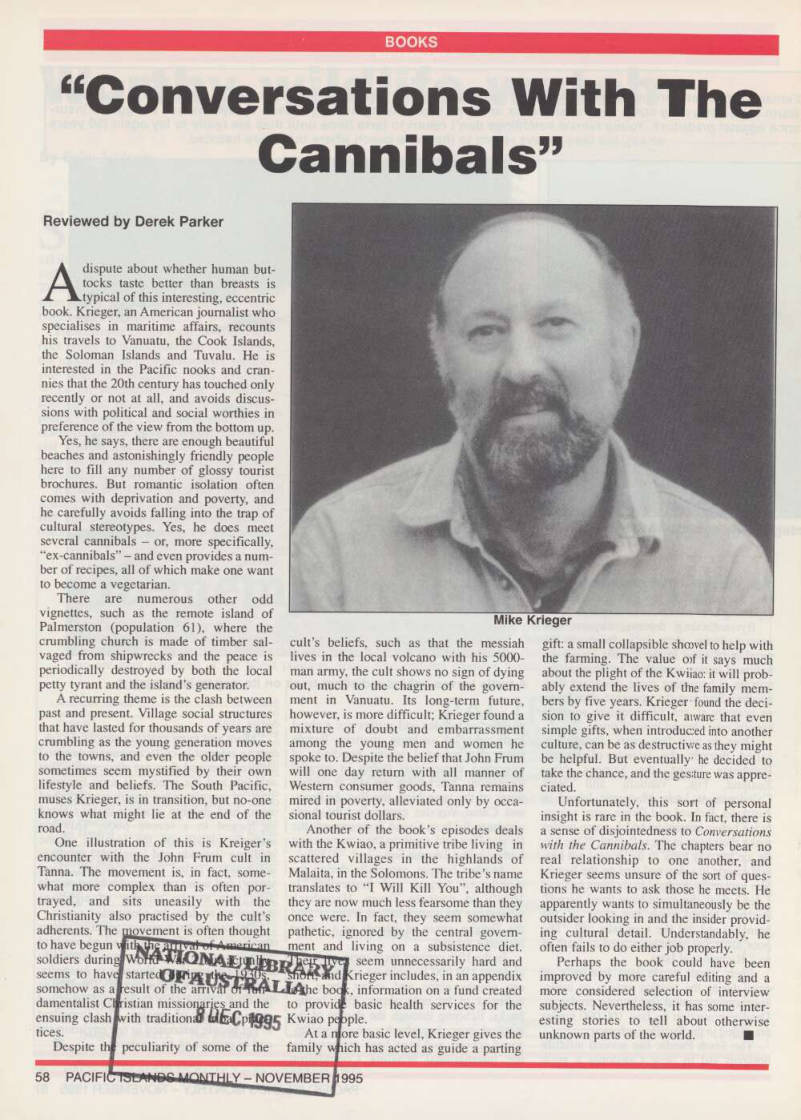
Mike Krieger