Worthy wildlife watch
pp. 56-57 · Read in the full issue
Yachting
By Sally Andrew
Soon after they began cruising,
Richard and Debra Boileau read an article in Cruising World magazine asking for volunteers to report sea turtle sightings to the Archie Carr Centre for Sea Turtle Research. Anxious to help the long term study of turtle movements, they began wildlife reporting.
Richard and Debra keep several refer ence books on board their boat to help with the identification of sea mammals, reptiles and birds, as do many other cruisers.
While on passage and while at anchor, Richard and Debra spotted whales, dol phins, dugongs, albatross and lesser seabirds. Turtles, though, remain their spe cial interest and they still work closely with the sea turtle research centre at the University of Florida in Gainsville.
Richard and Debra departed Florida in April 1991 aboard Strider, a Dufour 46, and sailed extensively in the Caribbean before passing through the Panama Canal
and north to Costa Rica, Mexico and Hawaii. During a three-day passage along the Pacific Coast of Central America, Strider and her crew were treated to the spectacle of loggerhead turtles migrating with booby bird “hitchhikers” standing on their backs. “We sighted about 20 turtles in all and they looked really comical,” they reported.
Sailing in the Pacific gave Debra and Richard another opportunity to report wildlife sightings. Ham radio operator John Anderson, VK9JA, on Norfolk Island heads the Pacific Wildlife Watch (P. O.
Box 19, Norfolk Island, Australia 2899).
Many yachts passing through the Pacific help John by reporting sightings of whales, dolphins, turtles, dugongs, and seabirds via amateur radio and by post. John is par ticularly interested in reports of migrating shearwaters and can provide information on whale identification.
Pacific Wildlife Watch uses every report that the yachties submit and passes these sightings on to the Australian Nature Conservation Agency for study. Even if absolutely nothing is sighted during a pas-
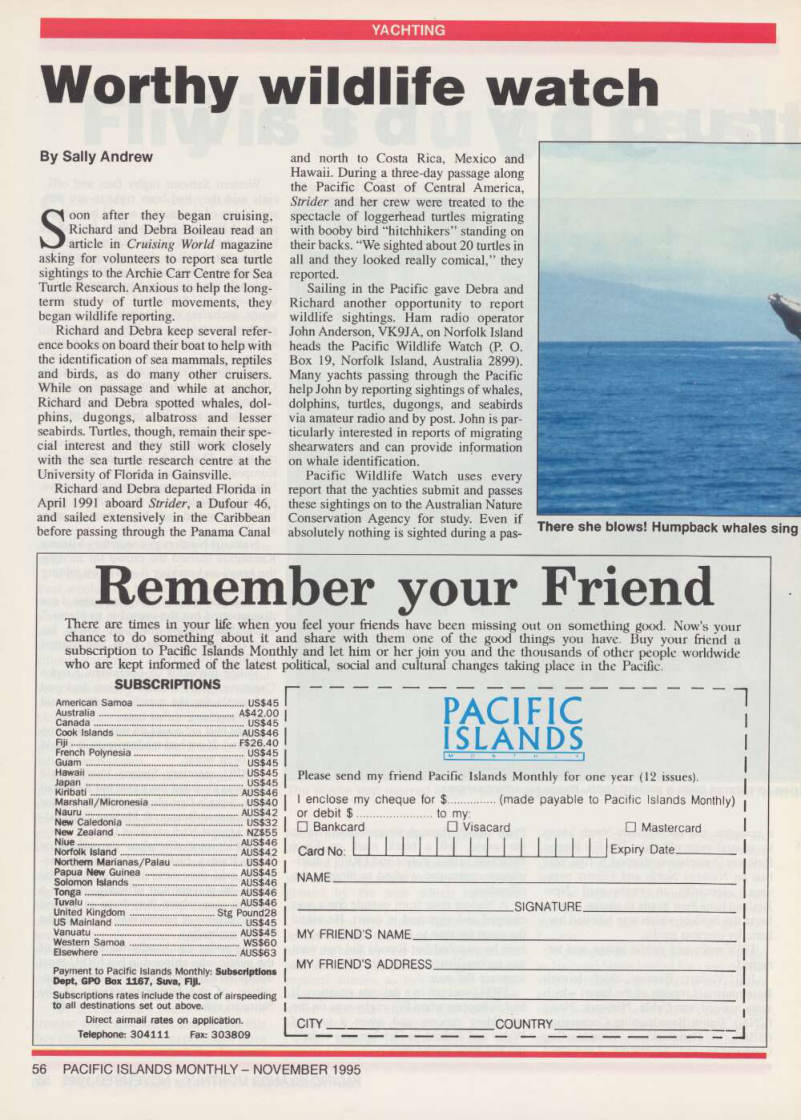
There she blows! Humpback whales sing
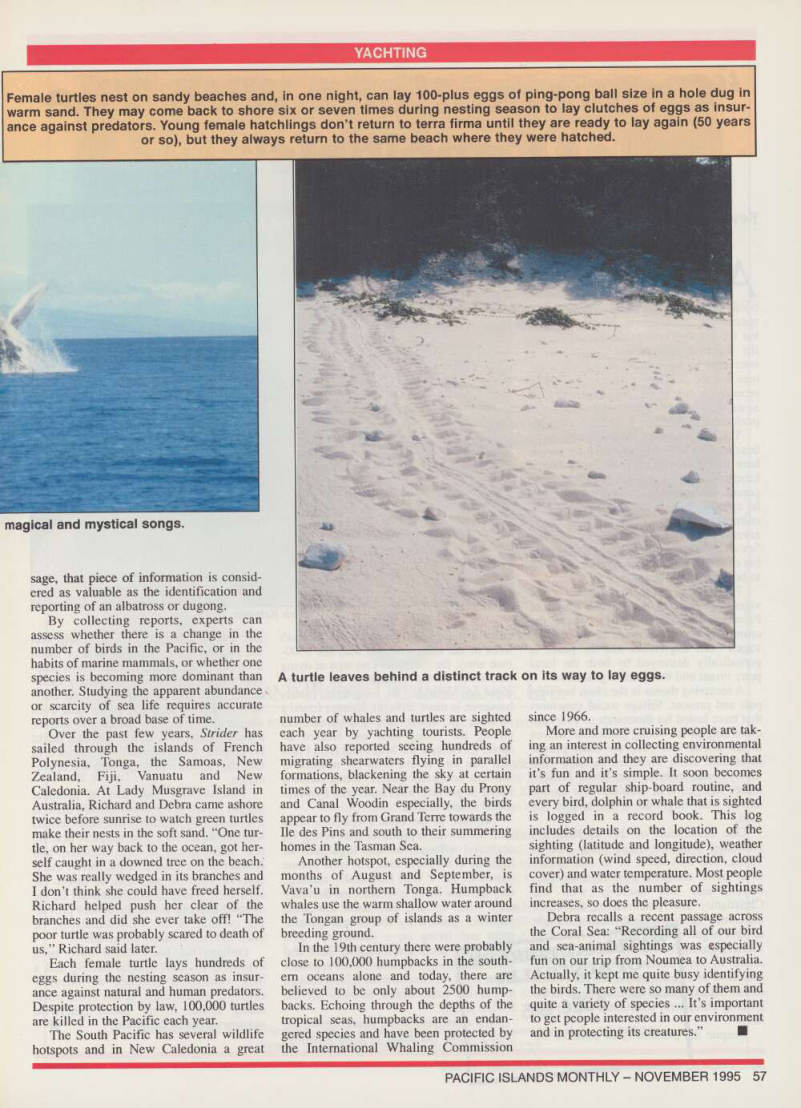
Female turtles nest on sandy beaches and, in one night, can lay 100-plus eggs of ping-pong ball size in a hole dug in warm sand. They may come back to shore six or seven times during nesting season to lay clutches of eggs as insur ance against predators. Young female hatchlings don’t return to terra firma until they are ready to lay again (50 years or so), but they always return to the same beach where they were hatched.
sage, that piece of information is consid ered as valuable as the identification and reporting of an albatross or dugong.
By collecting reports, experts can assess whether there is a change in the number of birds in the Pacific, or in the habits of marine mammals, or whether one species is becoming more dominant than another. Studying the apparent abundance or scarcity of sea life requires accurate reports over a broad base of time.
Over the past few years, Strider has sailed through the islands of French Polynesia, Tonga, the Samoas, New Zealand, Fiji, Vanuatu and New Caledonia. At Lady Musgrave Island in Australia, Richard and Debra came ashore twice before sunrise to watch green turtles make their nests in the soft sand. “One tur tle, on her way back to the ocean, got her self caught in a downed tree on the beach.' She was really wedged in its branches and I don’t think she could have freed herself.
Richard helped push her clear of the branches and did she ever take off! “The poor turtle was probably scared to death of us,” Richard said later.
Each female turtle lays hundreds of eggs during the nesting season as insur ance against natural and human predators.
Despite protection by law, 100,000 turtles are killed in the Pacific each year.
The South Pacific has several wildlife hotspots and in New Caledonia a great
number of whales and turtles are sighted each year by yachting tourists. People have also reported seeing hundreds of migrating shearwaters flying in parallel formations, blackening the sky at certain times of the year. Near the Bay du Prony and Canal Woodin especially, the birds appear to fly from Grand Terre towards the He des Pins and south to their summering homes in the Tasman Sea.
Another hotspot, especially during the months of August and September, is Vava’u in northern Tonga. Humpback whales use the warm shallow water around the Tongan group of islands as a winter breeding ground.
In the 19th century there were probably close to 100,000 humpbacks in the south ern oceans alone and today, there are believed to be only about 2500 hump backs. Echoing through the depths of the tropical seas, humpbacks are an endan gered species and have been protected by the International Whaling Commission
since 1966.
More and more cruising people are tak ing an interest in collecting environmental information and they are discovering that it’s fun and it’s simple. It soon becomes part of regular ship-board routine, and every bird, dolphin or whale that is sighted is logged in a record book. This log includes details on the location of the sighting (latitude and longitude), weather information (wind speed, direction, cloud cover) and water temperature. Most people find that as the number of sightings increases, so does the pleasure, Debra recalls a recent passage across the Coral Sea; “Recording all of our bird and sea-animal sightings was especially fun on our trip from Noumea to Australia, Actually, it kept me quite busy identifying the birds. There were so many of them and quite a variety of species ... It’s important to get people interested in our environment and in protecting its creatures.” ■
magical and mystical songs.
A turtle leaves behind a distinct track on its way to lay eggs.