Information Highway
p. 42 · Read in the full issue
Telecommunication Feature
By Yunus Rashid
Finally the term “Global Village” has taken on its literal meaning with the introduction of Internet. With a touch of a button Internet users can access 40 million people around the globe and at least 250,000 more subscribers every year.
People in the know say this is a conserva tive addition.
It is with this alarming realisation that the Forum Secretariat decided that this
year’s theme for the telecommunica tions showcase, “Calling the Pacific” , be “Building the Pacific Information Infrastructure”.
It was during this showcase in Suva, Fiji, that hundreds of people got their first experience of the infor mation highway with so much infor
mation that it could literally take a user an entire lifetime to go through all data.
But is such technology accessible to South Pacific islanders?
The Forum Secretariat’s telecommuni cations director, Ed Duran, explained that technology was available and people with computers, modems and telephone lines could easily access Internet services avail able through Australia.
Of course, there is the cost factor. Flours of use could mean telephone bills going through the roof. And there is no economic way for Pacific Islanders to actually getting on to the information freeway.
Duran said in previous years the Forum Secretariat had been placing emphasis on extending basic telephone services to peo ple in order to achieve what is described as “closing the gap”.
Fie added that this project has seen a slow progress - and in some instances the gap has been reduced.
Countries which have done well in this project are the Cook Islands and Fiji, which has outlined clearly its objectives.
Duran said many Pacific Island coun tries had the problem of small populations and lack of infrastructure.
It was this latter problem which prompt ed the theme “Building the Pacific Information Infrastructure”.
Even before the basic telephone service could be extended to all, another gap is appearing, according to Duran.
Fie said Value Added Services accom panying telephones in advanced countries worked over the top of basic telephone ser vices and these services catered for the extra demand on the function of telecom munication made by government agencies, businesses and other institutions.
Sadly, while the information highway concept is part of the modern world, the Pacific is lagging behind.
But there is hope. Duran said the very fact that Internet service available in Australia was used from Fiji indicated that there was potential for Fiji to get hooked onto Internet.
In this respect, Telecom New Zealand, FINTEL, Fiji Post and Telecommunications Limited and the Forum Secretariat have formed a temporary consortium to bring the Internet concept to Fiji for a trial period with the participating organisations subsidising the cost incurred by users.
Duran said while the Pacific faced numerous obstacles in its race to get onto the information highway, there was no rea son why it could not achieve its aim given the motivation and money invested in telecommunications.
Perhaps the biggest stumbling block in telecommunication development is the accessibility to fibre optic links. In Fiji fibre optic is being used locally but not interna tionally.
Island nations still rely on copper con nections and recent laying of fibre optic
lines saw the Pacific being bypassed. The reason for this, Duran said, was that the Pacific did not have a market which would justify the inclusion of the Pacific on the fibre optic lines.
The fact remains that the Pacific will have to realise the importance of Fibre Optic in today’s rapidly advancing telecom munication technology and make attempts to get linked. On the contrary the Pacific will become alienated from the global society.
Duran said indications do not show that there will be an early breakthrough for the Pacific to get linked to international fibre optic technology.
The reason for this is that the Pacific has the problem of distance, and the land ing cost of fibre optic would not be a prof itable investment.
Faced with such harsh geographical setbacks, what can the Pacific do to be linked?
“Do the best with the economies of scale to join the international information highway. We believe that Internet is a very good entry level for building the information infrastructure. It is not the only way but it is a good way,” Duran said.
There have been two demonstrations in Fiji so far of Internet and the University of the South Pacific is linked to the system.
The only factor that always poses a chal lenge for continued usage of the system is the sky-rocketing costs involved. ■
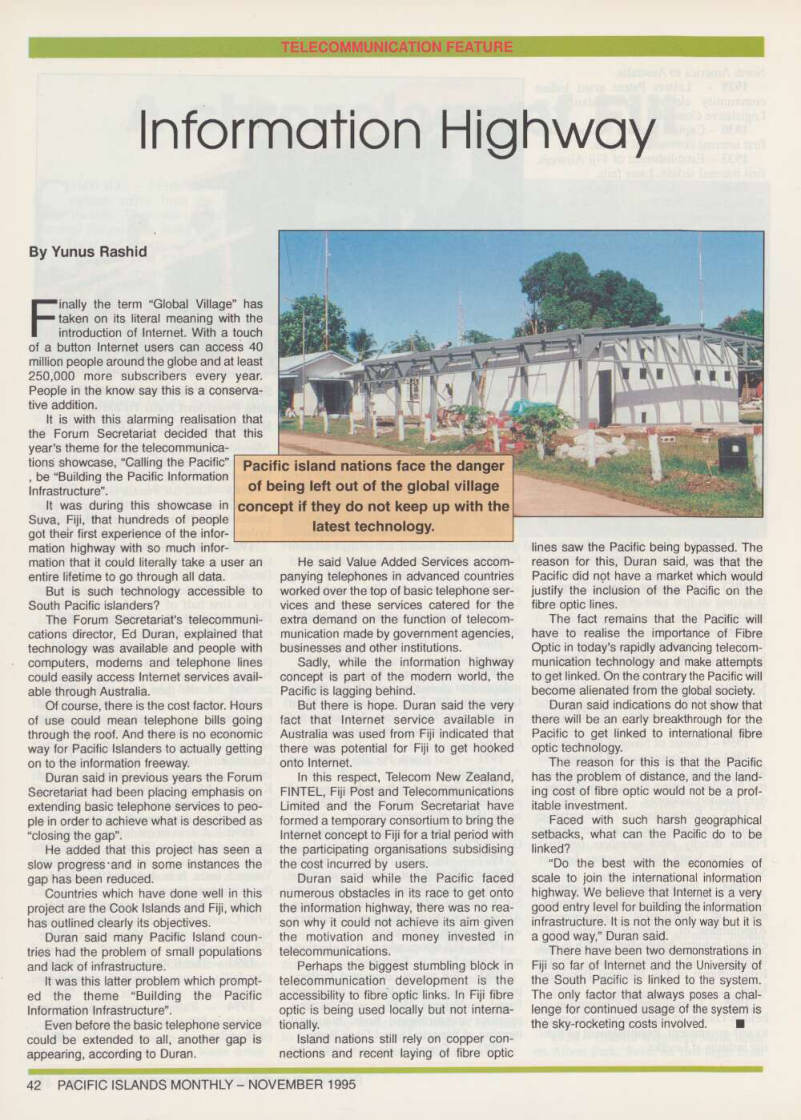
Pacific island nations face the danger of being left out of the global village concept if they do not keep up with the latest technology.