A chronology of Fiji
pp. 40-41 · Read in the full issue
Cl 600 B.C. - People of the Lapita culture arrive from the Western Pacific. They are probably the ancestral Polynesians, many later passing on to Tonga and Samoa. c5O BC - AD 1100 - Migratory groups from Melanesia arrive. The blending of Polynesian and Melanesian elements prob ably begins about this time. 1500-1600 (perhaps earlier).
Traditions speak of the arrival of the ancestral figure Lutunasobasoba and fol lowers at Vuda on Viti Levu. 1643 - 5 February - Abel Janszoon Tasman aground on Namuka Reef but
escapes undamaged and the following day
sights the northern tip of Taveuni and low lying islands near Nanuku Passage; later sights Cikobia on his way north out of Fiji. 1774 - Captain James Cook sights Vatoa and Vuata Vatoa reef. Southern Lau. 1789 - In early May, after being cast adrift by the Bounty mutineers. Captain William Bligh navigates his open boat
through the archipelago.
1792 - Bligh revisits group in HMS Providence. 1800-04 - Escaped convicts and sailors arrive from Australia and settle with the Fijians. 1800 - Wreck of schooner Argo on Bukatatanoa Reefs, east of Lakeba. 1801 - Arrival of first sandalwood ship El Plumier calling first at Lakeba then at
Vuya, Bua.
1808 - Wreck of brig Eliza on Mocea Reef near Nairai. Crew member Charles Savage arrives at Bau. 1817 - Birth of Seru, later King Cakobau, at Bau. 1820 18 August - Fabian von Belling shausen, of Russian Expedition, sights Ono and Tuvana Islands in Southern Lau. 1827 - Visit of Dumount d’Urville searching for La Perouse. 1830 - Arrival of three Tahitian mis sionaries of London Missionary Society in Lau Islands. 1835 - First Methodist missionaries, Cargill and Cross, arrive at Lakeba. 1839 - First text (catechism) printed in Fijian at Lakeba. 1840 - United States Exploring Expedition charts group 1844 - First Roman Catholic mission aries arrive at Lakeba 1847 - Ma’afu arrives from Tonga, landing at Lakeba. 1849 - US Consul John Brown Williams claims damages from Cakobau for Fijian looting after house bums down
during 4 July celebration.
1854 - Cakobau converts to
Christianity.
1855 - Lovoni warriors bum European section of Levuka, including property of American citizens. 1855 -1856 - Survey ship HMS Herald of the Royal Navy adds to US charts. 1858 - William Thomas Pritchard, Britain’s first Consul in Fiji, arrives in September. Cakobau offers Fiji to Britain on condition the US debt is paid. 1860 - Britain sends envoy to Fiji to investigate offer of cession. 1862 - Britain declines offer of cession.
Cakobau offers Fiji to America but America does not reply. 1865 - Formation of Confederacy of Independent Kingdoms. British Consul leads expedition across Viti Levu. 1867 - USS Tuscarora threatens to shell Levuka, Fiji’s capital if the US debt of $45,000 is not paid. Confederacy col
lapses.
1868 - Formation of Polynesian Company with the object of paying US claims against Cakobau in exchange for certain concessions. 1871 5 June - Cakobau proclaimed King and government forms. 1874 - With collapse of Cakobau gov ernment, Fiji makes fresh offer of cession to Britain. Britain accepts offer and Deed of Cession is signed at Levuka on 10
October, Fiji becoming a Crown Colony.
1875 30,000 Fijians die in measles
epidemic introduced by Fijians returning
from Sydney. First substantive Governor, Sir Arthur Gordon, arrives and establishes his headquarters at Levuka. 1877 - Establishment of first municipal council at Levuka. 1879 - 14 May - First indentured labourers arrive from India, landing at Yanuca Lailai, near Levuka, in the Leonidas. Opening of first government school at Levuka. 1881 - Rotuma ceded to Britain.
Opening of first government technical school at Yanawai. 1882 - Capital moves from Levuka to Suva. 1883 - CSR exports first sugar ship ment from Rewa Mill, Nausori. 1904 - Election of first European mem bers of Legislative Council. 1914 - 1919 - Fiji contingent serves with Allies in World War 1; Fiji Labour Battalion arriving in France in 1917. 1916 - Decision to terminate Indian indentured labour system. First Indian nominated member sits on Legislative Council. 1920 - Cancellation of inexperienced contracts under Indian indentured labour system. 1928 - Charles Kingsford Smith lands on Albert Park, Suva, on first flight from
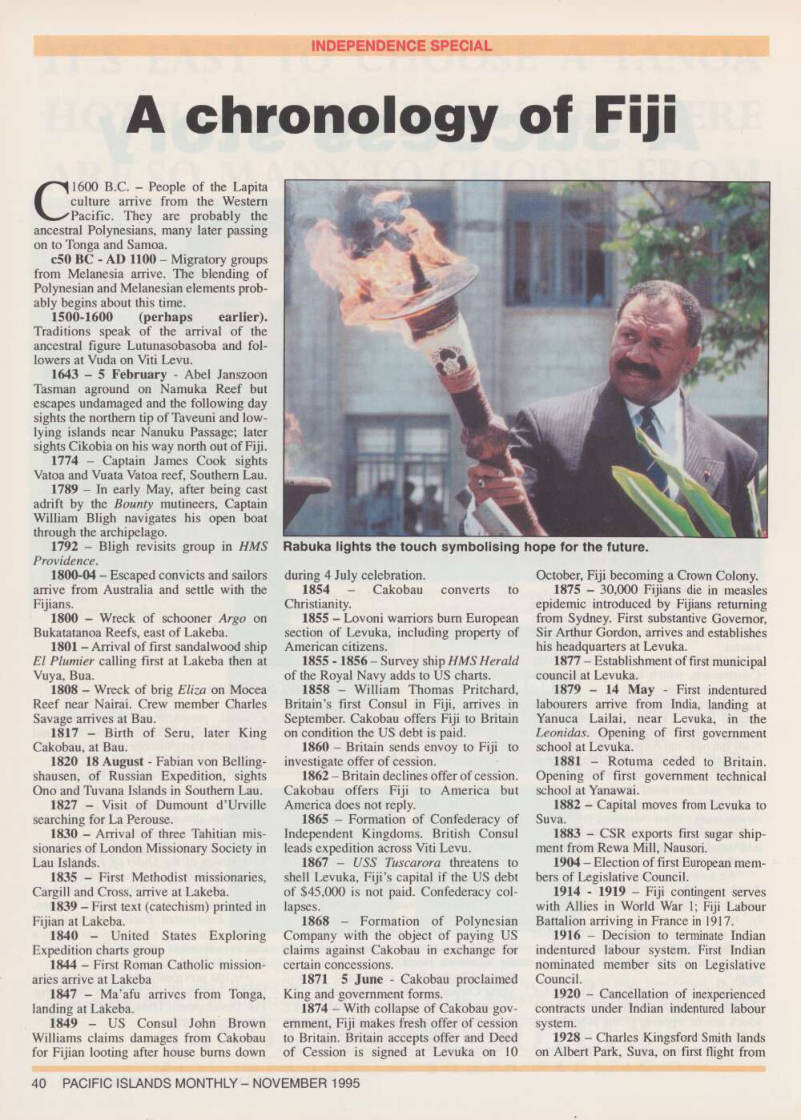
Rabuka lights the touch symbolising hope for the future.
North America to Australia. 1929 - Letters Patent grant Indian community elected representation on
Legislative Council.
1930 - Captain Gordon Fenton makes first internal commercial flights. 1933 - Establishment of Fiji Airways, first internal airline. Later fails. 1935 - Local subsidiary of Amalgamated Wireless (Australasia) Ltd. starts broadcast service. 1937 - Non-official Legislative Council membership becomes partly elect ed, partly nominated. 1939 - New Government Buildings open in Suva. First airfield built at Nadi.
Pan-Am begins trans-Pacific flying boat service. 1940 - Native Lands Trust Board set up to admin’Ster all native lands and to provide for present and future Fijian land requirements. 1941-1945 - Fiji Military Forces serve against Japanese in Solomons and Bougainville - FRNVR serves with
Rnzn.
1947 - Introduction of residential per mit system as part of restriction on immi gration. 1951 - World-famous flyer Harold Gatty starts a second Fiji Airways (compa ny later renamed Air Pacific). Legislative Council gets financial autonomy. 1952-1956 - Fiji Infantry Regiment, Ist Battalion, serves against communist insurgents in Malaya. 1953 17 December - Queen Elizabeth II arrives on first visit of reigning British monarch to Fiji. 1954 - Ratu Sir Lala Sukuna (first Fijian to be knighted) is appointed first Speaker of the Legislative Council.
Formation of Fiji Broadcasting Commission. Establishment of Credit Union movement. 1955 - Formation of Housing Authority. 1959 - Closure of Nausori sugar mill. 1961 - Eve Commission of Inquiry into Sugar Industry is held, and results in con trol of industry being given to an indepen dent statutory authority. 1963 - Reconstitution of Legislative Council; franchise extends to women and Fijians directly elect members for first time. First South Pacific Games held at Suva. 1964 - Introduction in Legislative Council of “member” system, as forerun ner of ministerial government.
Appointment of statutory authority for coconut industry. Methodist Church in Fiji becomes an autonomous body.
Establishment of Fiji National Provident Fund. 1965 - Constitutional Convention is held in London to decide steps to be taken to self-government. Establishment of fish ing industry at Levuka.
1966 - Fiji gets virtual self-government by Legislative Council being enlarged and reconstituted. Formation of political par ties, including Alliance. Formation of Fiji Electricity Authority. Establishment of Roman Catholic Archdiocese of Suva. 1967 - Council of Ministers replaces old Executive Council; six of the ministers
holding portfolios, including the Chief
Minister Ratu Sir Kamisese Mara, being elected members of the Legislative Council. 1968 - University of the South Pacific established. 1969 - The Fiji Times celebrates its centenary. 1970 10 October - Fiji becomes an independent dominion within the British Commonwealth. Ratu Sir Kamisese Mara becomes the first Prime Minister; Sir Robert Foster becomes the first Governor- General. 1971 - First South Pacific Festival of Arts held at Suva. 1972 - First post-independence general election; Alliance wins 33 of the 52 seats in the House of Representatives. 1973 - Appointment of Ratu Sir George Cakobau as Governor-General. 1977 - In April general election Alliance defeated but continues in office after Governor-General reappoints Ratu Sir Kamisese Mara as Prime Minister.
Alliance wins September general election with a majority of 20 seats. 1979 - Fiji troops take part in election monitoring force in Zimbabwe. 1981 - Fiji troops committed to Sinai
peace-keeping force. Pottery fragments
found on Naigani 3500 years older than
previous archaeological finds. Inaugural
meeting of Western United Front Party. 1982 - General election won by
Alliance Party; both parties claim foreign interference in election. Soviet cruise ships banned from Fiji ports. 1983 - Ratu Sir Penaia Ganilau sworn in as Governor-General. Hurricane Oscar causes SUS7Om damage. Monosavu hydro-electricity scheme opens. 1984 - Reserve Bank of Fiji opens.
Qantas takes over management of Air Pacific. 1985 - Four cyclones devastate parts of Fiji in first half of year. Labour Party of Fiji established. Two FM radio stations
commence broadcasting.
1987 - Fiji Labour Party sweeps to power after forming a coalition with the National Federation Party. A month later on May 14, the then Lieutenant Sitiveni Rabuka takes over the Indian-dominated government. He executes a second coup in September in opposition to the formation of a government of national unity. On December 5 he hands over power to an interim government headed by Ratu Sir Kamisese Mara. Fiji is also declared a Republic after the second coup. Fiji is expelled from the Commonwealth. 1990 - A new Constitution is promul gated giving Fijians 37 seats, Indians 27 seats, Rotumans 1 seat and the General Voters 5 seats. It is described as racist by the world community. 1992 - The first election under the 1990 Constitution is held. Rabuka comes to power after getting the support of the
Fiji Labour Party.
1993 - The Rabuka government falls after failing to secure majority support for
its budget.
1994 - Rabuka returns as Prime Minister and Ratu Sir Kamisese is appoint ed President. ■
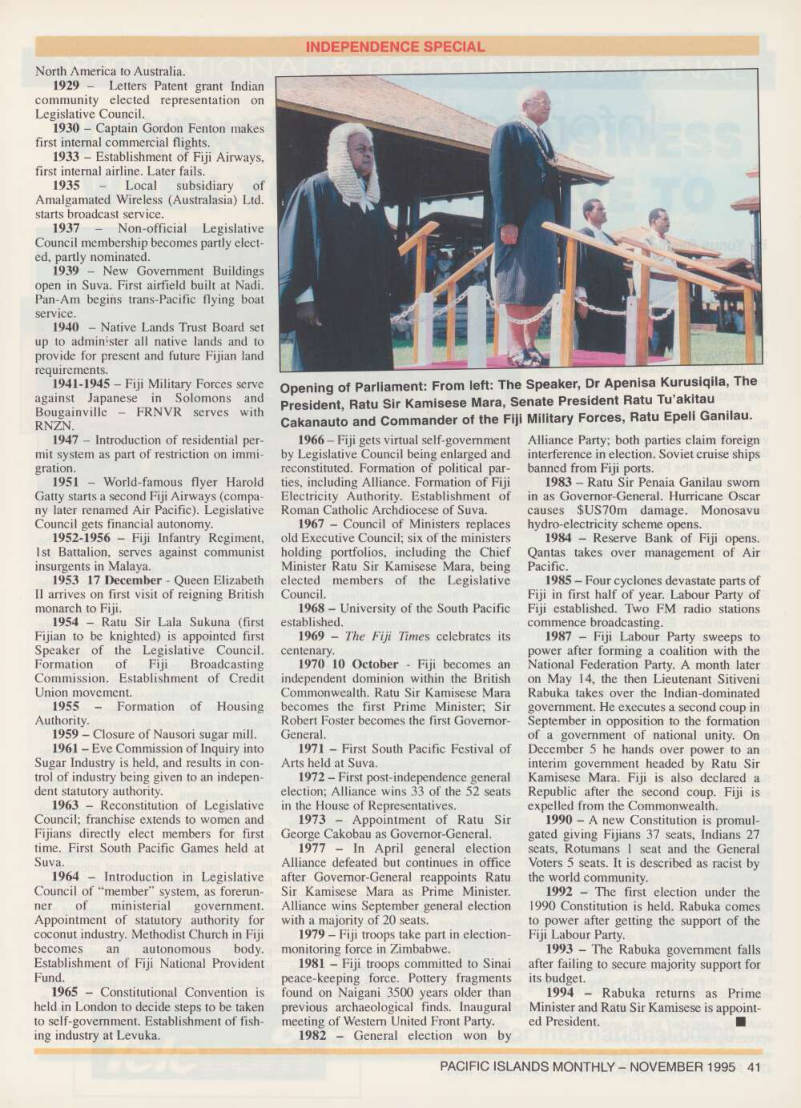
Opening of Parliament: From left: The Speaker, Dr Apenisa Kurusiqila, The President, Ratu Sir Kamisese Mara, Senate President Ratu Tu’akitau Cakanauto and Commander of the Fiji Military Forces, Ratu Epeli Ganilau.