Samoa’s new wealth well
pp. 28-29 · Read in the full issue
The Region
By David North
Usually when Samoans want mil lions of dollars they go to the US Congress.
But recently they have found a far more generous set of decision-makers, the jurors of Los Angeles.
Congress usually votes about SUS2O - million a year as a subsidy to the American Samoa Government (ASG) plus many smaller grants that flow through
Washington’s executive agencies.
But in three decisions, LA County juries have recently voted a total of SUS 102.6 million for two different Samoan causes, five times the annual direct subsidy for Pago Pago.
The first case was between an extended Samoan family residing in California, on one side, and the LA County Sheriff’s Office, on the other. The charge was police brutality and the jury awarded the family SUSIS.9 million.
The other case was between ASG and a Mainland insurance company, Rhode Island-based Affiliated FM Insurance Company. The firm was the unlucky one that covered ASG against storm damage when Hurricane Val hit the islands. The jury decided that Affiliated owed ASG SUS2B.9 million. That figure was in addi tion to SUS6.I million already paid ASG by the firm.
Then, in a later decision, the same jury added SUSS7.B million in punitive dam ages to the earlier verdict. Hence: three jury decisions, SUS 102.6 million.
The losers are appealing in these cases, and it may be years (certainly many months) before any money changes hands.
While the sheriff’s case jurors were certainly told to ignore such matters, LA area cops have an apparently well-justified reputation for mistreating members of eth nic minorities. Every American has seen
the sickening videotapes showing the Los
Angeles Police Department’s sustained
and senseless beating of Rodney King, a Black motorist. Football star OJ Simpson, another Black arrested by the LAPD, may walk free (he has since this article was written) because the decision-making of his jurors (largely Black) may be condi tioned by the King case.
It was in this broader setting that the Sheriff’s Office was sued for brutality
against the Samoans, if anything, a more disadvantaged minority than LA’s much larger Black population. (LAPD covers the city of Los Angeles; the Sheriff’s Office provides law enforcement in most of the surrounding municipalities.) The incident in question took place on Feb 11, 1989; there had been reports of a loud party, street fighting and thrown rocks and bottles and, in response, about 100 Sheriff’s deputies in riot gear descend ed on the home of Arthur Dole, a local Samoan.
The deputies, according to witnesses, proceeded to hit some party guests with night sticks, kicked some of them in the head, and used their big police flashlights as weapons.
A number of the Samoans were arrest ed, including Emily Dole, a presumably impressive woman. A professional wrester, she is known as “Mt Fuji”. None of the Samoans, however, were subsequently convicted of any crime.
The jurors not only ruled that the Samoans had been brutalised, they found that they had been falsely accused of vari ous crimes.
David Dole, Arthur’s son, received the largest award, SUS 3.9 million. He told the Press after the trial that the raid caused “pain that tore my family apart”. He added: “WeTe just proud it came out this way. It was just deputies overreacting to
nothing.”
The violence in the other court case
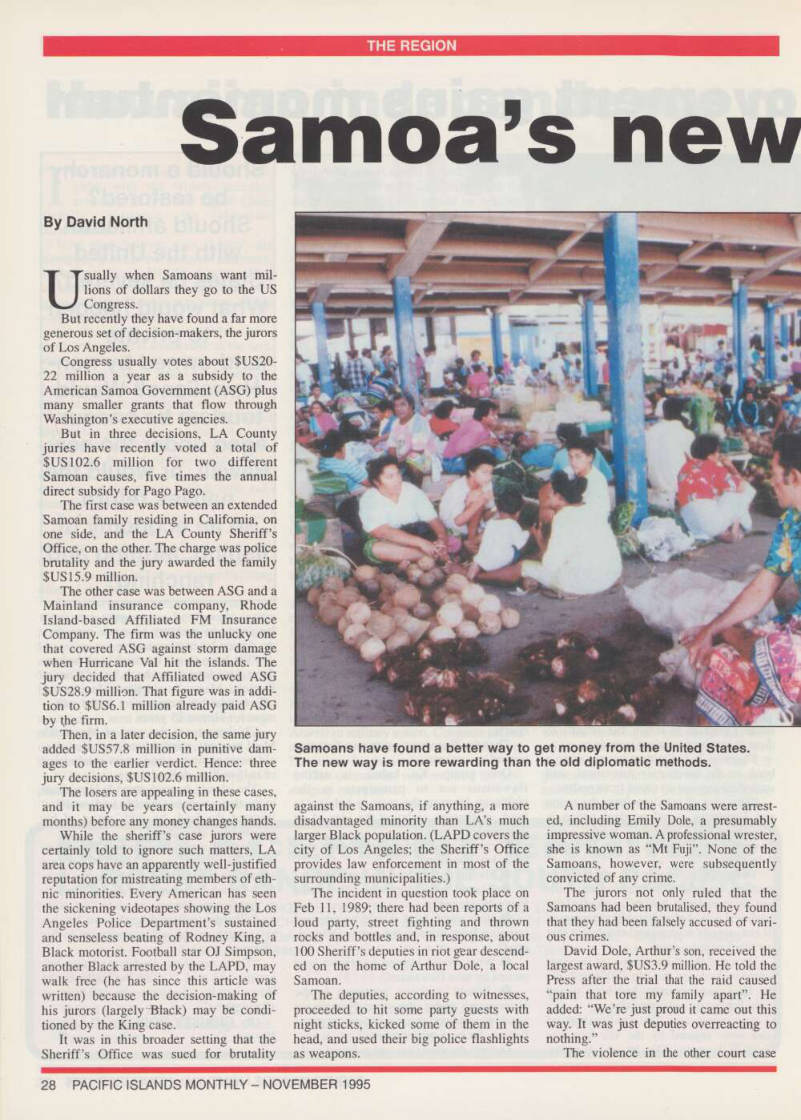
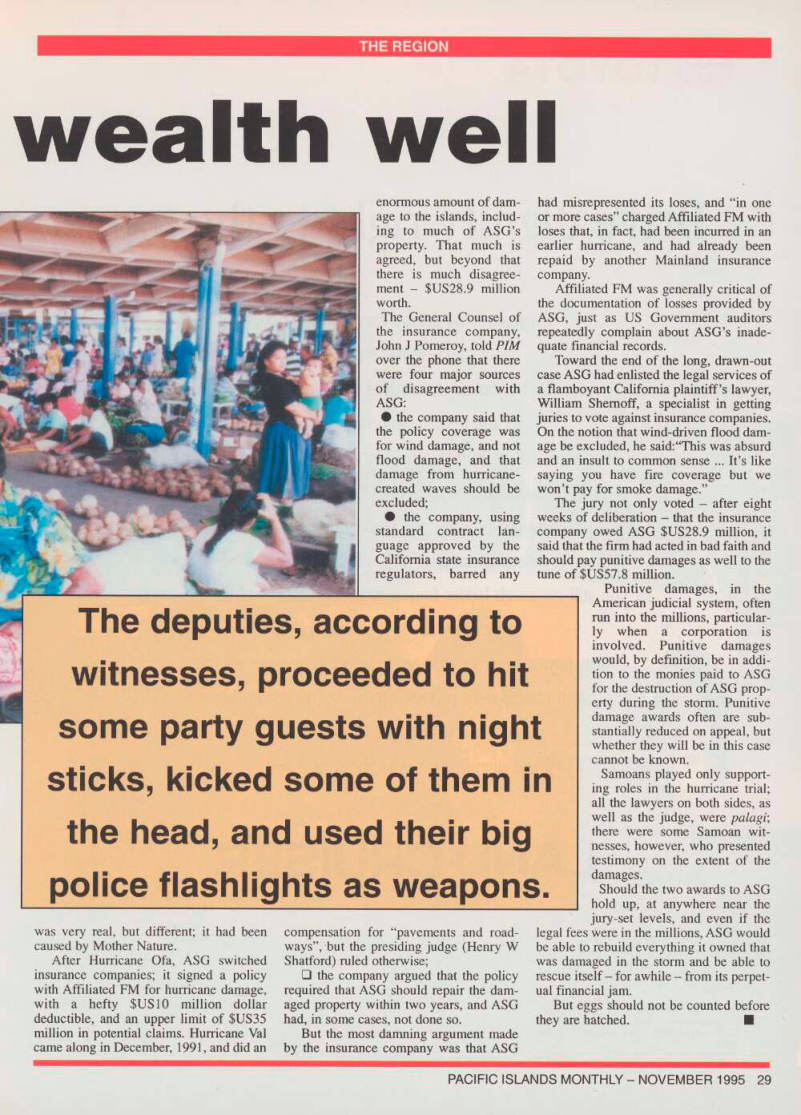
Samoans have found a better way to get money from the United States.
The new way is more rewarding than the old diplomatic methods.
The deputies, according to witnesses, proceeded to hit some party guests with night sticks, kicked some of them in the head, and used their big police flashlights as weapons.
was very real, but different; it had been caused by Mother Nature.
After Hurricane Ofa, ASG switched insurance companies; it signed a policy with Affiliated FM for hurricane damage, with a hefty SUSIO million dollar deductible, and an upper limit of SUS3S million in potential claims. Hurricane Val came along in December, 1991, and did an
compensation for “pavements and road ways”, but the presiding judge (Henry W Shatford) ruled otherwise; □ the company argued that the policy required that ASG should repair the dam aged property within two years, and ASG had, in some cases, not done so.
But the most damning argument made by the insurance company was that ASG
enormous amount of dam age to the islands, includ ing to much of ASG’s property. That much is
agreed, but beyond that
there is much disagree ment - SUS2B.9 million worth.
The General Counsel of the insurance company, John J Pomeroy, told PIM over the phone that there were four major sources of disagreement with
Asg:
• the company said that the policy coverage was for wind damage, and not flood damage, and that damage from hurricane created waves should be excluded; • the company, using standard contract lan guage approved by the California state insurance regulators, barred any
had misrepresented its loses, and “in one or more cases” charged Affiliated FM with loses that, in fact, had been incurred in an earlier hurricane, and had already been repaid by another Mainland insurance company.
Affiliated FM was generally critical of the documentation of losses provided by ASG, just as US Government auditors repeatedly complain about ASG’s inade quate financial records.
Toward the end of the long, drawn-out case ASG had enlisted the legal services of
a flamboyant California plaintiff’s lawyer,
William Shemoff, a specialist in getting juries to vote against insurance companies.
On the notion that wind-driven flood dam age be excluded, he said:“This was absurd and an insult to common sense ... It’s like saying you have fire coverage but we won’t pay for smoke damage.”
The jury not only voted - after eight weeks of deliberation - that the insurance company owed ASG SUS2B.9 million, it said that the firm had acted in bad faith and should pay punitive damages as well to the tune of SUSS7.B million.
Punitive damages, in the American judicial system, often run into the millions, particular ly when a corporation is involved. Punitive damages would, by definition, be in addi tion to the monies paid to ASG for the destruction of ASG prop erty during the storm. Punitive damage awards often are sub stantially reduced on appeal, but whether they will be in this case cannot be known.
Samoans played only support
ing roles in the hurricane trial; all the lawyers on both sides, as well as the judge, were palagv, there were some Samoan wit nesses, however, who presented testimony on the extent of the
damages.
Should the two awards to ASG hold up, at anywhere near the jury-set levels, and even if the
legal fees were in the millions, ASG would be able to rebuild everything it owned that was damaged in the storm and be able to rescue itself - for awhile - from its perpet ual financial jam.
But eggs should not be counted before they are hatched. ■