Hawaiian independence m[?]ovement gains momentum
pp. 26-27 · Read in the full issue
The Region
The election council begins its pam
phlet with the widely accepted
premise, “In 1893, the United States illegally overthrew the Hawaiian Government.”
Now many natives want it back: the pineapple groves, the national seashores, the military bases. All told, they’re asking for about 42 per cent of Hawaii’s land, plus up to SUSIO billion in reparations. Some want statehood renounced.
On the islands, the beat of the sover eignty movement is as constant as the surf.
Many native Hawaiians believe the US Government should return land and self determination to them, likening their situ ation to the American Indians’.
But the question of how that should happen has produced more than 50 politi cal factions. It also has brought predictions of success from their legal adviser and denunciation from non-native Hawaiians that the whole idea is “filled with bal coney”.
Trying to pull together the various pro sovereignty factions is Tara Lulani McKenzie, executive director of the Hawaiian Sovereignty Elections Council.
“I like to call it a nation-building office,” she said.
State lawmakers created the council in 1994 to conduct an election of native Hawaiians - about 180,000 residents of Hawaiian ancestry are still living there and another 74,000 in the continental United States. The other one million residents of Hawaii are not eligible to vote.
The ballot, expected to be mailed out next year, is seen as the first step in recog nition and organisation. It asks one ques tion: do Hawaiians want to create and elect their own government?
“The plebiscite is an event to bring peo ple together,” McKenzie said.
She said a large voter turnout and over
whelmed support would provide the public showing needed to build a framework for sovereignty. Delegates would be selected and a convention held to draft a self-gov
ernance plan.
The plan eventually would be presented
to the state and federal governments - per haps as early as 1997, McKenzie said.
At this point, the support of non- Hawaiians becomes crucial. The legisla ture would have to pass a state constitu tional amendment to award control of land and laws of native Hawaiians, which state voters would then have to approve.
Congress also would have to recognise sovereignty, McKenzie said.
“The process is unique to us. We don’t have the land. We don’t have the treaties.
What we’re trying to do is something dif ferent from anybody else,” McKenzie said.
The sovereignty movement has been percolating since 1893 when American troops, supported by US businessman and planters, overran the islands and deposed Queen Liliuokanlani, who was trying to restore her monarchy. US officials said they wanted to maintain control over the islands for military purposes.
By 1898, the United States had annexed the islands, including 400,000 hectares of land formerly ceded by King Kamehameha 111 to his people. That acreage amounts to about 42 per cent of the land in Hawaii.
Over the years, legal and political efforts to restore the ceded lands of Hawaiians sputtered along. But in 1993,
marking the 100-year anniversary of
American military action. Congress passed
a resolution offering a formal apology to Hawaiians for the invasion.
That ceremonial vote renewed the sov ereignty movement.
Legal consultant Francis A Boyle, a law
professor at the University of Illinois- Champaign, has advised those involved with the sovereignty movement that they could win a claim before the World Court.
With the apology resolution, “the US government admitted that we stole Hawaii and illegally deposed their queen and have inflicted conditions tantamount to geno
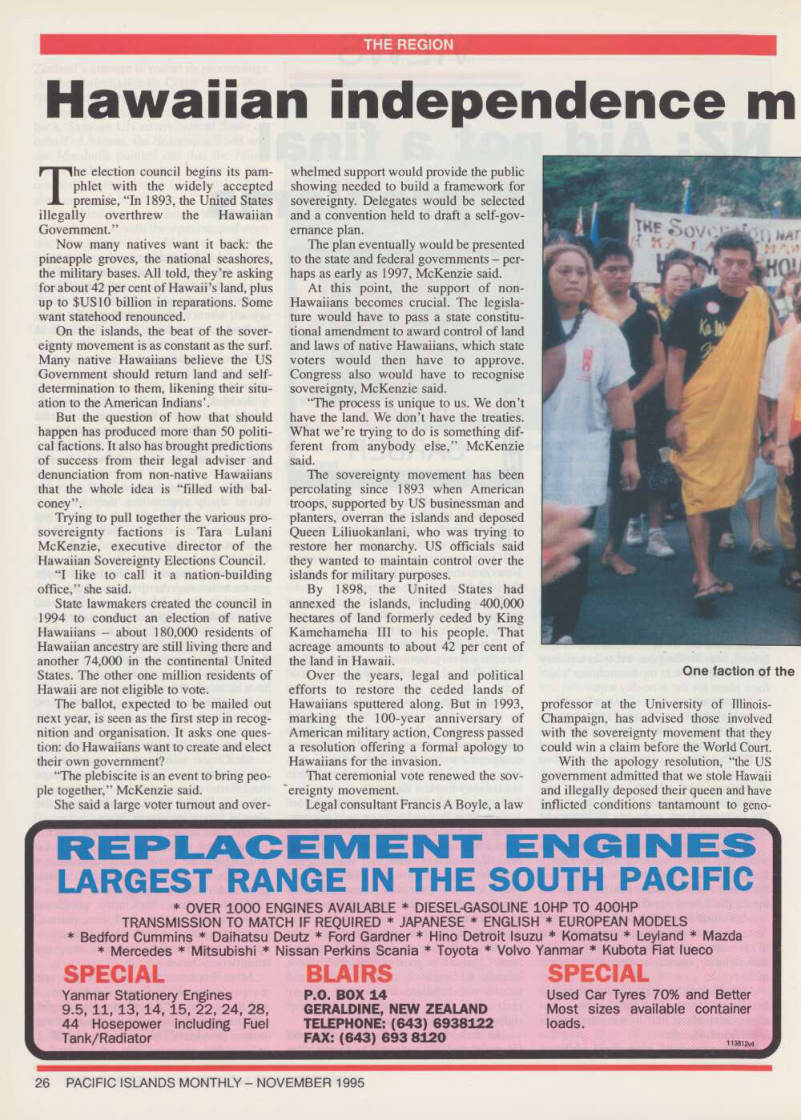
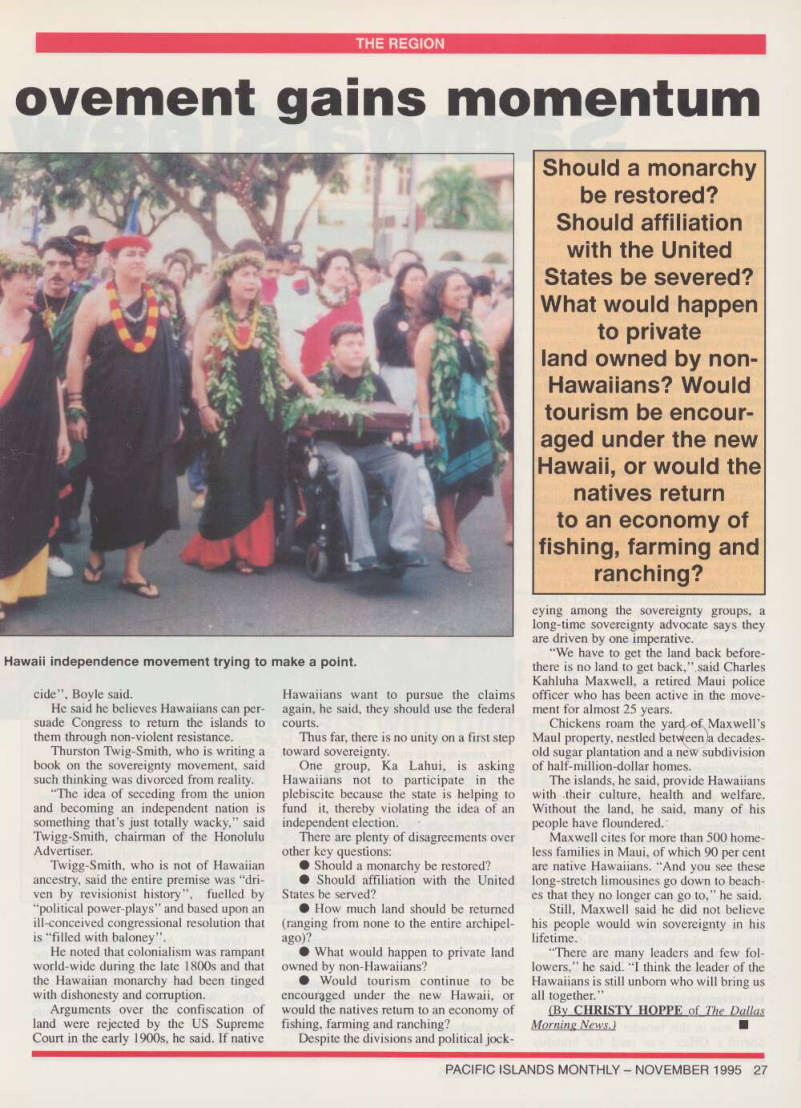
One faction of the
cide”, Boyle said.
He said he believes Hawaiians can per suade Congress to return the islands to them through non-violent resistance.
Thurston Twig-Smith, who is writing a book on the sovereignty movement, said such thinking was divorced from reality.
“The idea of seceding from the union and becoming an independent nation is
something that’s just totally wacky,” said
Twigg-Smith, chairman of the Honolulu Advertiser.
Twigg-Smith, who is not of Hawaiian ancestry, said the entire premise was “dri ven by revisionist history”, fuelled by “political power-plays” and based upon an ill-conceived congressional resolution that is “filled with baloney”.
He noted that colonialism was rampant world-wide during the late 1800 s and that the Hawaiian monarchy had been tinged
with dishonesty and corruption.
Arguments over the confiscation of land were rejected by the US Supreme Court in the early 1900 s, he said. If native
Hawaiians want to pursue the claims again, he said, they should use the federal courts.
Thus far, there is no unity on a first step
toward sovereignty.
One group, Ka Lahui, is asking Hawaiians not to participate in the plebiscite because the state is helping to fund it, thereby violating the idea of an
independent election;
There are plenty of disagreements over
other key questions:
• Should a monarchy be restored? • Should affiliation with the United States be served? • How much land should be returned (ranging from none to the entire archipel
ago)?
• What would happen to private land owned by non-Hawaiians? • Would tourism continue to be encouraged under the new Hawaii, or would the natives return to an economy of
fishing, farming and ranching?
Despite the divisions and political jock-
Should a monarchy be restored?
Should affiliation with the United States be severed?
What would happen to private land owned by non- Hawaiians? Would tourism be encour aged under the new Hawaii, or would the natives return to an economy of fishing, farming and ranchinq?
eying among the sovereignty groups, a long-time sovereignty advocate says they are driven by one imperative.
“We have to get the land back before there is no land to get back,” said Charles Kahluha Maxwell, a retired Maui police officer who has been active in the move ment for almost 25 years.
Chickens roam the yarcUof Maxwell’s Maul property, nestled bet\yeen)a decades old sugar plantation and a neW"subdivision of half-million-dollar homes.
The islands, he said, provide Hawaiians with their culture, health and welfare.
Without the land, he said, many of his people have floundered.' Maxwell cites for more than 500 home less families in Maui, of which 90 per cent are native Hawaiians. “And you see these long-stretch limousines go down to beach es that they no longer can go to,” he said.
Still, Maxwell said he did not believe his people would win sovereignty in his lifetime.
“There are many leaders and few fol lowers,” he said. “I think the leader of the Hawaiians is still unborn who will bring us all together.” (Bv CHRISTY HOPPE of The Dallas Morning News. ) ■
Hawaii independence movement trying to make a point.