A Hawaiian love affair
p. 58 · Read in the full issue
Neighbours
By Barry Markowitz
IF you believe in love at first sight, then you will believe in William Mahoni, a Tongan artist living in Honolulu and taking the Hawaii art scene by storm.
Mahoni has been many things but it is in love that he is luckiest. The woman who is now his wife had known him for only a day when Mahoni asked her to marry him. She said yes.
In Las Vegas and California recently, eager collectors of Polynesian art shelled out over $lOOO a day for Mahoni’s sketches and t-shirt designs.
But he is not just a craftsman with paint and brush. He also coaches touch rugby in a community of Maoris, Samoans, Cook Islander, Fijians, Tongans and Hawaiians. He is a master had led the traditional Maoiflfelegafion for the arrival of the. Polynesian Voyaging Canoes at in May.
How did all begin? Sayi “As a child I remember the partief*S?iF my father was involved with. I’m from a
family of heavy weight boxers. My father and brothers were actually South Pacific heavyweight champions. As a result there were parties that fol lowed. As a child I thought of means
of how I could make a couple of cents, a nickel or a dime.
“What I would do was take a pencil and paper and sketch them in a cartoon form as realistic as I could. After a period of time they would give me a couple of cents. I thought it was enter taining and a way to save money at an early age. I became self taught.”
Mahoni has taken Hawaii by storm because of his quality, authenticity and vibrant styles “Over the years I have technique with a pencil and other which requires a lot of
patience-T"
up in Auckland was not the idyllic artist nurturing scenario one
might imagine of such a sensitive artist.
“I was brought up fighting, whether it was street fighting or in the ring,” he says. “My father spent a lot of time developing my boxing skills. It was in my later teens that I stopped fighting. It was one knock to the head. Even though my father had trained his brother to become the heavyweight champ, he allowed me to follow the footsteps I wanted to follow. Besides my family, my real passion then was the artwork that I do.”
William Mahoni’s last name is a direct result of his father’s proud Tongan warrior heritage. Says he: “My Mahoni name is Irish, but it’s Tongan- Irish. The name was inherited in com bat. We go back quite a few generations to the first Irish settlers in Tonga. After peace was established between my Irish family side and my Tongan family side, we took their last name as our last
name.” Ironically, this rich Tongan heritage was not the culture for which Mahoni origi
nally identified. The strong vio lent and extreme generosity of his father’s island ties drew Mahoni closer to the Maori ways of his mother’s
indigenous culture.
“My father,” he says, “had not spo ken to one relative for 18 years. They came together at one family party and my father knocked him cold. Being the oldest of 18 children, (my father) would accommodate his other brothers and sis ters. I saw the sacrifices of the bed, the food and quite often I would see the sac rifices of many items in the household.
“It is here at Brigham Young University Hawaii that I began to understand my (Tongan) culture more. I became proud of my Tongan culture. It is only here in the Hawaiian Island that I began to associate more with other Tongans to understand my culture.”
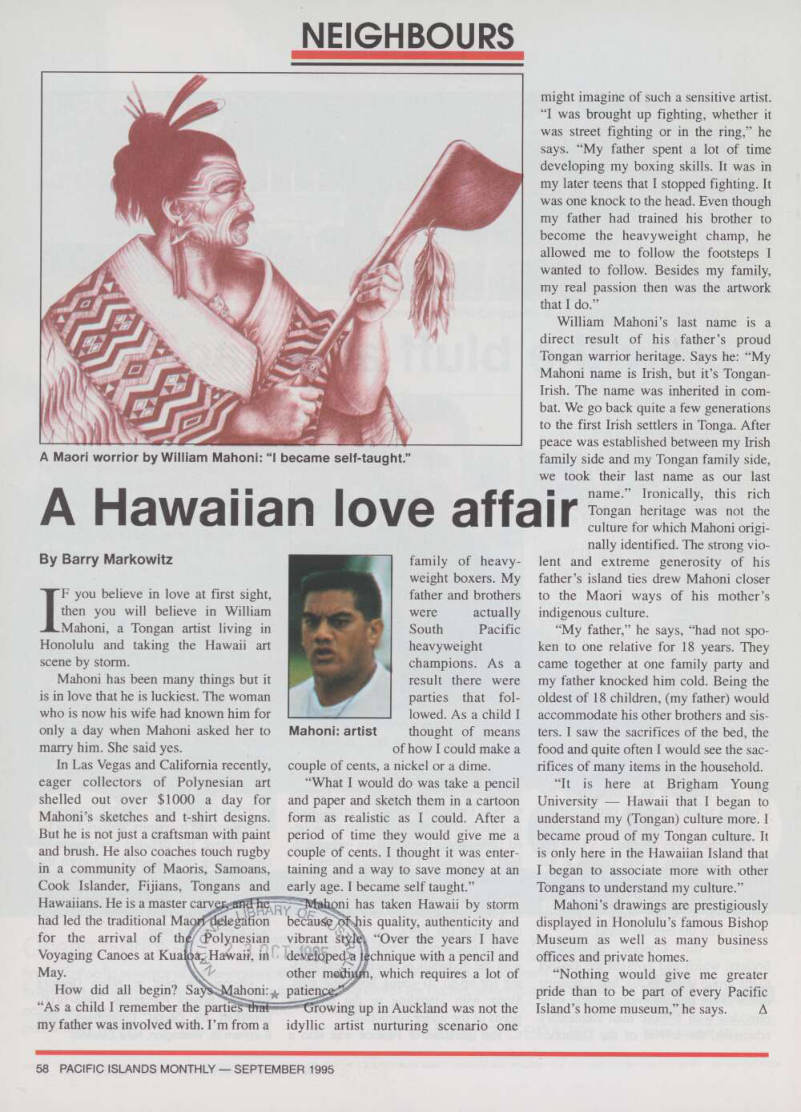
Mahoni’s drawings are prestigiously
displayed in Honolulu’s famous Bishop Museum as well as many business offices and private homes.
“Nothing would give me greater pride than to be part of every Pacific Island’s home museum,” he says. A
A Maori worrier by William Mahoni: “I became self-taught.”
Mahoni: artist