Below the bluff at Nikao
p. 57 · Read in the full issue
Books
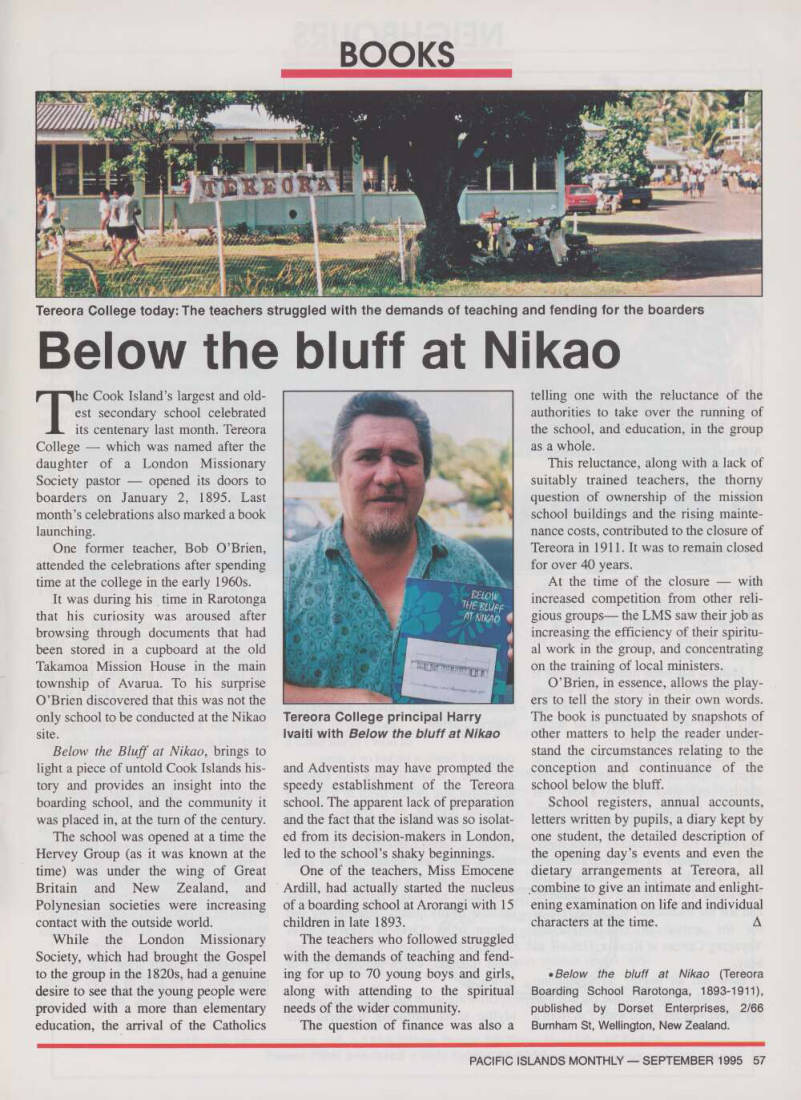
The Cook Island’s largest and old est secondary school celebrated its centenary last month. Tereora College which was named after the daughter of a London Missionary Society pastor opened its doors to boarders on January 2, 1895. Last month’s celebrations also marked a book launching.
One former teacher, Bob O’Brien, attended the celebrations after spending time at the college in the early 19605.
It was during his time in Rarotonga that his curiosity was aroused after browsing through documents that had been stored in a cupboard at the old Takamoa Mission House in the main township of Avarua. To his surprise O’Brien discovered that this was not the only school to be conducted at the Nikao site.
Below the Bluff at Nikao, brings to light a piece of untold Cook Islands his tory and provides an insight into the boarding school, and the community it was placed in, at the turn of the century.
The school was opened at a time the Hervey Group (as it was known at the time) was under the wing of Great Britain and New Zealand, and Polynesian societies were increasing contact with the outside world.
While the London Missionary
Society, which had brought the Gospel
to the group in the 1820 s, had a genuine desire to see that the young people were provided with a more than elementary education, the arrival of the Catholics
and Adventists may have prompted the speedy establishment of the Tereora school. The apparent lack of preparation and the fact that the island was so isolat ed from its decision-makers in London, led to the school’s shaky beginnings.
One of the teachers, Miss Emocene Ardill, had actually started the nucleus of a boarding school at Arorangi with 15 children in late 1893.
The teachers who followed struggled with the demands of teaching and fend ing for up to 70 young boys and girls, along with attending to the spiritual needs of the wider community.
The question of finance was also a
telling one with the reluctance of the authorities to take over the running of the school, and education, in the group as a whole.
This reluctance, along with a lack of suitably trained teachers, the thorny question of ownership of the mission school buildings and the rising mainte nance costs, contributed to the closure of Tereora in 1911. It was to remain closed for over 40 years.
At the time of the closure with increased competition from other reli gious groups— the LMS saw their job as increasing the efficiency of their spiritu al work in the group, and concentrating on the training of local ministers.
O’Brien, in essence, allows the play ers to tell the story in their own words.
The book is punctuated by snapshots of other matters to help the reader under stand the circumstances relating to the conception and continuance of the school below the bluff.
School registers, annual accounts, letters written by pupils, a diary kept by one student, the detailed description of the opening day’s events and even the dietary arrangements at Tereora, all combine to give an intimate and enlight ening examination on life and individual characters at the time. A
Tereora College today: The teachers struggled with the demands of teaching and fending for the boarders
Tereora College principal Harry Ivaiti with Below the bluff at Nikao
• Below the bluff at Nikao (Tereora Boarding School Rarotonga, 1893-1911), published by Dorset Enterprises, 2/66 Burnham St, Wellington, New Zealand.