Fishing won’t be
pp. 42-43 · Read in the full issue
By Ian Williams
ON August 4, steered by Fiji’s
Satya Nandan after a long negotiating voyage that began over two years ago, delegates accepted the final wording of a new section of the Law of the Sea on the “Conservation and Management of Straddling Fish Stocks and Highly Migratory Fish Stocks.”
After such a longwinded polysyllab ic name, even the questions that Ambassador Nandan was asked were nautically metaphorical. Does the agreement have teeth? Does it have loopholes you could haul a drift net through? Was it watered down? And by the time they have finished the final details, will there be any fish left?
Each of the questions got a yes from someone at UN headquarters in New York, but the new Convention was accepted without a vote, although with a sigh of relief, by weary diplomats and scientists. After being adopted by the UN General Assembly, it will be signed in December, and them comes into force 30 days after 30 states have rati fied it.
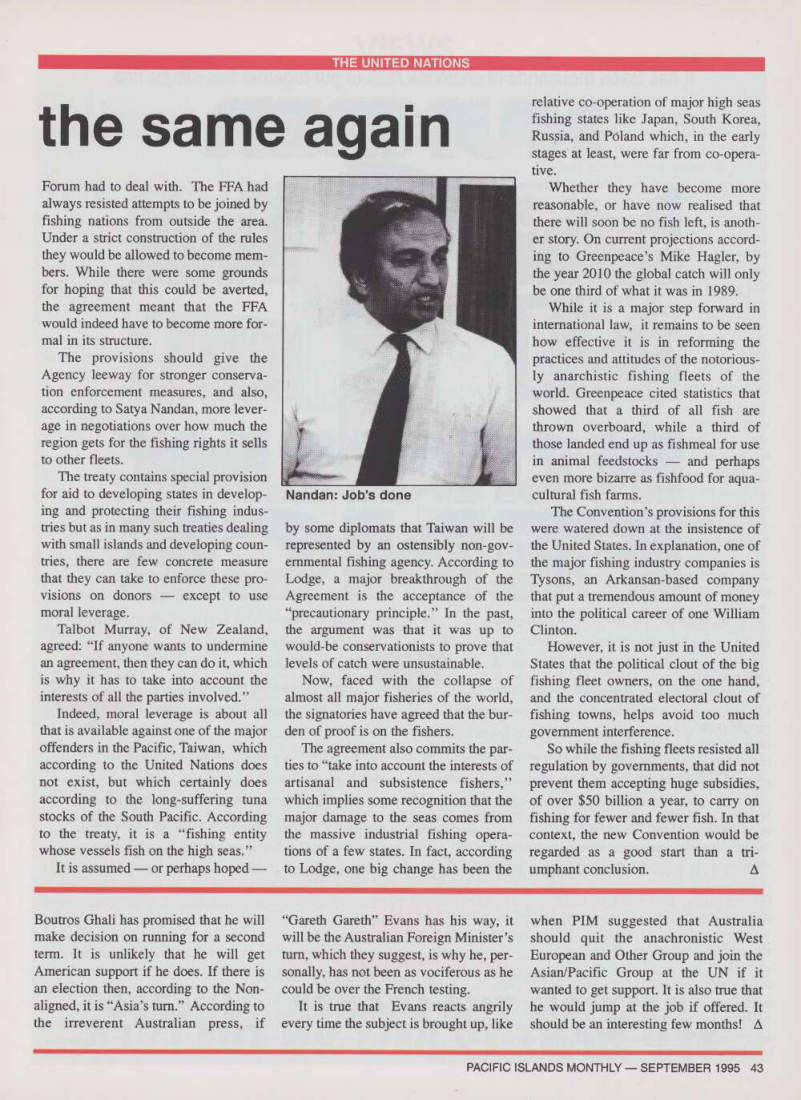
But will it be effective as well as legal? The quietly spoken Satya Nandan says yes. As the highest rank ing South Pacific official at the UN, he spent many years nursing the Law of the Sea through its long and tedious passage, before falling victim to one of Boutros Ghali’s early purges of senior officials in 1992. After a year as a fel low at the US Institute for Peace in Washington, he returned to the UN as a
Fiji diplomat to oversee the Fisheries talks. Asked if this meant that he was now looking for work, he smiled, “I expect to be here until the end of the year to ensure that the Convention is on its way to ratification.” Then he is what many people consider the front runner to be the Secretary General of the new International Sea Bed Authority. “But of course there are other runners,” he
points out modestly.
So what does the Convention he has worked on so hard actually do? For the first time it tries to regulate fishing on the high seas, where there have in the past been no rules. Nandan referred to conservation, enforcement and manda tory settlement as the three pillars of the agreement.
Nandan points out that it gives a legal basis for states to board other countries’ fishing vessels and check for violations of agreements. The proce dure, although cumbersome, should avoid the type of unseemly scuffles between Canada and Spain that were seen last year. The flag state has three days to respond to the boarding state’s requests to take action. It even envis ages some use of force if boarding is resisted.
The policing and regulation of catch es will be undertaken primarily by
regional fishing organisations like
the Forum Fishing Agency but only up to a point. While welcoming what he
called a “pretty comprehensive, quite
well balanced and equalising agree ment,” Michael Lodge, of the Solomons delegation, pointed out that there were some implications that the
Forum had to deal with. The FFA had always resisted attempts to be joined by fishing nations from outside the area.
Under a strict construction of the rules they would be allowed to become mem bers. While there were some grounds for hoping that this could be averted, the agreement meant that the FFA would indeed have to become more for mal in its structure.
The provisions should give the Agency leeway for stronger conserva tion enforcement measures, and also, according to Satya Nandan, more lever age in negotiations over how much the region gets for the fishing rights it sells to other fleets.
The treaty contains special provision for aid to developing states in develop ing and protecting their fishing indus tries but as in many such treaties dealing with small islands and developing coun tries, there are few concrete measure that they can take to enforce these pro visions on donors except to use
moral leverage.
Talbot Murray, of New Zealand, agreed: “If anyone wants to undermine an agreement, then they can do it, which is why it has to take into account the interests of all the parties involved.”
Indeed, moral leverage is about all that is available against one of the major offenders in the Pacific, Taiwan, which according to the United Nations does not exist, but which certainly does according to the long-suffering tuna stocks of the South Pacific. According to the treaty, it is a “fishing entity whose vessels fish on the high seas.”
It is assumed or perhaps hoped
by some diplomats that Taiwan will be represented by an ostensibly non-gov ernmental fishing agency. According to Lodge, a major breakthrough of the Agreement is the acceptance of the “precautionary principle.” In the past, the argument was that it was up to would-be conservationists to prove that levels of catch were unsustainable.
Now, faced with the collapse of almost all major fisheries of the world, the signatories have agreed that the bur den of proof is on the fishers.
The agreement also commits the par ties to “take into account the interests of artisanal and subsistence fishers,” which implies some recognition that the major damage to the seas comes from the massive industrial fishing opera tions of a few states. In fact, according to Lodge, one big change has been the
relative co-operation of major high seas fishing states like Japan, South Korea, Russia, and Poland which, in the early stages at least, were far from co-opera tive.
Whether they have become more reasonable, or have now realised that there will soon be no fish left, is anoth er story. On current projections accord ing to Greenpeace’s Mike Hagler, by the year 2010 the global catch will only be one third of what it was in 1989.
While it is a major step forward in international law, it remains to be seen how effective it is in reforming the practices and attitudes of the notorious ly anarchistic fishing fleets of the world. Greenpeace cited statistics that showed that a third of all fish are thrown overboard, while a third of those landed end up as fishmeal for use in animal feedstocks and perhaps even more bizarre as fishfood for aqua cultural fish farms.
The Convention’s provisions for this were watered down at the insistence of the United States. In explanation, one of the major fishing industry companies is Tysons, an Arkansan-based company that put a tremendous amount of money into the political career of one William Clinton.
However, it is not just in the United States that the political clout of the big fishing fleet owners, on the one hand, and the concentrated electoral clout of fishing towns, helps avoid too much government interference.
So while the fishing fleets resisted all regulation by governments, that did not prevent them accepting huge subsidies, of over $5O billion a year, to carry on fishing for fewer and fewer fish. In that context, the new Convention would be regarded as a good start than a tri umphant conclusion. A
Nandan: Job’s done