at the UN
pp. 41-43 · Read in the full issue
The United Nations
Pacific waves at the UN
As the United Nations prepares to celebrate its 50th birthday, the small states in the Pacific prepare to make their presence felt
By Ian Williams
FOR three days in October the great and good (well, some of them good, anyway) of the world will be piling into New York to celebrate the 50th anniversary of the United Nations.
Over 160 heads of states and govern ments, including most of the Pacific, will each address the UN General Assembly, If they have anything to say, they had better refine their speech writ
ing facilities since, big and small, they only have five minutes each.
For small states like those in the Pacific, the United Nations system, its conventions and declarations, are a first line of defence against the bigger nations who, if not always, at least more often than not feel bound by the treaties they have signed and the resolutions they have voted for.
One item due this year is a report from the Secretary General on the reso lution on the defence of small island
states jointly sponsored by the Maldives and the Solomons. It was originally passed in the first flush of enthusiasm after the UN had successfully defended the small state of Kuwait.
At the Heads of State summit, most if not all the Pacific contributions will mention Paris’s plans for the Pacific environment at Mururoa. Apart from its colonies in the Pacific, France’s last remnants of imperial pride are its nuclear weapons, and its seat on the UN Security Council.
In the latter guise, it insists on other countries, like Libya, sticking to the let ter of international law. But as a nuclear state it violated the spirit, if not the let ter of the non-proliferation treaty, by its announcement of a resumption of test ing in the Pacific this month.
So the Pacific States are now trying to use France’s own enthusiastic words at the time of the signing of the Biological Diversity Convention. The FSM, Marshalls and Nauru in particular are arguing that France must undertake an Environmental Impact Assessment under the Convention. By registering a dispute in this way, they will force the issue to go to arbitration, where it should be easy to prove that fireworks display by French President Jacques Chirac has more to do with French ideas about national valirity that about the conservation of species.
French patience is likely to be tested even more, since there are plans afoot to have French Polynesia, where the tests are scheduled to take place, re-inscribed on the agenda of the UN Decolonisation Committee. The same venue is also likely to see closer scrutiny of New Caledonia, where the spirit of the Matignon Accord is being as sorely test ed as the Non Proliferation Treaty. It appears that France is encouraging a steady stream of French settlers to move to shift the demographic balance in time for the promised referendum.
However the committee is itself under pressure from Western powers convinced that it is now a waste of money. Opponents are given ready made ammunition by the Committee which continues to scrutinise territories like Pitcairn, from whom not the slightest
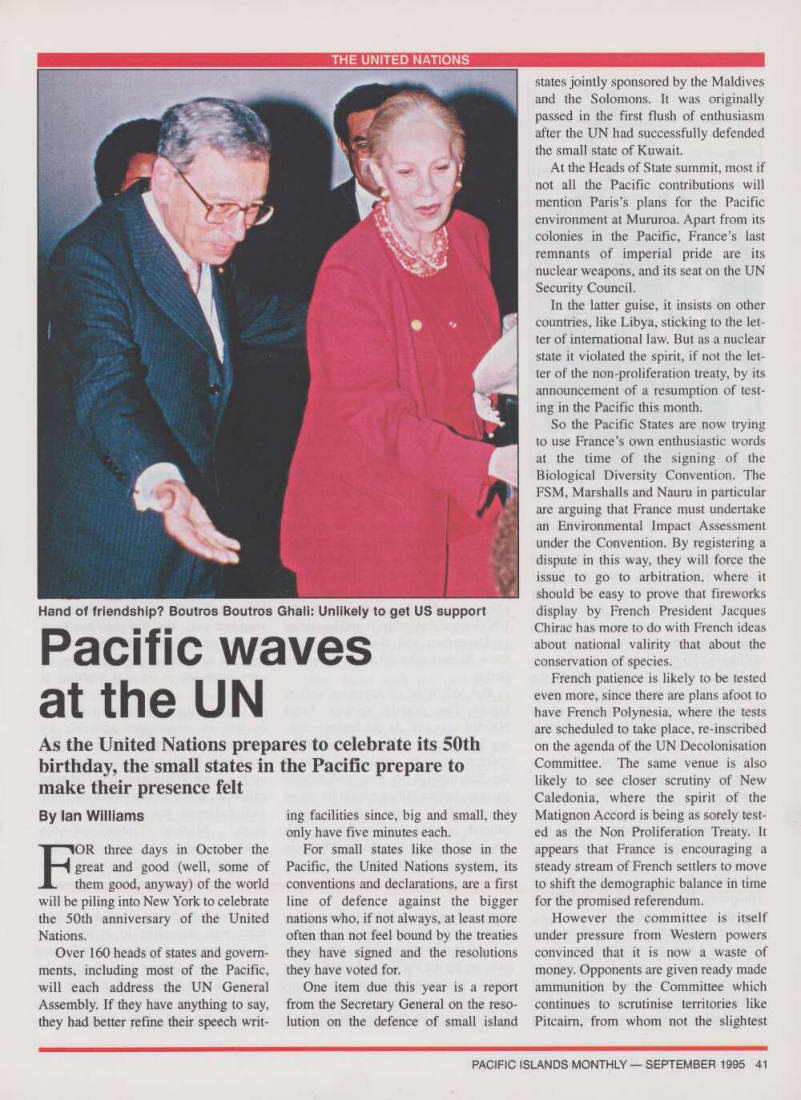
Hand of friendship? Boutros Boutros Ghali: Unlikely to get US support
whisper of a desire for independence has come, or American Samoa which seems to have a happy combination of financial support and political autonomy. There are some hints that the Committee may realise that inclusion of these makes them hostage to enemies, and prevents them from going after substantial targets like the French Polynesian territories.
During the Fiftieth Session the Pacific will also be resuming the attack to ensure delivery of promises made at the Barbados small islands conference and Global Climate Conventions.
Once again the method will be an attempt to use the larger countries’ own words against them. In this context it would be interesting to be a fly on the ceiling watching the Pacific envoys fill ing in their ballots for the temporary Security Council seats. This year Australia, Sweden and Portugal are competing for two seats in the “West European and Other Group.”
Australia has teamed up with Sweden to run on a joint ticket, which the scorn ful Portuguese, already angry at Canberra over the Timor Gap treaty with Indonesia, say is a big mistake. In fact New Zealand gained a seat last time by
beating Sweden, which suffers from having too many principles. New Zealand also benefited from enthusiastic lobbying by the Pacific and small island nations among other developing coun tries. There are suggestions of somewhat less enthusiasm for the Australians,
whose attitude during the global climate talks was, according to at least one Pacific envoy, of gas guzzling “closet Arabs.” The alleged prevarication by Gareth Evans over French nuclear test ing has also not gone unnoticed.
Towards the end of the year, Boutros
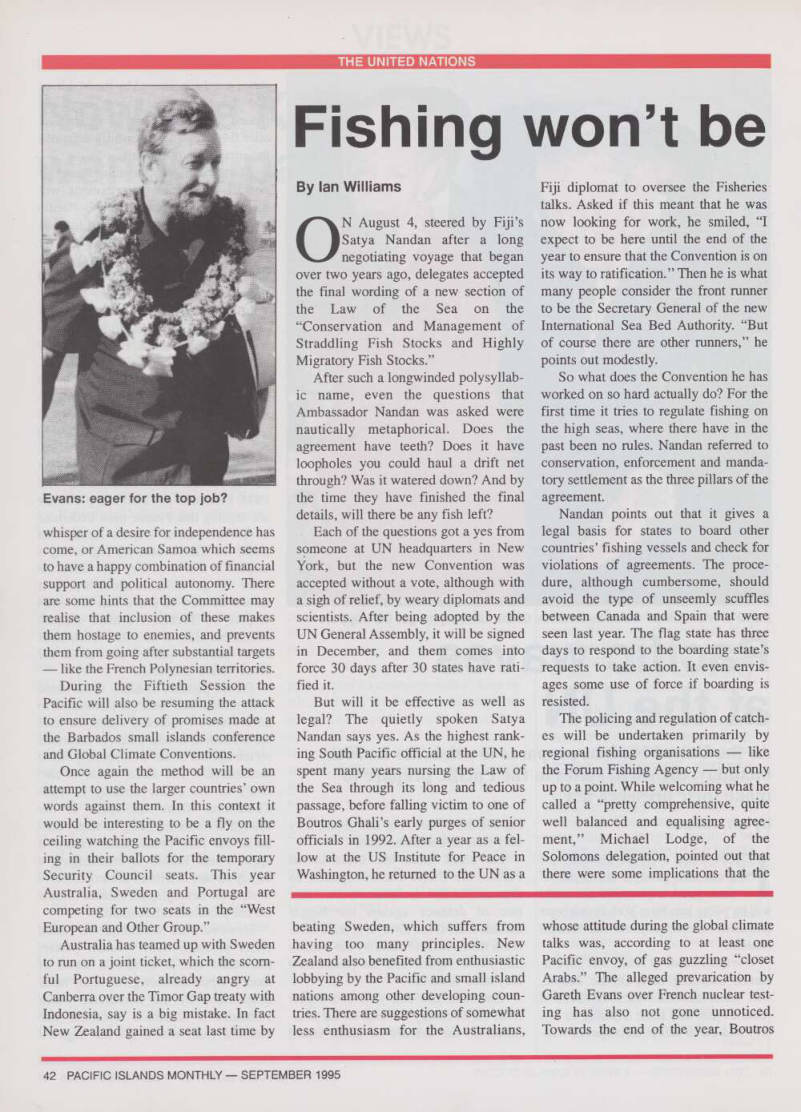
Evans: eager for the top job?
Boutros Ghali has promised that he will make decision on running for a second term. It is unlikely that he will get American support if he does. If there is an election then, according to the Non aligned, it is “Asia’s turn.” According to the irreverent Australian press, if
“Gareth Gareth” Evans has his way, it will be the Australian Foreign Minister’s turn, which they suggest, is why he, per sonally, has not been as vociferous as he could be over the French testing.
It is true that Evans reacts angrily every time the subject is brought up, like
when PIM suggested that Australia should quit the anachronistic West European and Other Group and join the Asian/Pacific Group at the UN if it wanted to get support. It is also true that he would jump at the job if offered. It should be an interesting few months! A