Letters from
p. 58 · Read in the full issue
Correspondence
Letters from the Pacific
By David North
readers are an admirable lot, least the ones that communi .X cate with me.
There is the wonderful gentleman in Australia who phones at his expense always at a thoughtful time of the morning on America’s east coast - to chat with me about Nauru.
Then there were half a dozen different people, from all over the Pacific, who phoned, faxed or wrote a couple of years ago to try to help PIM solve one aspect of the Amelia Earhart mystery.
On a continuing basis, there is the always helpful Chris Wong of the Cook Islands Tourists Authority (may his cur rency recover!) and, in recent months, that cheerful Nauruan journalist, Julie Olsson.
Local officials on Norfolk Island and in Tokelau have been equally nice to me.
But I had none of these good folk in mind when I was sorting the mail the other day at my home in Arlington, Virginia.
There was a big envelope from Great Britain and I assumed it related to a con ference on European immigration policy that I attended last year in Nuremberg, Germany. There is always lingering corre spondence after such events.
But no, it was from the Kiribati and Tuvalu Philatelic Society, founded 1983.
The letter was signed by Susie Cheyne, honorary editor, Ki-Tu News, and it had one of those wonderfully Brit mailing addresses: 30 Knighton Road, Sutton Coldfield, West Midlands, 874 4NX,
England.
Being a recovering stamp collector for more than a half century I her a check for US$l2, as annual dues, in hopes that she would send me more copies of the organisation’s newsletter in the future.
Needless to say the one that accompa nied her letter was enclosed in an envelope carrying a couple of smashing Brit stamps.
Her letter was in partial response of something I wrote last year for PIM, an article on what I called “the Sovereignty Business,” (July 1994), in which I recount ed the ways that some of the world’s stamp wholesalers (philatelic exporters) rip off
both First World collectors and Third World governments. The sovereignty busi ness was defined as a money-making oper ation that can only be mounted by a nation or a near-nation, such as issuing stamps and coins, licensing ships, selling pass
ports)
The enclosed copy of the Ki-Tu News was the one from October, 1992, which covered in glorious detail the scandals that erupted a few years ago about Tuvalu’s issuance of postage stamps.
There were two different problems.
First, Tuvalu and its agents overdid a good thing and started issuing an enormous number of stamps for the little nation (pop. 8000) and for half a dozen of its islands.
Soon collectors started to balk and refused to buy the new sets. Tuvalu’s income from stamp sales were cut in half.
Second, and at about the same time, the stamp world was startled by a fraud trial in London as one of Tuvalu’s stamp agents was charged with deliberately creating stamps with errors in them. (Stamps with error are much more valuable than error free ones.) That issue of Ki-Tu News also con tained some statistics on stamp sales that I had not seen before. A large German firm had compiled a world-wide tally of philat elic sales (all new issue) and it listed 234
issuing jurisdictions (mostly nations but
some lesser entities as well.) In 1992 Kiribati stood at a robust 57th
on the list (ahead of such major players as
Canada, Hong Kong and Sweden.) Tuvalu,
still suffering from the philatelic excesses of the 1980 s, had fallen to 183rd position but was still higher than the Cooks (184), Tonga (192), Niue (196) and two islands within the Cooks, Aitutaki (222) and Penrhyn (228). Ki-Tu News did not record who came in last (234).
The publication, as one might expect, was full of pictures of new stamps from the islands but it carried some non-philat elic news as well.
In the letter category was a story on the several-step process, completed earlier in 1992, for the election of Kiribati’s Beretitenti (president). A limited number of candidates are nominated by the Maneaba ni Maungatabu (parliament) and then the people choose among the nomi nees - an interesting combination of the Westminster system and the direct presi dential elections of France and the US.
Teatao Tiannaki won his country’s leader ship that year.
Not all of my PIM- related mail is as cheerful as the items cited above.
For example, I managed to get in the middle of a struggle between a couple of Americans about Bikini’s fate, and one of them told me so quietly but firmly. (I still think that the Bikinians, despite the fact that they do not have an island anymore, have the best-managed public funds in the Pacific, tens of millions of dollars are involved and there have been no losses and no scandals.) Then there was the bittersweet fan let ter from a professor at my old alma mater, Victoria University in Wellington, New Zealand. (It was Victoria University College when I was there as a Fulbright Student.) The professor wrote several years ago that my piece in PIM explaining Fiji’s
wonderfully complicated, multiracial vot
ing system that had been left behind by the departing Brits, was the best description he had ever seen. He went on to say that he had made it required reading for his stu dents- an unusual distinction for a mere magazine article.
As one who has paid attention to voting systems around the world, I had always been fascinated by the exquisite crafts manship that had been used to create the Fijian system, with its careful balance of seats assigned to the ethnic Fijians, to the Indians, and a few to General Voters (that is, everyone else).
My gratitude to the perceptive profes
sor, however, was overwhelmed a few days later when a coup wiped out the elec toral system. That meant I had become one of the world’s leading authorities on some thing that no longer existed.
It was, of course, a sadder day for Fiji than for me. ■
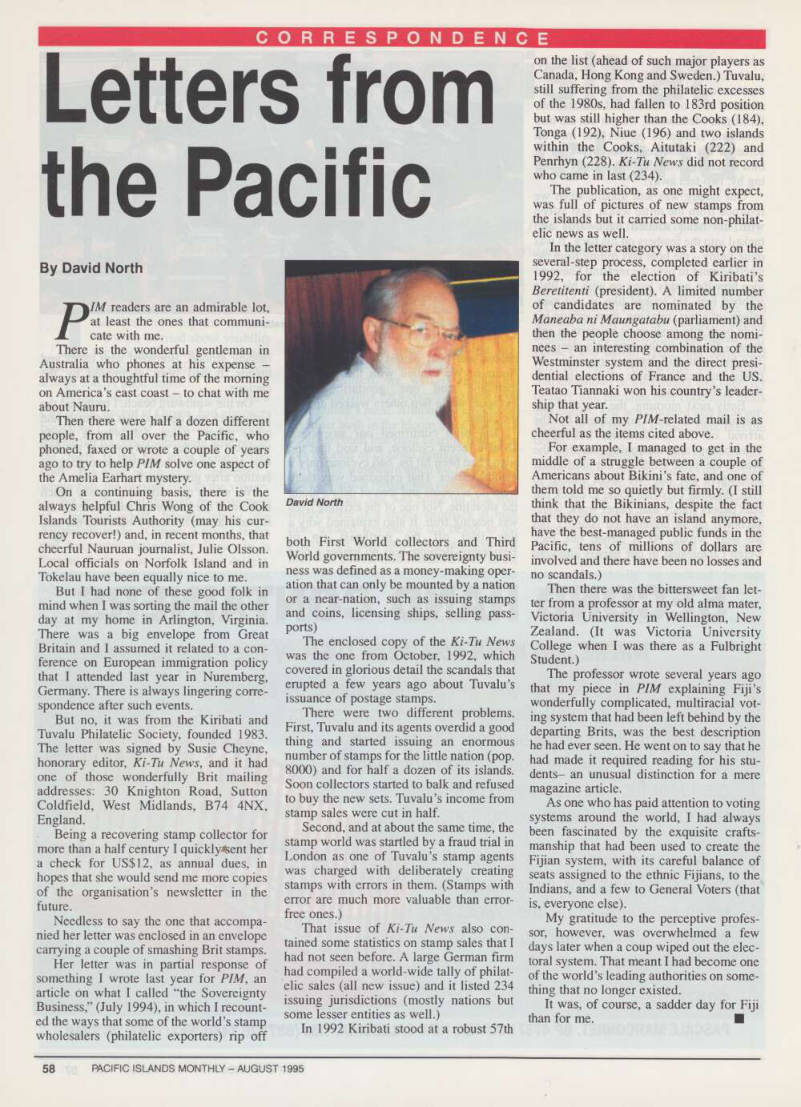
David North