A surprise visit at
pp. 56-57 · Read in the full issue
Yachting
A surprise visit at a cyclone hit island
Writer SALLY ANDREW was wondering why the trees were not bearing fruit and why tonnes of debris cov ered the golden beaches when she got her answers from visitors from the sky...
It was overcast when we left our anchorage at St. Joseph, rain showers obscuring the horizon.
We were worried about visibility for conning our way into our des tination but almost immediately we caught a huge fish. A good omen.
We had been told that all fish in New Caledonia, except at Ouvea, had ciguatera poisoning (“la gratte”). We had confirmed this earlier by double-checking with one of the chiefs. Is this fish good to eat? “Tres bon!” His eyes lit up as we presented a whole fish, the biggest one, to the village.
We reached out through the pass west of Deguala while friends about the Australian yacht “Copper Lady”, Helen and lan, went through the Passe de la Tarteau further east. Much to our delight, we caught up with them. The race was on!
We pressed on all sail and arrived at Beautemps-Beaupre - a beautiful atoll in New Caledonia’s Loyalty Group - at noon,
much to the surprise of mutual friends Yurgen and Corina abroad the German
yacht “Laguna” which was already lying
at anchor. The weather had cleared and we had good light to motor through the nar row opening to the anchorage.
After lunch, we walked around the island searching for a coconut to have with the evening’s meal. Although we found an oleander bush in the bloom there was not a single account tree bush bearing fruit. Was this because of cyclone damage?
On the windward since we found turtle tracks where a female had come ashore to lay her eggs. She had come up at a spot where there is a sandy approach at high tide, walked straight up the beach to the edge of the vegetation, dug one hole and then two others, then retreated back to the sea. The trac was very fresh - maybe one or two days old, and about 3 feet wide,
flipper to flipper.
In the evening we had a barbeque on
shore with the crews of LAGUNA and COPPER LADY. We built a big fire, and cooked up our fish (an outou) in tinned coconut milk, heated up some tinned veg etables and savoury rice, and barbequed teriyaki tuna. Afterwards we roasted marshmallows in the embers and later, for dessert, told tall tales over chocolate treats and coffee. The sun, flushed and exagger ated with the dust of Rabaul, sank into the ocean.
We all returned to our boast at ten.
Wide awake from the coffee, we decided to see if the turtle would return to lay more eggs. By the light of a full moon, we walked through the forest and along the beach to the area of the turtle tracks. We sat on a rock and enjoyed a thermos of Earl Grey tea, the stars, the surf, the antic ipation. Eventually we realized the tide wasn’t quite high enough for her to come ashore.
Before we had left for the turtle watch.
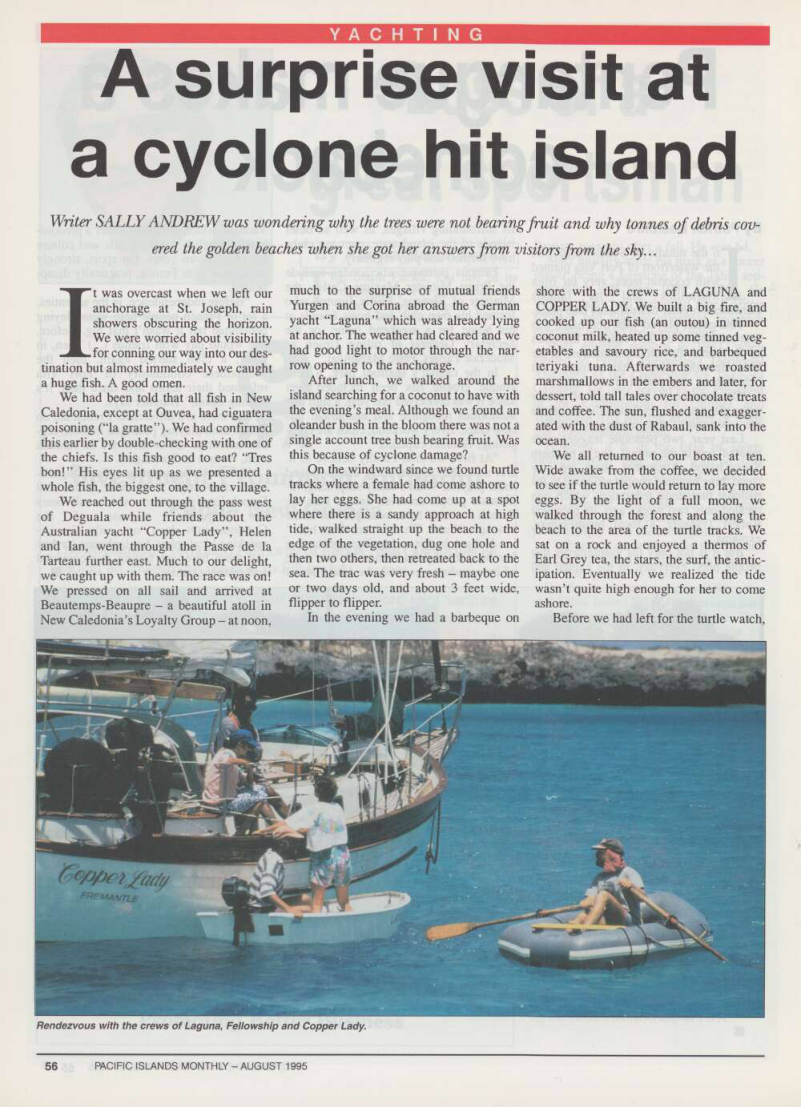
Rendezvous with the crews of Laguna, Fellowship and Copper Lady.
a black white-capped noddy had taken up residence on our lifeline, a wire “fence” that encloses our deck area. He was not afraid of us or our voices, and tolerated our flashlight. Meanwhile, we got out the bird book and compared photos and info on some of his close relations. My kind of bird watching, with the bird politely stand
ing by, two feet away!
Our noddy was still aboard when we returned from the turtle watch, fast asleep with his head rotated backwards and tucked into the feathers on his back. It was quite funny - the boat was rolling from the swell coming in over the reef and I have no idea how the noddy hung on with his little webbed feet. He looked like an old man, asleep on a bus, relaxing, then jerking his body back into position as he starts to col lapse - though all the time he’s sleeping.
The bird was still hanging on when we poked our heads outside at 4am, but left shortly after sunrise.
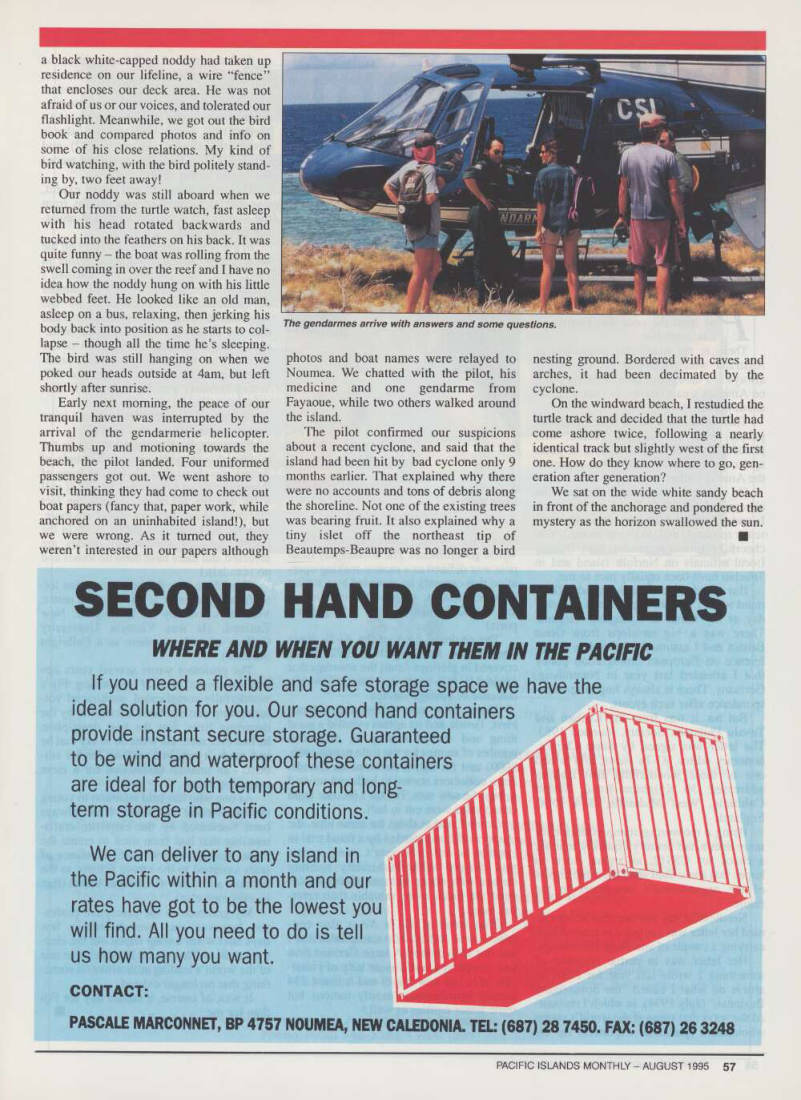
Early next morning, the peace of our tranquil haven was interrupted by the arrival of the gendarmerie helicopter.
Thumbs up and motioning towards the beach, the pilot landed. Four uniformed passengers got out. We went ashore to visit, thinking they had come to check out boat papers (fancy that, paper work, while anchored on an uninhabited island!), but we were wrong. As it turned out, they weren’t interested in our papers although
photos and boat names were relayed to Noumea. We chatted with the pilot, his medicine and one gendarme from Fayaoue, while two others walked around the island.
The pilot confirmed our suspicions about a recent cyclone, and said that the island had been hit by bad cyclone only 9 months earlier. That explained why there were no accounts and tons of debris along the shoreline. Not one of the existing trees was bearing fruit. It also explained why a tiny islet off the northeast tip of Beautemps-Beaupre was no longer a bird
nesting ground. Bordered with caves and arches, it had been decimated by the
cyclone.
On the windward beach, I restudied the turtle track and decided that the turtle had come ashore twice, following a nearly identical track but slightly west of the first one. How do they know where to go, gen eration after generation?
We sat on the wide white sandy beach in front of the anchorage and pondered the mystery as the horizon swallowed the sun.
The gendarmes arrive with answers and some questions.